534 books match the query 'Making' and 13 start with w

cover of Walt Whitman and the Making of Jewish American Poetry

Walt Whitman and the Making of Jewish American Poetry

Dara Barnat

University of Iowa Press, 2023

Walt Whitman has served as a crucial figure within the tradition of Jewish American poetry. But how did Whitman, a non-Jewish, American-born poet, become so instrumental in this area of poetry, especially for poets whose parents, and often they themselves, were not “born here?”

Dara Barnat presents a genealogy of Jewish American poets in dialogue with Whitman, and with each other, and reveals how the lineage of Jewish American poets responding to Whitman extends far beyond the likes of Allen Ginsberg. From Emma Lazarus and Adah Isaacs Menken, through twentieth-century poets such as Charles Reznikoff, Karl Shapiro, Kenneth Koch, Muriel Rukeyser, Adrienne Rich, Marge Piercy, Alicia Suskin Ostriker, and Gerald Stern, this book demonstrates that Whitman has been adopted by Jewish American poets as a liberal symbol against exclusionary and anti-Semitic elements in high modernist literary culture. The turn to Whitman serves as a mode of exploring Jewish and American identity.
 
[more]
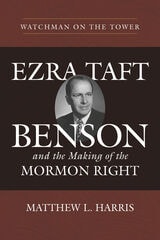
cover of Watchman on the Tower: Ezra Taft Benson and the Making of the Mormon Right

Watchman on the Tower

Ezra Taft Benson and the Making of the Mormon Right

Matthew L. Harris

University of Utah Press, 2020
Ezra Taft Benson is perhaps the most controversial apostle-president in the history of the Church of Jesus Christ of Latter-day Saints. For nearly fifty years he delivered impassioned sermons in Utah and elsewhere, mixing religion with ultraconservative right-wing political views and conspiracy theories. His teachings inspired Mormon extremists to stockpile weapons, predict the end of the world, and commit acts of violence against their government. The First Presidency rebuked him, his fellow apostles wanted him disciplined, and grassroots Mormons called for his removal from the Quorum of the Twelve. Yet Benson was beloved by millions of Latter-day Saints, who praised him for his stances against communism, socialism, and the welfare state, and admired his service as secretary of agriculture under President Dwight D. Eisenhower. Using previously restricted documents from archives across the United States, Matthew L. Harris breaks new ground as the first to evaluate why Benson embraced a radical form of conservatism, and how under his leadership Mormons became the most reliable supporters of the Republican Party of any religious group in America.
[more]
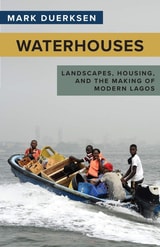
cover of Waterhouses: Landscapes, Housing, and the Making of Modern Lagos

Waterhouses

Landscapes, Housing, and the Making of Modern Lagos

Mark Duerksen

Ohio University Press, 2024
Waterhouses is about the places the people of Lagos have inhabited, imagined, and made home for the past two centuries. It asks what a house in Lagos is and explores how the answer to that question has been historically constructed and reconstructed in turn with the city’s changing landscapes. Written for historians of African and Atlantic history, scholars and practitioners of urbanism, and anyone looking to make sense of Africa’s most populous metropolis today, the book is an approachable history of how houses and water have formed modern Lagos. The book argues that in the coastlands from which Lagos rose, housing architectures were the single most important social, material, and political instruments for people hoping to contour the city’s landscapes—both its ecology and its image—and its historical course. The forms and meanings of houses in Lagos have shifted dramatically over time and in ways that reveal how power, house making, visual perception, and the environment are entangled in modern cities. The book’s chapters encompass six eras and six waterscapes: sandbars, canals, swamps, lagoons, oceans, and floods. These spaces guide the book’s exploration of how people saw and attempted to remake Lagos’s environs in a process that invariably involved housing architectures. At its core, Lagos is a city built through the materials, relations, and powers contained in the dry, solid, and hospitable spaces of homes, which have long been scarce and culturally celebrated resources in the city’s water-constricted setting. While shelter is integral to any city’s development, houses have been particularly important and sought after in Lagos because of the city’s land shortages and because of the societal influence and physical footprint of traditional Yoruba ilé (family compounds), in which activities were historically organized and centered. Through dozens of maps, photographs, and housing plans found in British and Nigerian archives, this book traces the relationship between Lagos’s residential spaces and its urban landscapes across the rise, fall, and aftermath of British colonization. By showing how Yoruba visions of home—though often forgotten or misunderstood today—coexisted with European notions, Waterhouses offers urban planners, policy makers, and architects ideas for how the definingly human act of inhabiting a place might be grounded in practices of continuous custodianship rather than extractive possession.
[more]
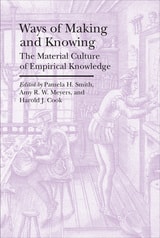
cover of Ways of Making and Knowing: The Material Culture of Empirical Knowledge

Ways of Making and Knowing

The Material Culture of Empirical Knowledge

Edited by Pamela H. Smith, Amy R. W. Meyers, and Harold J. Cook

Bard Graduate Center, 2017
Although craftspeople and artists often work with natural materials, the notion that making art can constitute a means of knowing nature is a novel one. This book, with contributions from historians of science, medicine, art, and material culture, shows that the histories of science and art are not simply histories of concepts or styles, but histories of the making and using of objects to understand the world. An examination of material practices makes it clear that the methods of the artisan represent a process of knowledge making that involves extensive experimentation and observation that parallel similar processes in the sciences. Ways of Making and Knowing offers a comprehensive and interdisciplinary history of the ways in which human beings have sought out, discovered, and preserved their own knowledge of the world around them; it has only been through material and human interaction with (and manipulation of) nature that we have come to understand it.
[more]
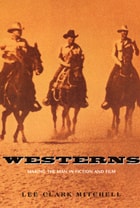
cover of Westerns: Making the Man in Fiction and Film

Westerns

Making the Man in Fiction and Film

Lee Clark Mitchell

University of Chicago Press, 1996

A history of the Western in fiction and on film that shows how it reflects the changing obsessions and fears of American culture

Few genres are so closely identified with America as the Western. In this wide-ranging examination of the Western and its appeal, Lee Clark Mitchell ranges from the novels of James Fenimore Cooper to Louis L'Amour, and from classic films like Stagecoach to spaghetti Westerns like A Fistful of Dollar to show how Westerns helped assuage a series of crises in American culture. This landmark book shows that the Western owes its perennial appeal not to unchanging conventions but to the deftness with which it responds to the obsessions and fears of its audience. And no obsession, Lee Mitchell argues, has figured more prominently in the Western than what it means to be a man. 
[more]
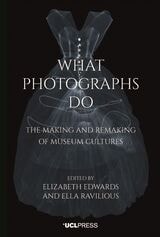
cover of What Photographs Do: The Making and Remaking of Museum Cultures

What Photographs Do

The Making and Remaking of Museum Cultures

Edited by Elizabeth Edwards and Ella Ravilious

University College London, 2022

A collective case study of photographic culture through the lens of the Victoria and Albert Museum.

A massive quantity of museums’ photographic holdings resides not on gallery walls or archives, but outside of their formal collections, including reference photos and ephemera that are integral to the workings of museums. What Photographs Do explores how museums are defined through their photographic practices. Studied through the prism of the Victoria and Albert Museum in London, this collection asks complex and ambiguous questions about how accumulations of photographs create the values, hierarchies, histories, and knowledge systems of a museum ecosystem. Chapters are comprised of short, auto-ethnographic interventions from museum practitioners, from studio photographers and image managers to conservators and non-photographic curators, who address the significance of both historical and contemporary practices of photography in their work, providing an extensive and unique range of accounts of what photographs do in museums while also expanding the critical discourse of both photography and museums.
[more]
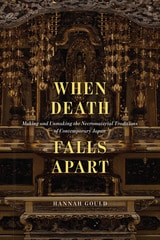
cover of When Death Falls Apart: Making and Unmaking the Necromaterial Traditions of Contemporary Japan

When Death Falls Apart

Making and Unmaking the Necromaterial Traditions of Contemporary Japan

Hannah Gould

University of Chicago Press, 2023

Through an ethnographic study inside Japan’s Buddhist goods industry, this book establishes a method for understanding change in death ritual through attention to the dynamic lifecourse of necromaterials.
 
Deep in the Fukuyama mountainside, “the grave of the graves” (o-haka no haka) houses acres of unwanted headstones—the material remains of Japan’s discarded death rites. In the past, the Japanese dead became venerated ancestors through sustained ritual offerings at graves and at butsudan, Buddhist altars installed inside the home. But in twenty-first-century Japan, this intergenerational system of care is rapidly collapsing.

In noisy carpentry studios, flashy funeral-goods showrooms, neglected cemeteries, and cramped kitchens where women prepare memorial feasts, Hannah Gould analyzes the lifecycle of butsudan, illuminating how they are made, circulate through religious and funerary economies, mediate intimate exchanges between the living and the dead, and—as the population ages, families disperse, and fewer homes have space for large lacquer cabinets—eventually fall into disuse. What happens, she asks, when a funerary technology becomes obsolete? And what will take its place? Gould examines new products better suited to urban apartments: miniature urns and sleek altars inspired by Scandinavian design, even reliquary jewelry. She visits an automated columbarium and considers new ritual practices that embrace impermanence. At an industry expo, she takes on the role of “demonstration corpse.” Throughout, Gould invites us to rethink memorialization and describes a distinct form of Japanese necrosociality, one based on material exchanges that seek to both nurture the dead and disentangle them from the world of the living.
[more]
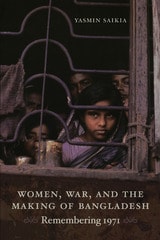
cover of Women, War, and the Making of Bangladesh: Remembering 1971

Women, War, and the Making of Bangladesh

Remembering 1971

Yasmin Saikia

Duke University Press, 2011
Fought between India and what was then East and West Pakistan, the war of 1971 led to the creation of Bangladesh, where it is remembered as the War of Liberation. For India, the war represents a triumphant settling of scores with Pakistan. If the war is acknowledged in Pakistan, it is cast as an act of betrayal by the Bengalis. None of these nationalist histories convey the human cost of the war. Pakistani and Indian soldiers and Bengali militiamen raped and tortured women on a mass scale. In Women, War, and the Making of Bangladesh, survivors tell their stories, revealing the power of speaking that deemed unspeakable. They talk of victimization—of rape, loss of status and citizenship, and the “war babies” born after 1971. The women also speak as agents of change, as social workers, caregivers, and wartime fighters. In the conclusion, men who terrorized women during the war recollect their wartime brutality and their postwar efforts to achieve a sense of humanity. Women, War, and the Making of Bangladesh sheds new light on the relationship among nation, history, and gender in postcolonial South Asia.
[more]
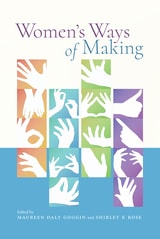
cover of Women’s Ways of Making

Women’s Ways of Making

Maureen Daly Goggin

Utah State University Press, 2021

Women’s Ways of Making draws attention to material practices—those that the hands perform—as three epistemologies—an episteme, a techne, and a phronesis—that together give pointed consideration to making as a rhetorical embodied endeavor. Combined, these epistemologies show that making is a form of knowing that (episteme), knowing how (techne), and wisdom-making (phronesis).
 
Since the Enlightenment, embodied knowledge creation has been overlooked, ignored, or disparaged as inferior to other forms of expression or thinking that seem to leave the material world behind. Privileging the hand over the eye, as the work in this collection does, thus problematizes the way in which the eye has been co-opted by thinkers as the mind’s tool of investigation. Contributors to this volume argue that other senses—touch, taste, smell, hearing­—are keys to knowing one’s materials. Only when all these ways of knowing are engaged can making be understood as a rhetorical practice.
 
In Women’s Ways of Making contributors explore ideas of making that run the gamut from videos produced by beauty vloggers to zine production and art programs at women’s correctional facilities. Bringing together senior scholars, new voices, and a fresh take on material rhetoric, this book will be of interest to a broad range of readers in composition and rhetoric.
 
Contributors: Angela Clark-Oates, Jane L. Donawerth, Amanda Ellis, Theresa M. Evans, Holly Fulton-Babicke, Bre Garrett, Melissa Greene, Magdelyn Hammong Helwig, Linda Hanson, Jackie Hoermann, Christine Martorana, Aurora Matzke, Jill McCracken, Karen S. Neubauer, Daneryl Nier-Weber, Sherry Rankins-Roberson, Kathleen J. Ryan, Rachael Ryerson, Andrea Severson, Lorin Shellenberger, Carey Smitherman-Clark, Emily Standridge, Charlese Trower, Christy I. Wenger, Hui Wu, Kathleen Blake Yancey

 
 
[more]
cover of World Class: The Making of the U.S. Women's Cross-Country Ski Team

World Class

The Making of the U.S. Women's Cross-Country Ski Team

Peggy Shinn

University Press of New England, 2018

What makes a great team? Sports journalist Peggy Shinn answers this question in her enthralling account of the dramatic rise of the U.S. women’s cross-country ski team, winners of eight medals at three world championships over the past five years. Shinn’s story—based on dozens of interviews with athletes, coaches, parents, spouses, and friends—paints a vivid picture of the obstacles that America’s female athletes must overcome not just to ski with the world’s best, but to beat them. In a sport where U.S. women have toiled for decades, mostly in the middle or the back of the pack, the development of a world-class team attests to the heady combination of a transformational leader, a coach who connects with his athletes, the super-fast individual skiers who are also conscientious teammates—and a bit of good luck. This is the story of Kikkan Randall, Liz Stephen, Holly Brooks, Jessie Diggins, Ida Sargent, Sadie Bjornsen, Sophie Caldwell, Rosie Brennan, and coach Matt Whitcomb—and how they created the perfect team.
[more]
cover of Wrestling with the Left: The Making of Ralph Ellison’s Invisible Man

Wrestling with the Left

The Making of Ralph Ellison’s Invisible Man

Barbara Foley

Duke University Press, 2010
In Wrestling with the Left, Barbara Foley presents a penetrating analysis of the creation of Invisible Man. In the process she sheds new light not only on Ralph Ellison’s celebrated novel but also on his early radicalism and the relationship between African American writers and the left during the early years of the cold war. Foley scrutinized thousands of pages of drafts and notes for the novel, as well as the author’s early journalism and fiction, published and unpublished. While Ellison had cut his ties with the Communist left by the time he began Invisible Man in 1945, Foley argues that it took him nearly seven years to wrestle down his leftist consciousness (and conscience) and produce the carefully patterned cold war text that won the National Book Award in 1953 and has since become a widely taught American classic. She interweaves her account of the novel’s composition with the history of American Communism, linking Ellison’s political and artistic transformations to his distress at the Communists’ wartime policies, his growing embrace of American nationalism, his isolation from radical friends, and his recognition, as the cold war heated up, that an explicitly leftist writer could not expect to have a viable literary career. Foley suggests that by expunging a leftist vision from Invisible Man, Ellison rendered his novel not only less radical but also less humane than it might otherwise have been.
[more]
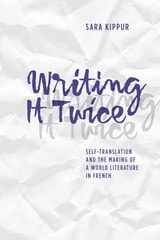
cover of Writing It Twice: Self-Translation and the Making of a World Literature in French

Writing It Twice

Self-Translation and the Making of a World Literature in French

Sara Kippur

Northwestern University Press, 2015

Though the practice of self-translation long predates modernity, it has found new forms of expression in the global literary market of the late twentieth and early twenty-first century. The international renown of self-translating authors Samuel Beckett, Joseph Brodsky, and Vladimir Nabokov has offered motivation to a new generation of writers who actively translate themselves.

Intervening in recent debates in world literature and translation studies, Writing It Twice establishes the prominence and vitality of self-translation in contemporary French literature. Because of its intrinsic connection to multiple literary communities, self-translation prompts a reexamination of the aesthetics and politics of reading across national lines. Kippur argues that self-translated works should be understood as the paradigmatic example of world literature and, as such, crucial for interpreting the dynamics of literary circulation into and out of French.
[more]
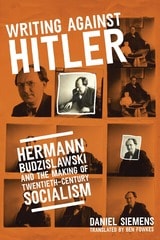
cover of Writing against Hitler: Hermann Budzislawski and the Making of Twentieth-Century Socialism

Writing against Hitler

Hermann Budzislawski and the Making of Twentieth-Century Socialism

Daniel Siemens, Translated by Ben Fowkes

University of Wisconsin Press, 2025

In Writing Against Hitler, Daniel Siemens reconstructs the history of the struggles of socialist intellectuals in Germany from the 1920s through the post–World War II era by focusing on the life of one influential member of that group, Hermann Budzislawski (1901–78). In the 1930s, Budzislawski served as the editor in chief of the prominent antifascist journal Die neue Weltbühne. After the German occupation of France, he worked in exile in the United States until 1948, when he moved to East Germany. He became influential in training a new generation of journalists and worked as a politician.

Through the twin stories of a highly ambitious figure and the legendary publication he headed, Siemens charts the course of the intellectual Left’s rise and decline in power during the decades that shaped the political divides of the mid-twentieth century. Crucially, his account challenges the widely held belief that post-1989 German unification has represented a victory over the traumas of the past. Instead, Siemens shows the complexity of different strains of socialist thought and activity and reveals the contested place of Nazi Germany’s exiles at the center of Cold War Germany’s cultural history.
[more]