Results by title
167 books match the query 'Masculinity' and 8 start with w

We Are Important People Now
Kichwa Tourism, Indigeneity, and Masculinity in Ecuador’s AmazonErnesto J. Benitez
University of Alabama Press, 2026
How the “ecoprimitivist” tourism boom of the early 1990s reshaped the lives of young Kichwa men
We Are Important People Now illuminates the trajectories and life experiences of young Napo Kichwa men who have worked as tour guides in the Ecuadorian Upper Amazon, in the wake of the “ecoprimitivist” tourism boom of the early 1990s. Anthropologist Ernesto J. Benitez analyzes the socioeconomic situation of these men and the motivations and desires that drive them to seek service-based employment. Benitez discusses how the tour guides go through complex processes of transition and adjustment navigating tourists’ expectations, familial obligations, and desires for socioeconomic mobility. The opportunities for self-transformation are at once attractive and fraught with contradictions. They now see their indigeneity as an asset, but their urban lifestyles, pursuits of intimate relationships with foreign tourists, and sometimes-dismissive attitudes toward Kichwa people in rural Ecuador distance them socially from the broader Kichwa population.
Importantly, the book interrogates the possibilities and limitations that produce—and are produced by—such emergent forms of identity formation, situating the current period within a broader analysis of the colonial and postcolonial history of the area. It pays special attention to how different processes of interaction with and incorporation into colonial and state productive and biopolitical regimes have impacted the historical production and performance of Kichwa ethnic and gendered identities in the Upper Amazon region. A wide swath of anthropologists, Latin Americanists, and gender and Indigenous studies specialists will be edified by this timely and accessible narrative.
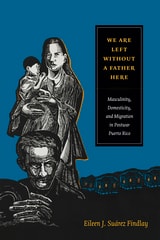
We Are Left without a Father Here
Masculinity, Domesticity, and Migration in Postwar Puerto RicoEileen J. Suárez Findlay
Duke University Press, 2015
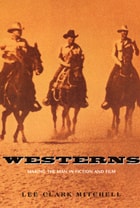
Westerns
Making the Man in Fiction and FilmLee Clark Mitchell
University of Chicago Press, 1996
Few genres are so closely identified with America as the Western. In this wide-ranging examination of the Western and its appeal, Lee Clark Mitchell ranges from the novels of James Fenimore Cooper to Louis L'Amour, and from classic films like Stagecoach to spaghetti Westerns like A Fistful of Dollar to show how Westerns helped assuage a series of crises in American culture. This landmark book shows that the Western owes its perennial appeal not to unchanging conventions but to the deftness with which it responds to the obsessions and fears of its audience. And no obsession, Lee Mitchell argues, has figured more prominently in the Western than what it means to be a man.
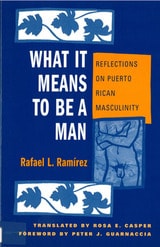
What It Means To Be A Man
Reflections on Puerto Rican MasculinityRafael L. Ramirez
Rutgers University Press, 1999
What It Means to Be a Man begins with a discussion of machismo set in the context of the social construction of masculinity. Ramírez presents his interpretation of what it means to be a Puerto Rican man, discussing the attributes and demands of masculinity, and pointing out the ways in which strength, competition, and sexuality are joined with power and pleasure. He examines the erotic relationships between men as part of the expressions of masculinity, and analyzes how the homosexual experience reproduces the dominant masculine ideology. Finally, Ramírez draws on the literature of the recent men's movements, offering Puerto Rican men the possibility of constructing a new masculinity, liberated from power games, to provide them with a chance to not only be better understood by others, but also to better understand themselves and their place in society.
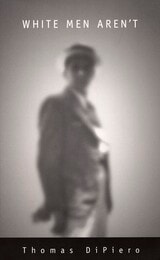
White Men Aren't
Thomas DiPiero
Duke University Press, 2002
Drawing on the writings of Freud, Lacan, Butler, Foucault, and Kaja Silverman, as well as on biology, anthropology, and legal sources, Thomas DiPiero contends that psychoanalytic theory has not only failed to account for the role of race in structuring identity, it has in many ways deliberately ignored it. Reading a wide variety of texts—from classical works such as Oedipus Rex and The Iliad to contemporary films including Boyz 'n' the Hood and Grand Canyon—DiPiero reveals how the anxiety of white masculine identity pervades a surprising range of Western thought, including such ostensibly race-neutral phenomena as Englightenment forms of reason.
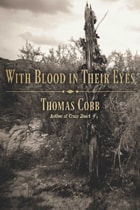
With Blood in Their Eyes
Thomas Cobb
University of Arizona Press, 2013
Winner, Spur Award for Best Western Long Novel (Western Writers of America) and Southwest Book Award (Border Regional Library Association)
On February 10, 1918, John Power woke to the sound of bells and horses’ hooves. He was sharing a cabin near the family mine with his brother Tom and their father Jeff; hired man Tom Sisson was also nearby. Then gunfire erupted, and so began the day when the Power brothers engaged the Graham County Sheriff’s Department in the bloodiest shootout in Arizona history.
Now Thomas Cobb, author of Crazy Heart and Shavetail, has taken up the story in this powerful and meticulously researched nonfiction novel. What seems at first a simple tale of crime and pursuit takes on much greater meaning and complexity as the story traces the past lives of the main characters and interconnects them—all leading back to the deadly confrontation that begins the book. Cobb cunningly weaves the story of the Power brothers’ escape with flashbacks of the boys’ father’s life and his struggle to make a living ranching, logging, and mining in the West around the turn of the century. Deftly drawn characters and cleverly concealed motivations work seamlessly to blend a compelling family history with a desperate story of the brothers as they attempt to escape.
Grappling with themes of loyalty, masculinity, technology, and honor, this sweeping saga reveals the passion and brutality of frontier life in Arizona a hundred years ago. Richly authentic and beautifully written, With Blood in Their Eyes breathes dramatic new life into this nearly forgotten episode of the American West.
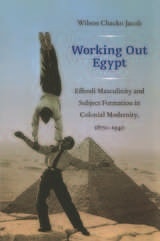
Working Out Egypt
Effendi Masculinity and Subject Formation in Colonial Modernity, 1870–1940Wilson Chacko Jacob
Duke University Press, 2011
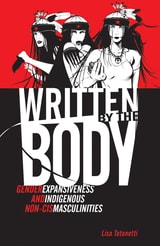
Written by the Body
Gender Expansiveness and Indigenous Non-Cis MasculinitiesLisa Tatonetti
University of Minnesota Press, 2021
Examining the expansive nature of Indigenous gender representations in history, literature, and film
Within Native American and Indigenous studies, the rise of Indigenous masculinities has engendered both productive conversations and critiques. Lisa Tatonetti intervenes in this conversation with Written by the Body by centering how female, queer, and/or Two-Spirit Indigenous people take up or refute masculinity, and, in the process, offer more expansive understandings of gender.
Written by the Body moves from the eighteenth- and nineteenth-century archive to turn-of-the-century and late-twentieth-century fiction to documentaries, HIV/AIDS activism, and, finally, recent experimental film and literature. Across it all, Tatonetti shows how Indigenous gender expansiveness, and particularly queer and non-cis gender articulations, moves between and among Native peoples to forge kinship, offer protection, and make change. She charts how the body functions as a somatic archive of Indigenous knowledge in Native histories, literatures, and activisms—exploring representations of Idle No More in the documentary Trick or Treaty, the all-female wildland firefighting crew depicted in Apache 8, Chief Theresa Spence, activist Carole laFavor, S. Alice Callahan, Thirza Cuthand, Joshua Whitehead, Carrie House, and more.
In response to criticisms of Indigenous masculinity studies, Written by the Body de-sutures masculinity from the cis-gendered body and investigates the ways in which female, trans, and otherwise nonconforming masculinities carry the traces of Two-Spirit histories and exceed the limitations of settler colonial imaginings of gender.