175 books match the query 'Mayas' and 3 start with w
cover of Warfare and the Fall of a Fortified Center: Archaeological Investigations at Aguateca

Warfare and the Fall of a Fortified Center

Archaeological Investigations at Aguateca

Takeshi Inomata

Vanderbilt University Press, 2006

This volume presents for the first time the detailed data and dramatic findings of Inomata's investigations of this Classic period second capital of the ancient Maya Petexbatun kingdom. As widely discussed in journals and the media, the autonomous Aguateca subproject of the Vanderbilt Petexbatun research recovered remarkable new evidence on the violent end of a great Maya center,. This monograph presents summaries and interpretations of the excavations and surveys, site maps, and recovered ceramics and artifacts, as well as a wide range of applied analyses of this data. The sprawling defensive fortifications of this center, its already formidable natural location, and its final destruction and burning represent one of the most remarkable sets of evidence of the collapse of a Classic Maya kingdom. Inomata presents the evidence on Aguateca and its sudden end, and the implications of his findings for theories of the end of Classic Maya civilization in the Petexbatun.

VIMA Series #3
[more]
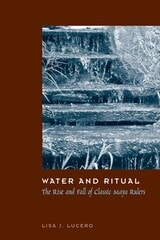
cover of Water and Ritual: The Rise and Fall of Classic Maya Rulers

Water and Ritual

The Rise and Fall of Classic Maya Rulers

By Lisa J. Lucero

University of Texas Press, 2006

In the southern Maya lowlands, rainfall provided the primary and, in some areas, the only source of water for people and crops. Classic Maya kings sponsored elaborate public rituals that affirmed their close ties to the supernatural world and their ability to intercede with deities and ancestors to ensure an adequate amount of rain, which was then stored to provide water during the four-to-five-month dry season. As long as the rains came, Maya kings supplied their subjects with water and exacted tribute in labor and goods in return. But when the rains failed at the end of the Classic period (AD 850-950), the Maya rulers lost both their claim to supernatural power and their temporal authority. Maya commoners continued to supplicate gods and ancestors for rain in household rituals, but they stopped paying tribute to rulers whom the gods had forsaken.

In this paradigm-shifting book, Lisa Lucero investigates the central role of water and ritual in the rise, dominance, and fall of Classic Maya rulers. She documents commoner, elite, and royal ritual histories in the southern Maya lowlands from the Late Preclassic through the Terminal Classic periods to show how elites and rulers gained political power through the public replication and elaboration of household-level rituals. At the same time, Lucero demonstrates that political power rested equally on material conditions that the Maya rulers could only partially control. Offering a new, more nuanced understanding of these dual bases of power, Lucero makes a compelling case for spiritual and material factors intermingling in the development and demise of Maya political complexity.
[more]
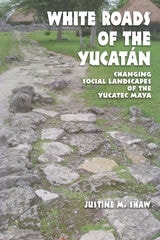
cover of White Roads of the Yucatán: Changing Social Landscapes of the Yucatec Maya

White Roads of the Yucatán

Changing Social Landscapes of the Yucatec Maya

Justine M. Shaw

University of Arizona Press, 2008

Maya sacbeob, or raised “white roads,” are often considered a single class of features, with a sole purpose. In this first systematic examination of their functions, meanings, arrangements, and construction styles, Justine Shaw reveals that these causeways served a variety of cultural and natural functions. In White Roads of the Yucatán, author Justine Shaw presents original field data collected with the Cochuah Regional Archaeological Survey at two ancient Maya sites, Ichmul and Yo’okop. Both centers chose to invest enormous resources in the construction of monumental roadways during a time of social and political turmoil in the Terminal Classic period. Shaw carefully examines why it was at this point—and no other—that the settlements made such a decision. She argues that both settlements used the sacbeob as a method of socially integrating the largest, most diverse and dispersed population in the Cochuah region. She further demonstrates that their use of the sacbeob, in concert with other innovative strategies, allowed Ichmul and Yo’okop to outlast many of the sites that they may have sought to emulate and to flourish during a time of tremendous sociopolitical and economic change. In addition to her detailed discussion of these two sites, Shaw provides an exhaustive review of the literature of Maya sacbeob archaeology, describing various interpretations of construction, features, and variability. This synthetic and interpretive treatment will aid researchers working on a variety of complex civilizations with road systems, as well as those interested in core-periphery relationships, cultural collapse, and social integration.
[more]