Results by title
85 books match the query 'Men's Studies' and 7 start with w
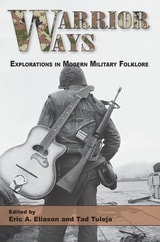
Warrior Ways
Explorations in Modern Military FolkloreEric Eliason and Tad Tuleja
Utah State University Press, 2012
Warrior Ways is one of the first book-length explorations of military folklife, and focuses on the lore produced by modern American warriors, illuminating the ways in which members of the armed services creatively express the complex experience of military life. In short, lively essays, contributors to the volume, all of whom have close personal or professional relationships to the military, examine battlefield talismans, personal narrative (storytelling), “Jody calls” (marching and running cadences), slang, homophobia and transgressive humor, music, and photography, among other cultural expressions.
Military folklore does not remain in an isolated subculture; it reveals our common humanity by delighting, disturbing, infuriating, and inspiring both those deeply invested in and those peripherally touched by military life. Highlighting the contemporary and historical importance of the military in American life, Warrior Ways will be of interest to scholars and students of folklore, anthropology, and popular culture; those involved in veteran services and education; and general readers interested in military culture.

We Boys Together
Teenagers in Love Before Girl-CrazinessJeffery P. Dennis
Vanderbilt University Press, 2007
This book explores romantic relationships between teenage boys as they were portrayed before, during, and immediately after World War II. The author takes the reader through a rich landscape of media -- sci fi pulps, comics, adventure stories, tales of teen sleuths, boys' serial novels, wartime bestsellers, and movies populated by many types of male adolescents: Boys Next Door, Adventure Boys, Jungle Boys, and Lost Boys. In Hollywood movies, Boys Next Door like Jackie Cooper, Ronald Sinclair, and Jimmy Lydon were constantly falling in love, but not with girls. In serial novels, Jungle Boys like Bomba, Sorak, and Og Son of Fire swung through the trees to rescue teenage boys, not teenage girls. In comic strips and on the radio, Adventure Boys like Don Study, Jack Armstrong, and Tim Tyler formed lasting romantic partnerships with other boys or men. Lost Boys like Frankie Darro, Leo Gorcey, and Billy Halop starred in dozens of movies about pairs of poor urban teenagers sticking together, with never a girl in sight.
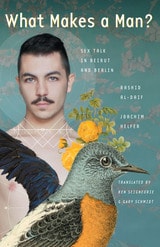
What Makes a Man?
Sex Talk in Beirut and BerlinRashid al-Daif and Joachim Helfer. Translated by Ken Seigneurie and Gary Schmidt
University of Texas Press, 2015
In 2003, Lebanese writer Rashid al-Daif spent several weeks in Germany as part of the “West-East Divan” program, a cultural exchange effort meant to improve mutual awareness of German and Middle Eastern cultures. He was paired with German author Joachim Helfer, who then returned the visit to al-Daif in Lebanon. Following their time together, al-Daif published in Arabic a literary reportage of his encounter with Helfer in which he focuses on the German writer’s homosexuality. His frank observations have been variously read as trenchant, naïve, or offensive. In response, Helfer provided an equally frank point-by-point riposte to al-Daif’s text. Together these writers offer a rare exploration of attitudes toward sex, love, and gender across cultural lines. By stretching the limits of both fiction and essay, they highlight the importance of literary sensitivity in understanding the Other.
Rashid al-Daif’s “novelized biography” and Joachim Helfer’s commentary appear for the first time in English translation in What Makes a Man? Sex Talk in Beirut and Berlin. Also included in this volume are essays by specialists in Arabic and German literature that shed light on the discourse around sex between these two authors from different cultural contexts.
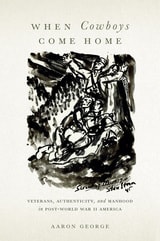
When Cowboys Come Home
Veterans, Authenticity, and Manhood in Post–World War II AmericaAaron George
Rutgers University Press, 2024
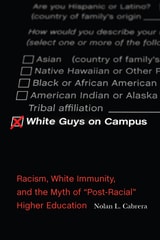
White Guys on Campus
Racism, White Immunity, and the Myth of "Post-Racial" Higher EducationCabrera, Nolan L
Rutgers University Press, 2019
On April 22, 2015, Boston University professor Saida Grundy set off a Twitter storm with her provocative question: “Why is white America so reluctant to identify white college males as a problem population?” White Guys on Campus is a critical examination of race in higher education, centering Whiteness, in an effort to unveil the frequently unconscious habits of racism among White male undergraduates. Nolan L. Cabrera moves beyond the “few bad apples” frame of contemporary racism, and explores the structures, policies, ideologies, and experiences that allow racism to flourish. This book details many of the contours of contemporary, systemic racism, while engaging the possibility of White students to participate in anti-racism. Ultimately, White Guys on Campus calls upon institutions of higher education to be sites of social transformation instead of reinforcing systemic racism, while creating a platform to engage and challenge the public discourse of “post- racialism.”

White Men Aren't
Thomas DiPiero
Duke University Press, 2002
Drawing on the writings of Freud, Lacan, Butler, Foucault, and Kaja Silverman, as well as on biology, anthropology, and legal sources, Thomas DiPiero contends that psychoanalytic theory has not only failed to account for the role of race in structuring identity, it has in many ways deliberately ignored it. Reading a wide variety of texts—from classical works such as Oedipus Rex and The Iliad to contemporary films including Boyz 'n' the Hood and Grand Canyon—DiPiero reveals how the anxiety of white masculine identity pervades a surprising range of Western thought, including such ostensibly race-neutral phenomena as Englightenment forms of reason.
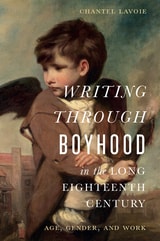
Writing through Boyhood in the Long Eighteenth Century
Age, Gender, and WorkChantel Lavoie
University of Delaware Press, 2024