Results by title
67 books match the query 'Mexican American women' and 5 start with w
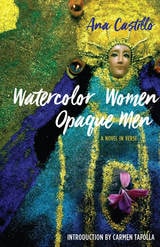
Watercolor Women Opaque Men
A Novel in VerseAna Castillo, introduction by Carmen Tafolla
Northwestern University Press, 2017
In this updated edition of Ana Castillo’s celebrated novel in verse, featuring a new introduction by Poet Laureate of Texas Carmen Tafolla, we revisit the story’s spirited heroine, known only as “Ella” or “She,” as she takes us through her own epic journey of self-actualization as an artist and a woman. With a remarkable combination of tenderness, lyricism, wicked humor, and biting satire, Castillo dramatizes Ella’s struggle through poverty as a Chicano single mother at the threshold of the twenty-first century, fighting for upward mobility while trying to raise her son to be independent and self-sufficient. Urged on by the gods of the ancients, Ella’s life interweaves with those of others whose existences are often neglected, even denied, by society’s status quo. Castillo’s strong rhythmic voice and exploration of such issues as love, sexual orientation, and cultural identity will resonate with readers today as much as they did upon the book’s original publication more than ten years ago. This expanded edition also includes a short preface by the author, as well as a glossary, a reader’s guide, and a list of additional suggested readings.
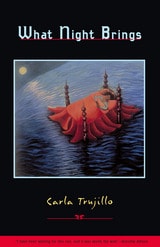
What Night Brings
Carla Trujillo
Northwestern University Press, 2003
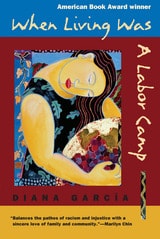
When Living Was a Labor Camp
Diana García
University of Arizona Press, 2000
"I write what I eat and smell," says Diana García, and her words are a bountiful harvest. Her poems color the page with the vibrancy and sweetness of figs, the freshness of tortillas, and the sensuality of language.
In this, García's first collection of poems, she takes a bittersweet look back at the migrant labor camps of California and offers a tribute to the people who toiled there. Writing from the heart of California's San Joaquin Valley, she catapults the reader into the lives of the campesinos with their daily joys and sorrows.
Bold, political, and familial, García's poems gift the reader with a sense of earth, struggle, and pride—each line filled with the sounds of agrarian music, from mariachi melodies to repatriation revolts. Embodied with such spirit, her poems rise with the convictions of power and equality
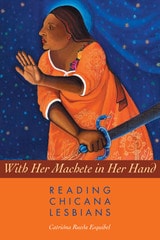
With Her Machete in Her Hand
Reading Chicana LesbiansBy Catrióna Rueda Esquibel
University of Texas Press, 2006
With the 1981 publication of the groundbreaking anthology This Bridge Called My Back: Writings by Radical Women of Color, Cherríe Moraga and Gloria Anzaldúa ushered in an era of Chicana lesbian writing. But while these two writers have achieved iconic status, observers of the Chicana/o experience have been slow to perceive the existence of a whole community—lesbian and straight, male as well as female—who write about the Chicana lesbian experience. To create a first full map of that community, this book explores a wide range of plays, novels, and short stories by Chicana/o authors that depict lesbian characters or lesbian desire.
Catrióna Rueda Esquibel starts from the premise that Chicana/o communities, theories, and feminisms cannot be fully understood without taking account of the perspectives and experiences of Chicana lesbians. To open up these perspectives, she engages in close readings of works centered around the following themes: La Llorona, the Aztec Princess, Sor Juana Inés de la Cruz, girlhood friendships, rural communities and history, and Chicana activism. Her investigation broadens the community of Chicana lesbian writers well beyond Moraga and Anzaldúa, while it also demonstrates that the histories of Chicana lesbians have had to be written in works of fiction because these women have been marginalized and excluded in canonical writings on Chicano life and experience.
Women and Migration in the U.S.-Mexico Borderlands
A ReaderDenise A. Segura and Patricia Zavella, eds.
Duke University Press, 2007
This reader includes twenty-three essays—two of which are translated from the Spanish—that illuminate women’s engagement with diverse social and cultural challenges. One contributor critiques the statistical fallacy of nativist discourses within the United States that portray Chicana and Mexican women’s fertility rates as “out of control.” Other contributors explore the relation between sexual violence and women’s migration from rural areas to urban centers within Mexico, the ways that undocumented migrant communities challenge conventional notions of citizenship, and young Latinas’ commemorations of the late, internationally renowned singer Selena. Several essays address workplace intimidation and violence, harassment and rape by U.S. border patrol agents and maquiladora managers, sexual violence, and the brutal murders of nearly two hundred young women near Ciudad Juárez. This rich collection highlights both the structural inequities faced by Mexican women in the borderlands and the creative ways they have responded to them.
Contributors. Ernestine Avila, Xóchitl Castañeda, Sylvia Chant, Leo R. Chavez, Cynthia Cranford, Adelaida R. Del Castillo, Sylvanna M. Falcón, Gloria González-López, Maria de la Luz Ibarra, Jonathan Xavier Inda, Rosa Linda Fregoso, Jennifer S. Hirsch, Pierrette Hondagneu-Sotelo, Eithne Luibheid, Victoria Malkin, Faranak Miraftab, Olga Nájera-Ramírez, Norma Ojeda de la Peña, Deborah Paredez, Leslie Salzinger, Felicity Schaeffer-Grabiel, Denise A. Segura, Laura Velasco Ortiz, Melissa W. Wright, Patricia Zavella