Results by title
157 books match the query 'Mexican-American Border Region' and 9 start with w
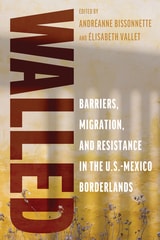
Walled
Barriers, Migration, and Resistance in the U.S.-Mexico BorderlandsEdited by Andréanne Bissonnette and Élisabeth Vallet
University of Arizona Press, 2025
From the bustling San Diego–Tijuana region to the borderlands of Brownsville-Matamoros, the U.S.-Mexico border is marked by extensive stretches of walls. Over the past thirty years, these walls have evolved from purely physical barriers into multifaceted systems encompassing administrative, legal, legislative, and biometric components. This volume invites readers to reflect on the transformations of the border since the construction of the initial fourteen miles of wall, and the subsequent addition of 1,940 miles. It provides a comprehensive exploration of the border’s evolution, and its profound and lasting impacts.
Bringing together recognized scholars in border studies, Walled delves into the varied manifestations and lived experiences associated with U.S.-Mexico border walls. The introduction by Andréanne Bissonnette and Élisabeth Vallet offers a thorough review of the border walls’ thirty-year history, placing it within a global context. Contributions offer diverse perspectives of the border experience, from state policies and migrant experiences to the daily lives of border residents. Topics such as militarization, migration, artistic resistance, and humanitarian aid are carefully examined. This volume is an essential resource for policymakers, activists, scholars, and anyone seeking to understand the intricate realities of border communities and the far-reaching consequences of border policies.
Contributors
Susana Báez-Ayala
Andréanne Bissonnette
Mathilde Bourgeon
Silvia M. Chávez-Baray
Irasema Coronado
Thalia D’Aragon-Giguère
Erin Hoekstra
Anthony Jimenez
T. Mark Montoya
Eva M. Moya
Scott Nicol
Héctor Antonio Padilla Delgado
Lisa Sun-Hee Park
Tony Payan
Patricia Ravelo-Blancas
David A. Shirk
Allyson Teague
Élisabeth Vallet

Warriors for Social Justice and Equality
Maria Jimenez of Houston and Mexican American ActivismLinda J. Quintanilla
University of North Texas Press, 2025
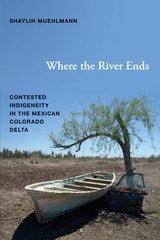
Where the River Ends
Contested Indigeneity in the Mexican Colorado DeltaShaylih Muehlmann
Duke University Press, 2013
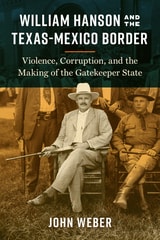
William Hanson and the Texas-Mexico Border
Violence, Corruption, and the Making of the Gatekeeper StateJohn Weber
University of Texas Press, 2024
An examination of the career of Texas Ranger and immigration official William Hanson illustrating the intersections of corruption, state-building, and racial violence in early twentieth century Texas.
At the Texas-Mexico border in the 1910s and 1920s, William Hanson was a witness to, and an active agent of, history. As a Texas Ranger captain and then a top official in the Immigration Service, he helped shape how US policymakers understood the border, its residents, and the movement of goods and people across the international boundary. An associate of powerful politicians and oil company executives, he also used his positions to further his and his patrons' personal interests, financial and political, often through threats and extralegal methods.
Hanson’s career illustrates the ways in which legal exclusion, white-supremacist violence, and official corruption overlapped and were essential building blocks of a growing state presence along the border in the early twentieth century. In this book, John Weber reveals Hanson’s cynical efforts to use state and federal power to proclaim the border region inherently dangerous and traces the origins of current nativist politics that seek to demonize the border population. In doing so, he provides insight into how a minor political appointee, motivated by his own ambitions, had lasting impacts on how the border was experienced by immigrants and seen by the nation.
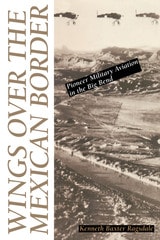
Wings over the Mexican Border
Pioneer Military Aviation in the Big BendBy Kenneth Baxter Ragsdale
University of Texas Press, 1997
Against a backdrop of revolution, border banditry, freewheeling aerial dramatics, and World War II comes this compelling look at the rise of U.S. combat aviation at an unlikely proving ground—a remote airfield in the rugged reaches of the southwestern Texas borderlands. Here, at Elmo Johnson's Big Bend ranch, hundreds of young Army Air Corps pilots demonstrated the U.S. military's reconnaissance and emergency response capabilities and, in so doing, dramatized the changing role of the airplane as an instrument of war and peace.
Kenneth Ragsdale's gripping account not only sets the United States squarely in the forefront of aerial development but also provides a reflective look at U.S.-Mexican relations of the 1920s, 1930s, and 1940s, particularly the tense days and aftermath of the Escobar Rebellion of 1929. He paints a vivid picture of the development of the U.S. aerial strike force; the character, ideals, and expectations of the men who would one day become combat leaders; and the high esteem in which U.S. citizens held the courageous pilots.
Particularly noteworthy is Ragsdale's portrait of Elmo Johnson, the Big Bend rancher, trader, and rural sage who emerges as the dominant figure at one of the most unusual facilities in the annals of the Air Corps. Wings over the Mexican Border tells a stirring story of the American frontier juxtaposed with the new age of aerial technology.

With the River on Our Face
Emmy Pérez
University of Arizona Press, 2016
Pérez reveals the strengths and nuances of a universe where no word is “foreign.” Her fast-moving, evocative words illuminate the prayers, gasps, touches, and gritos born of everyday discoveries and events. Multiple forms of reference enrich the poems in the form of mantra: ecologist’s field notes, geopolitical and ecofeminist observations, wildlife catalogs, trivia, and vigil chants.
“What is it to love / within viewing distance of night / vision goggles and guns?” is a question central to many of these poems.
The collection creates a poetic confluence of the personal, political, and global forces affecting border lives. Whether alluding to El Valle as a place where toxins now cross borders more easily than people or wildlife, or to increased militarization, immigrant seizures, and twenty-first-century wall-building, Pérez’s voice is intimate and urgent. She laments, “We cannot tattoo roses / On the wall / Can’t tattoo Gloria Anzaldúa’s roses / On the wall”; yet, she also reaffirms Anzaldúa’s notions of hope through resilience and conocimiento.
With the River on Our Face drips deep like water, turning into amistad—an inquisition into human relationships with planet and self.
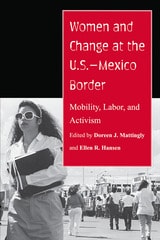
Women and Change at the U.S.–Mexico Border
Mobility, Labor, and ActivismEdited by Doreen J. Mattingly and Ellen R. Hansen
University of Arizona Press, 2006
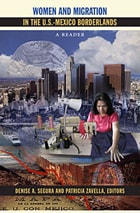
Women and Migration in the U.S.-Mexico Borderlands
A ReaderDenise A. Segura and Patricia Zavella, eds.
Duke University Press, 2007
This reader includes twenty-three essays—two of which are translated from the Spanish—that illuminate women’s engagement with diverse social and cultural challenges. One contributor critiques the statistical fallacy of nativist discourses within the United States that portray Chicana and Mexican women’s fertility rates as “out of control.” Other contributors explore the relation between sexual violence and women’s migration from rural areas to urban centers within Mexico, the ways that undocumented migrant communities challenge conventional notions of citizenship, and young Latinas’ commemorations of the late, internationally renowned singer Selena. Several essays address workplace intimidation and violence, harassment and rape by U.S. border patrol agents and maquiladora managers, sexual violence, and the brutal murders of nearly two hundred young women near Ciudad Juárez. This rich collection highlights both the structural inequities faced by Mexican women in the borderlands and the creative ways they have responded to them.
Contributors. Ernestine Avila, Xóchitl Castañeda, Sylvia Chant, Leo R. Chavez, Cynthia Cranford, Adelaida R. Del Castillo, Sylvanna M. Falcón, Gloria González-López, Maria de la Luz Ibarra, Jonathan Xavier Inda, Rosa Linda Fregoso, Jennifer S. Hirsch, Pierrette Hondagneu-Sotelo, Eithne Luibheid, Victoria Malkin, Faranak Miraftab, Olga Nájera-Ramírez, Norma Ojeda de la Peña, Deborah Paredez, Leslie Salzinger, Felicity Schaeffer-Grabiel, Denise A. Segura, Laura Velasco Ortiz, Melissa W. Wright, Patricia Zavella
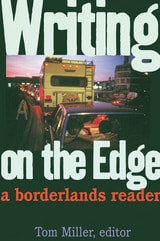
Writing on the Edge
A Borderlands ReaderEdited by Tom Miller
University of Arizona Press, 2003
This wide-ranging anthology—gathering short stories and essays, song lyrics and poems—offers readers a new appreciation of the border and its literature. Residents of the region may be startled to learn how many passers-by have been struck by this unruly slice of North America, while those living in other parts of the country may be surprised to find it more than a dateline for reports of smuggling and illegal immigration.
Collected here are both celebrated and underappreciated gems of American and Mexican literature depicting a region that for some writers represents an exotic land, for others home. Writing on the Edge juxtaposes passages by New Jersey poet William Carlos Williams and native songwriter Flaco Jiménez, British novelist Graham Greene and American poet Demetria Martínez, to show us the border from both sides and from a distance. In all of the selections, La Frontera looms larger than life—an energizing force that frames the lives of the characters living within its boundaries. Included in the book is a literary map of the border highlighting the sites with which each author is identified.
As editor Tom Miller observes, the very notion of literature in a region considered an "irrelevant nuisance" allows for more free-ranging creative output." Writing on the Edge sparkles with such creativity and invites readers to enjoy the best of two worlds—and of the world they share.
Print a literary map of the borderlands here!