Results by title
64 books match the query 'Military policy' and 5 start with w
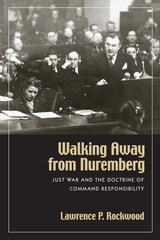
Walking Away from Nuremberg
Just War and the Doctrine of Command ResponsibilityLawrence P. Rockwood
University of Massachusetts Press, 2007
In September 1994, Lawrence P. Rockwood, then a counterintelligence officer with the U.S. Army's Tenth Mountain Division, was deployed to Haiti as part of Operation Restore Democracy, the American-led mission to oust the regime of Raoul Cedras and reinstall President Jean-Bertrand Aristide. Shortly after arriving in-country, Captain Rockwood began receiving reports of human rights abuses at the local jails, including the murder of political prisoners. He appealed to his superiors for permission to take action but was repeatedly turned down. Eventually, after filing a formal complaint with an army inspector general, he set off to inspect the jails on his own. The next day, Captain Rockwood found himself on a plane headed back to the United States, where he was tried by court-martial, convicted on several counts, and discharged from military service.
In this book, Rockwood places his own experience within the broader context of the American military doctrine of “command responsibility”—the set of rules that holds individual officers directly responsible for the commission of war crimes under their authority. He traces the evolution of this doctrine from the Civil War, where its principles were first articulated as the “Lieber Code,” through the Nuremberg trials following World War II, where they were reaffirmed and applied, to the present. Rockwood shows how in the past half-century the United States has gradually abandoned its commitment to these standards, culminating in recent Bush administration initiatives that in effect would shield American commanders and officials from prosecution for many war crimes. The Abu Ghraib and Guantánamo prison abuse scandals, the recently disclosed illegal CIA detention centers, the unprecedented policy of tolerating acts considered as torture by both international standards and U.S. military doctrine, and the recent cover-ups of such combat-related war crimes as the Haditha massacre of November 2005, all reflect an “official anti-humanitarian” trend, Rockwood argues, that is at odds with our nation's traditions and principles.

War Stars
The Superweapon and the American ImaginationH. Bruce Franklin
University of Massachusetts Press, 2008
In this new and expanded edition of an already classic work, H. Bruce Franklin brings the epic story of the superweapon and the American imagination into the ominous twenty-first century, demonstrating its continuing importance both to comprehending our current predicament and to finding ways to escape from it.
Sweeping through two centuries of American culture and military history, Franklin traces the evolution of superweapons from Robert Fulton's eighteenth-century submarine through the strategic bomber, atomic bomb, and Star Wars to a twenty-first century dominated by “weapons of mass destruction,” real and imagined. Interweaving culture, science, technology, and history, he shows how and why the American pursuit of the ultimate defensive weapon—guaranteed to end all war and bring universal triumph to American ideals—has led our nation and the world into an epoch of terror and endless war.
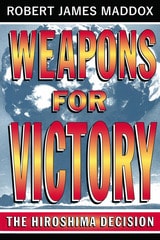
Weapons for Victory
The Hiroshima Decision Fifty Years LaterRobert James Maddox
University of Missouri Press, 2004
The highly acclaimed Weapons for Victory originally appeared in 1995, the fiftieth anniversary of the end of World War II. Now, in this paperback edition, Robert James Maddox provides a new introduction about the ongoing controversy related to the decision to bomb Hiroshima.

Weapons of Choice
The Development of Precision Guided MunitionsPaul G. Gillespie
University of Alabama Press, 2006
A military history study that traces the development of precision‑guided munitions from World War I through the Gulf War, examining how advances in weapons technology reshaped air power, military strategy, and U.S. national security policy.
In the United States, efforts to develop precision guided munitions—PGMs—began during the First World War and resulted in an 'aerial torpedo' by the 1920s. While World War II was dominated by large-scale strategic bombing—essentially throwing out tons of free-falling munitions in the hope they hit something important—both sides in the war worked to develop airborne munitions that could be steered toward a target. However after that war, U.S. national security policy focused on the atomic bomb, hardly a weapon that needed to be directed with accuracy.
The cost of emphasis on atomic weapons was revealed in the general unsuitability of American tactics and weapons deployment systems during the Vietnam War. Lessons learned in that conflict, coupled with rapid technological developments in aerodynamics, lasers, and solid-state electronics, brought air power dramatically closer to the "surgical strike" now seen as crucial to modern warfare. New technology created attractive choices and options for American policymakers as well as field commanders, and events in the Arab-Israeli wars, the U.S. raid on Libya, and most dramatically in the first Gulf War created an ever-increasing demand for the precision weapons.
The prospect of pinpoint delivery of weapons right to the enemy's door by speeding aircraft seems to presage war in which the messy and politically risky deployment of ground troops is unnecessary. The potential of such weapons, and their strategic limitations, made the Gulf War and Iraqi War living theater for assessing what such weapons can and cannot do and have important implications for planning for future warfare.

Weapons of the People
The Culture and Politics of Guns in Modern ChinaLei Duan
University of Michigan Press, 2027
Why did a country that once mobilized millions of armed civilians become one of the most tightly regulated gun societies in the world? Weapons of the People traces the history of private gun ownership in modern China, from the late Qing dynasty to the early People’s Republic of China. Far from being rare, firearms were once embedded in everyday life, used for self-defense, social status, and political struggle. At the same time, government policies toward civilian arms were often inconsistent. These inconsistencies extended beyond uneven enforcement to include shifting official attitudes toward unsanctioned armed groups. The Chinese Communist Party’s treatment of armed individuals and groups repeatedly adapted to changing political conditions and strategic needs.
Drawing on extensive archival research, as well as published documents, legal cases, and personal accounts, Lei Duan reconstructs the social life of firearms and their shifting political meanings across different regimes. By uncovering these patterns of diversity in firearm ownership and inconsistency in government policy, this book highlights the complex interplay between firearms, society, and the state in modern Chinese history. This study invites readers to reconsider the role of firearms in shaping China’s modern trajectory and to challenge conventional understandings of the nation’s sociopolitical landscape. Duan offers a new prism through which to examine state-society relations in modern China.