Results by title
57 books match the query 'Mountains' and 2 start with w
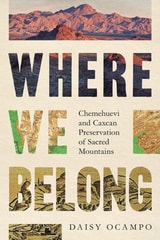
Where We Belong
Chemehuevi and Caxcan Preservation of Sacred MountainsDaisy Ocampo
University of Arizona Press, 2023
The author brings together the history and experiences of the Chemehuevi people and their ties with Mamapukaib, or the Old Woman Mountains in the East Mojave Desert, and the Caxcan people and their relationship with Tlachialoyantepec, or Cerro de las Ventanas, in Zacatecas, Mexico. Through a trans-Indigenous approach, Daisy Ocampo weaves historical methodologies (oral histories, archival research, ethnography) with Native studies and historic preservation to reveal why Native communities are the most knowledgeable and transformational caretakers of their sacred places.
This work transcends national borders to reveal how settler structures are sustained through time and space in the Americas. Challenging these structures, traditions such as the Chemehuevi Salt Songs and Caxcan Xuchitl Dance provide both an old and a fresh look at how Indigenous people are reimagining worlds that promote Indigenous-to-Indigenous futures through preservation.
Ultimately, the stories of these two peoples and places in North America illuminate Indigenous sovereignty within the field of public history, which is closely tied to governmental policies, museums, archives, and agencies involved in historic preservation.
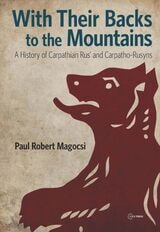
With Their Backs to the Mountains
A History of Carpathian Rus' and Carpatho-RusynsPaul Robert Magocsi
Central European University Press, 2016
This is a history of a stateless people, the Carpatho-Rusyns, and their historic homeland, Carpathian Rus’, located in the heart of central Europe. A little over 100,000 Carpatho-Rusyns are registered in official censuses but their population is estimated at around 1,000,000, the greater part in Ukraine and Slovakia. The majority of the diaspora—nearly 600,000—lives in the US.
At the present, when it is fashionable to speak of nationalities as “imagined communities” created by intellectuals or elites who may live in the historic homeland, Carpatho-Rusyns provide an ideal example of a people made—or some would say still being made—before our very eyes. The book traces the evolution of Carpathian Rus’ from earliest prehistoric times to the present, and the complex manner in which a distinct Carpatho-Rusyn people, since the mid-nineteenth century, came into being, disappeared, and then re-appeared in the wake of the revolutions of 1989 and the collapse of communist rule in central and eastern Europe.
To help guide the reader further there are 34 detailed maps plus an annotated discussion of relevant books, chapters, and journal articles.