Results by title
120 books match the query 'Multicultural Education' and 4 start with w
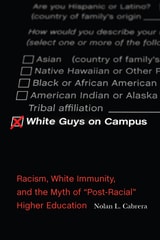
White Guys on Campus
Racism, White Immunity, and the Myth of "Post-Racial" Higher EducationCabrera, Nolan L
Rutgers University Press, 2019
On April 22, 2015, Boston University professor Saida Grundy set off a Twitter storm with her provocative question: “Why is white America so reluctant to identify white college males as a problem population?” White Guys on Campus is a critical examination of race in higher education, centering Whiteness, in an effort to unveil the frequently unconscious habits of racism among White male undergraduates. Nolan L. Cabrera moves beyond the “few bad apples” frame of contemporary racism, and explores the structures, policies, ideologies, and experiences that allow racism to flourish. This book details many of the contours of contemporary, systemic racism, while engaging the possibility of White students to participate in anti-racism. Ultimately, White Guys on Campus calls upon institutions of higher education to be sites of social transformation instead of reinforcing systemic racism, while creating a platform to engage and challenge the public discourse of “post- racialism.”
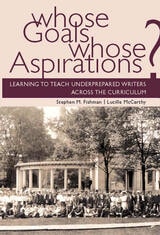
Whose Goals Whose Aspirations
Learning to Teach Underprepared Writers across the CurriculumStephen M. Fishman and Lucille McCarthy
Utah State University Press, 2002
Ever since Horace Mann promoted state supported schooling in the 1850s, the aims of U.S. public education have been the subject of heated national debate. Whose Goals? Whose Aspirations? joins this debate by exploring clashing educational aims in a discipline-based university classroom and the consequences of these clashes for "underprepared" writers.
In this close-up look at a White middle-class teacher and his ethnically diverse students, Fishman and McCarthy examine not only the role of Standard English in college writing instruction but also the underlying and highly charged issues of multiculturalism, race cognizance, and social class.
Whose School Is It?
Women, Children, Memory, and Practice in the CityBy Rhoda H. Halperin
University of Texas Press, 2006
Whose School Is It?: Women, Children, Memory, and Practice in the City is a success story with roadblocks, crashes, and detours. Rhoda Halperin uses feminist theorist and activist Gloria Anzaldúa's ideas about borderlands created by colliding cultures to deconstruct the creation and advancement of a public community charter school in a diverse, long-lived urban neighborhood on the Ohio River. Class, race, and gender mix with age, local knowledge, and place authenticity to create a page-turning story of grit, humor, and sheer stubbornness. The school has grown and flourished in the face of daunting market forces, class discrimination, and an increasingly unfavorable national climate for charter schools. Borderlands are tense spaces. The school is a microcosm of the global city.
Many theoretical strands converge in this book—feminist theory, ideas about globalization, class analysis, and accessible narrative writing—to present some new approaches in urban anthropology. The book is multi-voiced and nuanced in ways that provide authenticity and texture to the real circumstances of urban lives. At the same time, identities are threatened as community practices clash with rules and regulations imposed by outsiders.
Since it is based on fifteen years of ethnographic fieldwork in the community and the city, Whose School Is It? brings unique long-term perspectives on continuities and disjunctures in cities. Halperin's work as researcher and advocate also provides insider perspectives that are rare in the literature of urban anthropology.
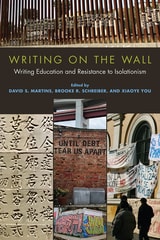
Writing on the Wall
Writing Education and Resistance to Isolationismedited by David S. Martins, Brooke R. Schreiber & Xiaoye You
Utah State University Press, 2022
The collection extends existing scholarship and research about the ways racist and colonial rhetorics impact writing education; the impact of translingual, transnational, and cosmopolitan ideologies on student learning and student writing; and the role international educational partnerships play in pushing back against isolationist ideologies. Established and early-career scholars who work in a broad range of institutional contexts highlight the historical connections among monolingualism, racism, and white nationalism and introduce community- and classroom-based practices that writing teachers use to resist isolationist beliefs and tendencies.
“Writing on the wall” serves as a metaphor for the creative, direct action writing education can provide and invokes border spaces as sites of identity expression, belonging, and resistance. The book connects transnational writing education with the fight for racial justice in the US and around the world and will be of significance to secondary and postsecondary writing teachers and graduate students in English, linguistics, composition, and literacy studies.
Contributors: Olga Aksakalova, Sara P. Alvarez, Brody Bluemel, Tuli Chatterji, Keith Gilyard, Joleen Hanson, Florianne Jimenez Perzan, Rebecca Lorimer Leonard, Layli Maria Miron, Tony D. Scott, Kate Vieira, Amy J. Wan