Results by title
209 books match the query 'Mystery & Detective' and 3 start with w
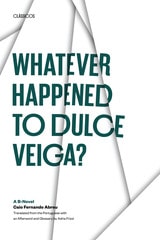
Whatever Happened to Dulce Veiga?
A B-NovelBy Caio Fernando Abreu
University of Texas Press, 2001
A forty-year-old Brazilian journalist reduced to living in a dilapidated building inhabited by a bizarre human fauna—fortune-tellers, transvestites, tango-loving Argentinean hustlers—is called upon to track down and write the story of Dulce Veiga, a famous singer who disappeared twenty years earlier on the eve of her first big show. Thus begins a mad race through an underground, nocturnal São Paulo among rock bands with eccentric names, feline reincarnations of Vita Sackville-West, ex-revolutionaries turned junkies, gay Pietas, echoes of Afro-Brazilian religions, and intimations of AIDS . . .
Constructed like a mystery, the novel unravels over a week, evoking a decadent and contaminated atmosphere in which the journalist's own search for meaning finds its expression in the elusive Dulce Veiga, who constantly appears to him as if in a dream, her arm pointing heavenward. Whatever Happened to Dulce Veiga? is a descent into the underworld of contemporary megalopolises where, like the inside of a huge TV, life intermingles with bits of music, film clips, and soap opera characters in a crazy and macabre dance, moving toward a possible catharsis.
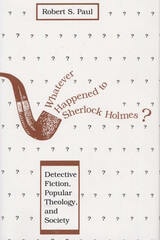
Whatever Happened to Sherlock Holmes?
Detective Fiction, Popular Theology, and SocietyRobert S. Paul
Southern Illinois University Press, 1991
Robert S. Paul suggests that the reason detective fiction has won legions of readers may be that "the writer of detective fiction, without conscious intent, appeals directly to those moral and spiritual roots of society unconsciously affirmed and endorsed by the readers."
Because detective stories deal with crime and punishment they cannot help dealing implicitly with theological issues, such as the reality of good and evil, the recognition that humankind has the potential for both, the nature of evidence (truth and error), the significance of our existence in a rational order and hence the reality of truth, and the value of the individual in a civilized society.
Paul argues that the genre traces its true beginning to the Enlightenment and documents two related but different reactions to the theological issues involved: first, a line of writers who are generally positive in relation to their cultural setting, such as Edgar Allan Poe, Wilkie Collins, Conan Doyle; and second, a reactionary strain, critical of the prevailing culture, that begins in William Godwin’s Caleb Williams and continues through the anti-heroic writers like Arsène Lupin to Raymond Chandler, Dashiell Hammett, and John MacDonald.
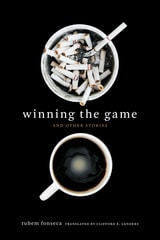
Winning the Game and Other Stories
Rubem Fonseca
Tagus Press, 2013