Results by title
50 books match the query 'Mysticism' and 2 start with w

With the World at Heart
Studies in the Secular TodayThomas A. Carlson
University of Chicago Press, 2019
What is the role of love in opening and sustaining the temporal worlds we inhabit? One of the leading scholars in philosophy and the history of religious thought, Thomas A. Carlson here traces this question through Christian theology, twentieth-century phenomenological and deconstructive philosophy, and nineteenth-century individualism. Revising Augustine’s insight that when we love a place, we dwell there in the heart, Carlson also pointedly resists lines of thought that seek to transcend loss and its grief by loving all things within the realm of the eternal. Through masterful readings of Heidegger, Derrida, Marion, Nancy, Emerson, and Nietzsche, Carlson shows that the fragility and sorrow of mortal existence in its transience do not, in fact, contradict love, but instead empower love to create a world.
[more]
Women, Mysticism, and Hysteria in Fin-de-Siècle Spain
Jennifer Smith
Vanderbilt University Press, 2021
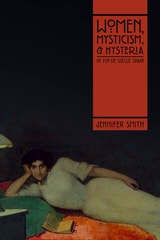
Women, Mysticism, and Hysteria in Fin-de-Siècle Spain argues that the reinterpretation of female mysticism as hysteria and nymphomania in late nineteenth- and early twentieth-century Spain was part of a larger project to suppress the growing female emancipation movement by sexualizing the female subject. This archival-historical work highlights the phenomenon in medical, social, and literary texts of the time, illustrating that despite many liberals' hostility toward the Church, secular doctors and intellectuals employed strikingly similar paradigms to those through which the early modern Spanish Church castigated female mysticism as demonic possession.
Author Jennifer Smith also directs modern historians to the writings of Emilia Pardo Bazán (1851-1921) as a thinker whose work points out mysticism's subversive potential in terms of the patriarchal order. Pardo Bazán, unlike her male counterparts, rejected the hysteria diagnosis and promoted mysticism as a path for women's personal development and self-realization.
Author Jennifer Smith also directs modern historians to the writings of Emilia Pardo Bazán (1851-1921) as a thinker whose work points out mysticism's subversive potential in terms of the patriarchal order. Pardo Bazán, unlike her male counterparts, rejected the hysteria diagnosis and promoted mysticism as a path for women's personal development and self-realization.
[more]