59 books match the query 'Narratives' and 4 start with w
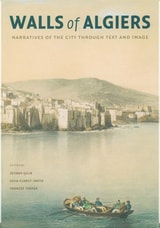
cover of Walls of Algiers: Narratives of the city through text and image

Walls of Algiers

Narratives of the city through text and image

Zeynep Çelik

J. Paul Getty Trust, The, 2023

Walls of Algiers examines the historical processes that transformed Ottoman Algiers, the "Bulwark of Islam," into "Alger la blanche," the colonial urban showpiece—and, after the outbreak of revolution in 1954—counter-model of France's global empire. In this volume, the city of Algiers serves as a case study for the analysis of the proactive and reactive social, political, technical, and artistic forces that generate a city's form. Visual sources—prints, photographs, paintings, architectural drawings, urban designs, and film—are treated as primary evidence that complements and even challenges textual documents.

The contributors' wide-ranging but intersecting essays span the disciplines of art history, social and cultural history, urban studies, and film history. Walls of Algiers presents a multifaceted look at the social use of urban space in a North African city. Its contributors' innovative methodologies allow important insights into often overlooked aspects of life in a city whose name even today conjures up enchantment as well as incomprehensible violence.
[more]
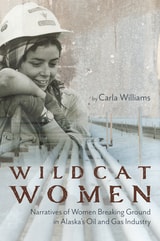
cover of Wildcat Women: Narratives of Women Breaking Ground in Alaska's Oil and Gas Industry

Wildcat Women

Narratives of Women Breaking Ground in Alaska's Oil and Gas Industry

Carla Williams

University of Alaska Press, 2018

Subzero temperatures, whiteout blizzards, and even the lack of restrooms didn’t deter them. Nor did sneers, harassment, and threats. Wildcat Women is the first book to document the life and labor of pioneering women in the oil fields of Alaska’s North Slope. It profiles fourteen women who worked in the fields, telling a little-known history of the Trans-Alaska Pipeline. These trailblazers conquered their fears to face hazardous working and living conditions, performing and excelling at “a man’s job in a man’s world.” They faced down challenges on and off the job: they drove buses over ice roads through snowstorms; wrestled with massive pipes; and operated dangerous valves that put their lives literally in their hands; they also fought union hall red tape, challenged discriminatory practices, and fought for equal pay—and sometimes won. The women talk about the roads that brought them to this unusual career, where they often gave up comfort and convenience and felt isolated and alienated. They also tell of the lifelong friendships and sense of family that bonded these unlikely wildcats. The physical and emotional hardship detailed in these stories exemplifies their courage, tenacity, resilience, and leadership, and shows how their fight for recognition and respect benefited woman workers everywhere.
[more]
cover of Women Political Prisoners in Germany: Narratives of Self and Captivity, 1915-91

Women Political Prisoners in Germany

Narratives of Self and Captivity, 1915-91

Kim Richmond

University of London Press, 2016
One of the few major enquiries into women’s narratives of political incarceration, this volume examines first-person accounts written against a backdrop of momentous historical events in twentieth-century Germany. Rosa Luxemburg’s prison letters are the starting point for the study, which explores the ways in which writing is used as a response to incarceration: how does the writer ‘perform’ femininity within the de-feminizing context of prison? How does she negotiate a self-representation as a ‘good’ woman? Central to this investigation is an awareness of the role of language as a means of empowerment within the disempowering environment of prison. As a key female political figure in twentieth-century Germany, Luxemburg wrote letters from prison that encapsulate prevalent notions about womanhood, prison, and political engagement that are perceptible in the subsequent texts of the study. The diaries of Luise Rinser and Lore Wolf from National Socialist prisons show, in different ways, how the writer uses language to ‘survive’ prison, whilst Margret Bechler’s and Elisabeth Graul’s retrospective accounts of GDR incarceration give insight into the elastic concept of both the political prisoner and the ‘good’ woman. All narratives provide examples of the role of language in resisting an imposed identity as ‘prisoner’, ‘criminal’, and object of the prison system. Kim Richmond completed her PhD at the University of Edinburgh and is now an Associate Lecturer in Languages at the Open University.
[more]
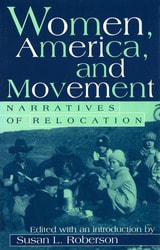
cover of Women, America, and Movement: Narratives of Relocation

Women, America, and Movement

Narratives of Relocation

Edited & Intro by Susan L. Roberson

University of Missouri Press, 1998

Since the colonial days, American women have traveled, migrated, and relocated, always faced with the challenge of reconstructing their homes for themselves and their families. Women, America, and Movement offers a journey through largely unexplored territory—the experiences of migrating American women. These narratives, both real and imagined, represent a range of personal and critical perspectives; some of the women describe their travels as expansive and freeing, while others relate the dreadful costs and sacrifices of relocating.

Despite the range of essays featured in this study, the writings all coalesce around the issues of politics, poetry, and self- identity described by Adrienne Rich as the elements of the "politics of location," treated here as the politics of relocation. The narratives featured in this book explore the impact of race, class, and sexual economics on migratory women, their self-identity, and their roles in family and social life. These issues demonstrate that in addition to geographic place, ideology is itself a space to be traversed.

By examining the writings of such women as Louise Erdrich, Zora Neale Hurston, and Gertrude Stein, the essayists included in this volume offer a variety of experiences. The book confronts such issues as racist politicking against Native Americans, African Americans, and Asian immigrants; sexist attitudes that limit women to the roles of wife, mother, and sexual object; and exploitation of migrants from Appalachia and of women newly arrived in America.

These essays also delve into the writings themselves by looking at what happens to narrative structure as authors or their characters cross geographic boundaries. The reader sees how women writers negotiate relocation in their texts and how the written word becomes a place where one finds oneself.

[more]