Results by title
166 books match the query 'Native American' and 7 start with w
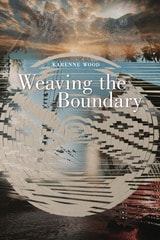
Weaving the Boundary
Karenne Wood
University of Arizona Press, 2016
This focused, accessible collection carries readers into a deep and intimate understanding of the natural world, the power of language, and the interconnectedness of life. Untold stories are revealed through documented events in various tribal histories, and indictments of destructive encounters between Western colonialism and Native peoples are juxtaposed with a lyric voice that gently insists on reweaving the past, honoring women and all life, creating a sovereign space for indigenous experience. Wood writes, “Nothing was discovered. Everything was already loved.”
Political yet universal, Weaving the Boundary tells of love and betrayal, loss and forgiveness. Wood intertwines important and otherwise untold stories and histories with a heightened sense of awareness of Native peoples’ issues and present realities.
Moving from elegy to evocations of hope and desire, the poems call for respect toward Mother Earth and feminine sensibility. One hears in this collection a longing to be carried deeper into the world, to return to tradition, to nature, to truth, to an innate belonging in the “weaving” of all life.
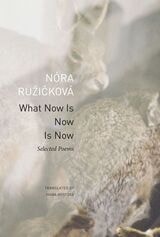
What Now Is Now Is Now
Selected PoemsNóra Ružicková
Seagull Books, 2025
A selection of poems that blend raw imagery with experimental forms, offering a vivid exploration of the body, language and shifting identities.
Nóra Ružičková’s poetry merges bodily experience with linguistic experimentation, evolving from self-reflection to an exploration of the complexities of gender and Central European identity. Her work deftly weaves personal narratives with political and social commentary, forging poems that are both intellectually provocative and deeply embodied.
This selection spans nearly 25 years, tracing her work from a late-millennium debut to her latest, most socially engaged collection, which explores novelty within the grand narratives of modern history and critiques humanity's obsession with progress. Through her poems, she challenges the boundaries of language, blending physicality with abstraction through a combination of potent imagery and philosophical reflection. Her poetry treats the body as a space where meaning is simultaneously created and dismantled, probing themes of identity, existence and the instability of interpretation. By experimenting with materiality, bodily experience and the ever-changing mediascape, Ružičková captures the complexities of contemporary human life and dissolves the divide between language and physical reality. In its concluding section, the selection confronts pivotal historical moments and humanity’s relentless pursuit of progress, making for a powerful, thought-provoking engagement with the present.
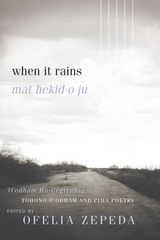
When It Rains
Tohono O'odham and Pima PoetryEdited by Ofelia Zepeda
University of Arizona Press, 1982
The poems capture brief moments of beauty, the loving bond between family members, and a deep appreciation of Tohono O’odham culture and traditions, as well as reverent feelings about the landscape and wildlife native to the Southwest. A motif of rain and water is woven throughout the poetry in When It Rains, tying in the collection’s title to the importance of this life-giving and sustaining resource to the Tohono O’odham people. With the poems in both O’odham and English, the volume serves as an important reminder of the beauty and changeability of the O’odham language.
The themes and experiences expressed by the language educators in this volume capture still-rural community life: children are still bussed for miles to school, and parents still have hours-long daily commutes to work. The Sonoran Desert also remains an important part of daily life—seasons, rain on desert plants, and sacred mountains serve as important markers.
In a new foreword to the volume, Sun Tracks editor Ofelia Zepeda reflects on how meaningful this volume was when it was first published and its continued importance. “Things have changed but many things remain the same,” writes Zepeda. “The pieces in this collection will be meaningful to many still.”
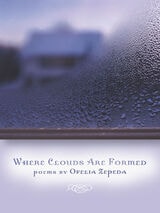
Where Clouds Are Formed
Ofelia Zepeda
University of Arizona Press, 2008
Zepeda is as clear-eyed about the past as she is about the present. She recalls waiting for the school bus on a cold morning inside her father’s truck, listening to the sounds of the engine, the windshield wipers, and the “soft rain on the hood.” She remembers celebrating Mass on the “cold dirt floor of the Winter Solstice.” In the present, she sees both the frustration and the humor in a woman she observes trying to eat pancakes with one hand while her other resides in a cast: “Watching her, I realize eating pancakes is a two-handed job.”
Whatever she sees, she filters through her second set of eyes, which keep the past always present. She tells of traveling to Waw Giwulig, the most sacred mountain of the Tohono O’odham, to ask for blessings—and forgiveness. She writes that one should always bring music to the mountains, “so they are generous with the summer rains.” And, still, “the scent of burning wood / holds the strongest memory. / Mesquite, cedar, piñon, juniper, . . . / we catch the scent of burning wood; / we are brought home.” It is a joy to see the world afresh through her eyes.
Wiijiwaaganag
More Than BrothersPeter Razor
Michigan State University Press, 2022

Woven Stone
Simon J. Ortiz
University of Arizona Press, 1992
Going for the Rain (1976) expresses closeness to a specific Native American way of life and its philosophy and is structured in the narrative form of a journey on the road of life. A Good Journey (1977), an evocation of Ortiz's constant awareness of his heritage, draws on the oral tradition of his Pueblo culture. Fight Back: For the Sake of the People, For the Sake of the Land (1980)—revised for this volume—has its origins in his work as a laborer in the uranium industry and is intended as a political observation and statement about that industry's effects on Native American lands and lives.
In an introduction written for this volume, Ortiz tells of his boyhood in Acoma Pueblo, his early love for language, his education, and his exposure to the wider world. He traces his development as a writer, recalling his attraction to the Beats and his growing political awareness, especially a consciousness of his and other people's social struggle.
"Native American writers must have an individual and communally unified commitment to their art and its relationship to their indigenous culture and people," writes Ortiz. "Through our poetry, prose, and other written works that evoke love, respect, and responsibility, Native Americans may be able to help the United States of America to go beyond survival."

Written to the Lamanites
Indigenous Perspectives on Mormon Narratives of IndigeneityFarina King and Michael Ing
University of Utah Press, 2027