52 books match the query 'Nature in literature' and 6 start with w
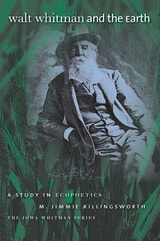
cover of Walt Whitman and the Earth: A Study of Ecopoetics

Walt Whitman and the Earth

A Study of Ecopoetics

M. Jimmie Killingsworth

University of Iowa Press, 2005

Now I am terrified at the Earth, it is that calm and patient,
It grows such sweet things out of such corruptions,
It turns harmless and stainless on its axis, with such endless successions of diseas’d corpses,
It distills such exquisite winds out of such infused fetor,
It renews with such unwitting looks its prodigal, annual, sumptuous crops,
It gives such divine materials to men, and accepts such leavings from them at last.
—Walt Whitman, from “This Compost”
How did Whitman use language to figure out his relationship to the earth, and how can we interpret his language to reconstruct the interplay between the poet and his sociopolitical and environmental world? In this first book-length study of Whitman’s poetry from an ecocritical perspective, Jimmie Killingsworth takes ecocriticism one step further into ecopoetics to reconsider both Whitman’s language in light of an ecological understanding of the world and the world through a close study of Whitman’s language.
Killingsworth contends that Whitman’s poetry embodies the kinds of conflicted experience and language that continually crop up in the discourse of political ecology and that an ecopoetic perspective can explicate Whitman’s feelings about his aging body, his war-torn nation, and the increasing stress on the American environment both inside and outside the urban world. He begins with a close reading of “This Compost”—Whitman’s greatest contribution to the literature of ecology,” from the 1856 edition of Leaves of Grass. He then explores personification and nature as object, as resource, and as spirit and examines manifest destiny and the globalizing impulse behind Leaves of Grass, then moves the other way, toward Whitman’s regional, even local appeal—demonstrating that he remained an island poet even as he became America’s first urban poet. After considering Whitman as an urbanizing poet, he shows how, in his final writings, Whitman tried to renew his earlier connection to nature.
Walt Whitman and the Earth reveals Whitman as a powerfully creative experimental poet and a representative figure in American culture whose struggles and impulses previewed our lives today.
[more]
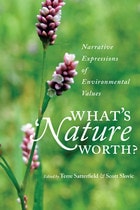
cover of What's Nature Worth

What's Nature Worth

Terre Satterfield

University of Utah Press, 2004

Based on either written or oral interviews with a dozen prominent environmental writers, What’s Nature Worth? explores how the art of storytelling might bring new perspectives and insights to economic and policy discussions regarding the "value" of nature and the environment. The diverse points of view explored, and the writers’ insistence on careful interpretation, demonstrate that environmental values are complex, rich, and deeply felt—far more so than mainstream economic methodology would have us believe. There is general consensus among the contributors that the narrative form allows for an exploration of the richness of what it means to "value" nature without being preachy or didactic. Following interviews with the twelve authors, examples of their work demonstrate how indirect expressions of value, in the words of Allison Hawthorne Deming, have an "emotional hue" that can replenish the energy depleted by the coldness of cost-benefit arguments.
[more]
cover of Wordsworth and the Green Romantics: Affect and Ecology in the Nineteenth Century

Wordsworth and the Green Romantics

Affect and Ecology in the Nineteenth Century

Lisa Ottum

University of New Hampshire Press, 2016
Situated at the intersection of ecocriticism, affect studies, and Romantic studies, this collection breaks new ground on the role of emotions in Western environmentalism. Recent scholarship highlights how traffic between Romantic-era literature and science helped to catalyze Green Romanticism. Closer to our own moment, the affective turn reflects similar cross-disciplinary collaboration, as many scholars now see the physiological phenomenon of affect as a force central to how we develop conscious attitudes and commitments. Together, these trends offer suggestive insights for the study of Green Romanticism.
[more]
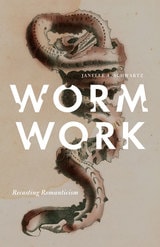
cover of Worm Work: Recasting Romanticism

Worm Work

Recasting Romanticism

Janelle A. Schwartz

University of Minnesota Press, 2012

Worms. Natural history is riddled with them. Literature is crawling with them. From antiquity to today, the ubiquitous and multiform worm provokes an immediate discomfort and unconscious distancing: it remains us against them in anthropocentric anxiety. So there is always something muddled, or dirty, or even offensive when talking about worms. Rehabilitating the lowly worm into a powerful aesthetic trope, Janelle A. Schwartz proposes a new framework for understanding such a strangely animate nature. Worms, she declares, are the very matter with which the Romantics rethought the relationship between a material world in constant flux and the human mind working to understand it.

Worm Work studies the lesser-known natural historical records of Abraham Trembley and his contemporaries and the familiar works of Erasmus Darwin, Charles Darwin, William Blake, Mary Shelley, and John Keats, to expose the worm as an organism that is not only reviled as a taxonomic terror but revered as a sign of great order in nature as well as narrative. This book traces a pattern of cultural production, a vermiculture that is as transformative of matter as it is of mind. It distinguishes decay or division as positive processes in Romantic era writings, compounded by generation or renewal and used to represent the biocentric, complex structuring of organicism.

Offering the worm as an archetypal figure through which to recast the evolution of a literary order alongside questions of taxonomy from 1740 to 1820 and on, Schwartz unearths Romanticism as a rich humus of natural historical investigation and literary creation.
[more]
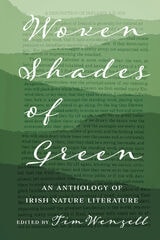
cover of Woven Shades of Green: An Anthology of Irish Nature Literature

Woven Shades of Green

An Anthology of Irish Nature Literature

Tim Wenzell

Bucknell University Press, 2019

Woven Shades of Green is an annotated selection of literature by authors who focus on the natural world and the beauty of Ireland. It begins with the Irish monks and their largely anonymous nature poetry, written at a time when Ireland was heavily forested. A section follows devoted to the changing Irish landscape, through both deforestation and famine, including the nature poetry of William Allingham, and James Clarence Mangan, essays from Thomas Gainford and William Thackerary, and novel excerpts from William Carleton and Emily Lawless. The anthology then turns to the nature literature of the Irish Literary Revival, including Yeats and Synge, and an excerpt from George Moore’s novel The Lake. Part four shifts to modern Irish nature poetry, beginning with Patrick Kavanaugh, and continuing with the poetry of Seamus Heaney, Eavan Boland, and others. Finally, the anthology concludes with a section on various Irish naturalist writers, and the unique prose and philosophical nature writing of John Moriarty, followed by a comprehensive list of environmental organizations in Ireland, which seek to preserve the natural beauty of this unique country.    

Published by Bucknell University Press. Distributed worldwide by Rutgers University Press.
[more]
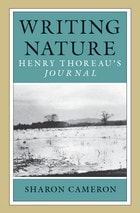
cover of Writing Nature: Henry Thoreau's Journal

Writing Nature

Henry Thoreau's Journal

Sharon Cameron

University of Chicago Press, 1989

At his death, Henry Thoreau left the majority of his writing unpublished. The bulk of this material is a journal that he kept for twenty-four years. Sharon Cameron's major claim is that this private work (the Journal) was Thoreau's primary work, taking precedence over the books that he published in his lifetime. Her controversial thesis views Thoreau's Journal as a composition that confounds the distinction between public and private—the basis on which our conventional treatment of discourse depends.
[more]