Results by title
58 books match the query 'Navajo Indians' and 3 start with w
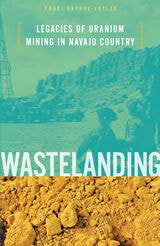
Wastelanding
Legacies of Uranium Mining in Navajo CountryTraci Brynne Voyles
University of Minnesota Press, 2015
Wastelanding tells the history of the uranium industry on Navajo land in the U.S. Southwest, asking why certain landscapes and the peoples who inhabit them come to be targeted for disproportionate exposure to environmental harm. Uranium mines and mills on the Navajo Nation land have long supplied U.S. nuclear weapons and energy programs. By 1942, mines on the reservation were the main source of uranium for the top-secret Manhattan Project. Today, the Navajo Nation is home to more than a thousand abandoned uranium sites. Radiation-related diseases are endemic, claiming the health and lives of former miners and nonminers alike.
Traci Brynne Voyles argues that the presence of uranium mining on Diné (Navajo) land constitutes a clear case of environmental racism. Looking at discursive constructions of landscapes, she explores how environmental racism develops over time. For Voyles, the “wasteland,” where toxic materials are excavated, exploited, and dumped, is both a racial and a spatial signifier that renders an environment and the bodies that inhabit it pollutable. Because environmental inequality is inherent in the way industrialism operates, the wasteland is the “other” through which modern industrialism is established.
In examining the history of wastelanding in Navajo country, Voyles provides “an environmental justice history” of uranium mining, revealing how just as “civilization” has been defined on and through “savagery,” environmental privilege is produced by portraying other landscapes as marginal, worthless, and pollutable.
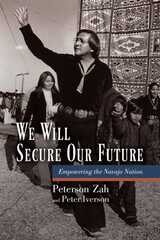
We Will Secure Our Future
Empowering the Navajo NationPeterson Zah and Peter Iverson
University of Arizona Press, 2012
And so began a career that took Zah to the presidency of the Navajo Nation. His life and accomplishments have exemplified the ongoing efforts by American Indian communities to gain greater control over their lives and lands. He has made important contributions in many areas, but education has always been one of his main priorities. Perhaps no one in the Southwest has done more than Peterson Zah to increase the recruitment, retention, and graduation of American Indian students from colleges and universities.
Zah's presentations to Peter Iverson's classes at Arizona State University, employed examples drawn from his own experiences. Students praised his thoughtful, honest and direct observations. He reinforced a central theme in Iverson's classesthat Indian history encompasses triumph as well as tragedy and victory as well as victimization.
This book grew out of Iverson's determination to share Zah's insights with a wider audience. The two met every few months to consider many subjects related to Zah's life. These sessions formed the foundation for this volume.
Part autobiography, part interview, and part conversation, Zah and Iverson's account touches on a wide range of overlapping topics, but two central themes prevail: education and empowerment. We Will Secure Our Future is a fascinating look into the life of a man who became a respected visionary and passionate advocate for his people.
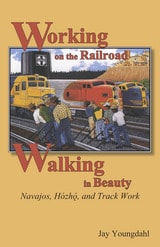
Working on the Railroad, Walking in Beauty
Navajos, Hozho, and Track WorkJay Youngdahl
Utah State University Press, 2011
For over one hundred years, Navajos have gone to work in significant numbers on Southwestern railroads. As they took on the arduous work of laying and anchoring tracks, they turned to traditional religion to anchor their lives.
Jay Youngdahl, an attorney who has represented Navajo workers in claims with their railroad employers since 1992 and who more recently earned a master's in divinity from Harvard, has used oral history and archival research to write a cultural history of Navajos' work on the railroad and the roles their religious traditions play in their lives of hard labor away from home.