126 books match the query 'New England' and 6 start with w
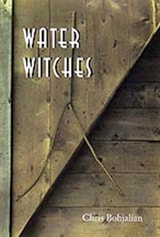
cover of Water Witches

Water Witches

Chris. Bohjalian

University Press of New England, 1995
Vermont is drying up. The normally lush, green countryside is in the grip of the worst drought in years: stunted cornstalks rasp in the hot July breeze, parched vegetable gardens wither and die, the Chittenden River shrinks to a trickle, and the drilling trucks are booked solid as one by one the wells give out. Patience Avery, known nationwide as a gifted "water witch," is having a busy summer, too. Using the tools of the dowser's trade -- divining sticks, metal rods, bobbers, and pendulums -- she can locate, among other things, aquifers deep within the earth. In the midst of this crisis, Scottie Winston lobbies for permits to expand Powder Peak, a local ski area that's his law firm's principal client. As part of the expansion, the resort seeks to draw water for snowmaking from the beleaguered Chittenden, despite opposition from environmentalists who fear that the already weakened river will be damaged beyond repair. What ensues in Chris Bohjalian's fourth novel is a struggle between conservation and development, rugged tradition versus inevitable progress. But it is also a tale of the clash between science and mystery, a chronicle of one man's transformation from cynic to believer. Vivid with the texture of New England ways, alive with characters both quirky and real, informed by the ongoing, real-life battles between environmentalism and economic expansion in Vermont, Water Witches is a story of ineffable forces, tenuous balances, "and perhaps something about our abilities as a people to heal and forgive and to love."
[more]
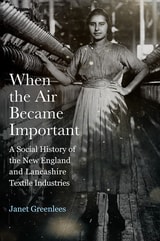
cover of When the Air Became Important: A Social History of the New England and Lancashire Textile Industries

When the Air Became Important

A Social History of the New England and Lancashire Textile Industries

Janet Greenlees

Rutgers University Press, 2019
In When the Air Became Important, medical historian Janet Greenlees examines the working environments of the heartlands of the British and American cotton textile industries from the nineteenth to the late twentieth centuries. Greenlees contends that the air quality within these pioneering workplaces was a key contributor to the health of the wider communities of which they were a part. Such enclosed environments, where large numbers of people labored in close quarters, were ideal settings for the rapid spread of diseases including tuberculosis, bronchitis and pneumonia. When workers left the factories for home, these diseases were transmitted throughout the local population, yet operatives also brought diseases into the factory. Other aerial hazards common to both the community and workplace included poor ventilation and noise. Emphasizing the importance of the peculiarities of place as well as employers’ balance of workers’ health against manufacturing needs, Greenlees’s pioneering book sheds light on the roots of contemporary environmentalism and occupational health reform. Her work highlights the complicated relationships among local business, local and national politics of health, and community priorities.
[more]
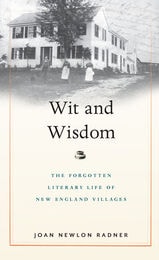
cover of Wit and Wisdom: The Forgotten Literary Life of New England Villages

Wit and Wisdom

The Forgotten Literary Life of New England Villages

Joan Newlon Radner

University of Massachusetts Press, 2023

The lyceum movement gained momentum in the decades preceding the Civil War, presenting members with the opportunity to participate in literary life and engage with the issues of the day. While urban lyceums played host to a who’s who of nineteenth-century intellectual life, literary societies also cropped up in thousands of villages across the nation, acting as influential sites of learning, creativity, and community engagement. In rural New England, ordinary men and women, farmers and intelligentsia, selectmen and schoolchildren came together to write and perform poetry and witty parodies and debate a wide range of topics, from women’s rights and temperance to slavery, migration, and more.

Wit and Wisdom takes readers inside this long-forgotten tradition, providing new access to the vibrant voices, surprising talents, and understated humor on display on many a cold winter’s night. Having uncovered dozens of handwritten newspapers produced by village lyceums across Maine, New Hampshire, Vermont, and Massachusetts, Joan Newlon Radner proves that these close-knit groups offered a vital expression of the beliefs, ambitions, and resilience of rural New Englanders.
[more]
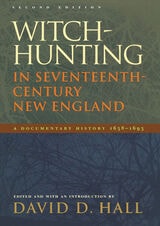
cover of Witch-Hunting in Seventeenth-Century New England: A Documentary History 1638-1693, Second Edition

Witch-Hunting in Seventeenth-Century New England

A Documentary History 1638-1693, Second Edition

David D. Hall

Duke University Press, 2007

This superb documentary collection illuminates the history of witchcraft and witch-hunting in seventeenth-century New England. The cases examined begin in 1638, extend to the Salem outbreak in 1692, and document for the first time the extensive Stamford-Fairfield, Connecticut, witch-hunt of 1692–1693. Here one encounters witch-hunts through the eyes of those who participated in them: the accusers, the victims, the judges. The original texts tell in vivid detail a multi-dimensional story that conveys not only the process of witch-hunting but also the complexity of culture and society in early America. The documents capture deep-rooted attitudes and expectations and reveal the tensions, anger, envy, and misfortune that underlay communal life and family relationships within New England’s small towns and villages.

Primary sources include court depositions as well as excerpts from the diaries and letters of contemporaries. They cover trials for witchcraft, reports of diabolical possessions, suits of defamation, and reports of preternatural events. Each section is preceded by headnotes that describe the case and its background and refer the reader to important secondary interpretations. In his incisive introduction, David D. Hall addresses a wide range of important issues: witchcraft lore, antagonistic social relationships, the vulnerability of women, religious ideologies, popular and learned understandings of witchcraft and the devil, and the role of the legal system. This volume is an extraordinarily significant resource for the study of gender, village politics, religion, and popular culture in seventeenth-century New England.

[more]
cover of Words, Works, and Ways of Knowing: The Breakdown of Moral Philosophy in New England before the Civil War

Words, Works, and Ways of Knowing

The Breakdown of Moral Philosophy in New England before the Civil War

Sara Paretsky

University of Chicago Press, 2016

Crime writer Sara Paretsky is known the world over for her acclaimed series of mysteries starring Chicago private investigator V. I. Warshawski, now in its seventeenth installment. Paretsky’s work has long been inflected with history—for her characters the past looms large in the present—and in her decades-long career, she has been recognized for transforming the role of women in contemporary crime fiction.
What’s less well-known is that before Paretsky began her writing career, she earned a PhD in history from the University of Chicago with a dissertation on moral philosophy and religion in New England in the early and mid-nineteenth century. Now, for the first time, fans of Paretsky can read that earliest work, Words, Works, and Ways of Knowing.

Paretsky here analyzes attempts by theologians at Andover Seminary, near Boston, to square and secure Calvinist religious beliefs with emerging knowledge from history and the sciences. She carefully shows how the open-minded scholasticism of these theologians paradoxically led to the weakening of their intellectual credibility as conventional religious belief structures became discredited, and how this failure then incited reactionary forces within Calvinism. That conflict between science and religion in the American past is of interest on its face, but it also sheds light on contemporary intellectual battles.

Rounding out the book, leading religious scholar Amanda Porterfield provides an afterword discussing where Paretsky’s work fits into the contemporary study of religion. And in a sobering—sometimes shocking—preface, Paretsky paints a picture of what it was like to be a female graduate student at the University of Chicago in the 1970s. A treat for Paretsky’s many fans, this book offers a glimpse of the development of the mind behind the mysteries.
[more]
cover of Working with Your Woodland: A Landowner’s Guide

Working with Your Woodland

A Landowner’s Guide

Mollie Beattie, Charles Thompson, and Lynn Levine

University Press of New England, 1993

Packed with information and illustrations, Working with Your Woodland has given woodland owners all the basics necessary for making key decisions since it was first published in 1983. The revised edition reflects the fundamental changes in the way private woodlands are viewed. Today they must be seen as part of the whole earth rather than as owner-managed islands. Few owners are aware of the wide spectrum of compatible management objectives--such as encouragement of wildlife, development for recreation, and enhancement of scenic beauty--that can coexist with the more familiar timber and firewood potential of forested areas. Even fewer understand the purpose, techniques, environmental impacts, economics, or legalities of forest management. This edition provides necessary updating of the technological, environmental, tax, and legal concerns associated with woodland management. Three chapters have been completely rewritten, and there is new information on wetlands management, global warming, acid deposition, and rare or endangered species.
[more]