Results by title
77 books match the query 'Nietzsche, Friedrich Wilhelm' and 3 start with w
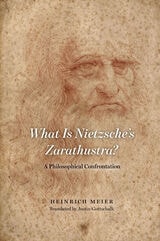
What Is Nietzsche's Zarathustra?
A Philosophical ConfrontationHeinrich Meier
University of Chicago Press, 2021
A masterful, nuanced, and novel examination of Nietzsche’s Zarathustra.
Thus Spoke Zarathustra is Nietzsche’s most famous and most puzzling work, one in which he makes the greatest use of poetry to explore the questions posed by philosophy. But in order to understand the movement of this drama, we must first understand the character of its protagonist: we must ask, What Is Nietzsche’s Zarathustra?
Heinrich Meier attempts to penetrate the core of the drama, following as a guiding thread the question of whether Zarathustra is a philosopher or a prophet, or, if he is meant to be both, whether Zarathustra is able to unite philosopher and prophet in himself. Via a close reading that uncovers the book’s hidden structure, Meier develops a highly stimulating and original interpretation of this much-discussed but still ill-understood masterwork of German poetic prose. In the process, he carefully overturns long-established canons in the academic discourse of Nietzsche interpretation. The result is a fresh and surprising grasp of Nietzsche’s well-known teachings of the overman, the will to power, and the eternal return.
What a Philosopher Is
Becoming NietzscheLaurence Lampert
University of Chicago Press, 2018
With this book, Laurence Lampert answers that question. He does so through his trademark technique of close readings of key works in Nietzsche’s journey to philosophy: The Birth of Tragedy, Schopenhauer as Educator, Richard Wagner in Bayreuth, Human All Too Human, and “Sanctus Januarius,” the final book of the 1882 Gay Science. Relying partly on how Nietzsche himself characterized his books in his many autobiographical guides to the trajectory of his thought, Lampert sets each in the context of Nietzsche’s writings as a whole, and looks at how they individually treat the question of what a philosopher is. Indispensable to his conclusions are the workbooks in which Nietzsche first recorded his advances, especially the 1881 workbook which shows him gradually gaining insights into the two foundations of his mature thinking. The result is the most complete picture we’ve had yet of the philosopher’s development, one that gives us a Promethean Nietzsche, gaining knowledge even as he was expanding his thought to create new worlds.
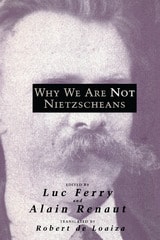
Why We Are Not Nietzscheans
Edited by Luc Ferry and Alain Renaut
University of Chicago Press, 1997
Though linked by no common dogma, these essays all argue that the "French Nietzsche" transmitted through the deconstructionists must be reexamined in light of the original context in which Nietzsche worked. Each essay questions the viability of Nietzsche's thought in the modern world, variously critiquing his philosophy of history as obsessed with hierarchy, his views on religion and art as myopic and irrational, and his stance on science as hopelessly reactionary.
Contending that we must abandon the Nietzsche propped up as patron saint by French deconstructionists in order to return to reason, these essays will stimulate debate not just among Nietzscheans but among all with a stake in modern French philosophy.
Contributors are Alain Boyer, André Compte-Sponville, Vincent Descombes, Luc Ferry, Robert Legros, Philippe Raynaud, Alain Renault, and Pierre-André Taguieff.