Results by title
75 books match the query 'Nigeria' and 4 start with w
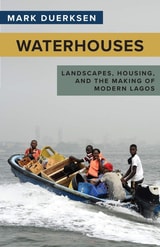
Waterhouses
Landscapes, Housing, and the Making of Modern LagosMark Duerksen
Ohio University Press, 2024
Waterhouses is about the places the people of Lagos have inhabited, imagined, and made home for the past two centuries. It asks what a house in Lagos is and explores how the answer to that question has been historically constructed and reconstructed in turn with the city’s changing landscapes. Written for historians of African and Atlantic history, scholars and practitioners of urbanism, and anyone looking to make sense of Africa’s most populous metropolis today, the book is an approachable history of how houses and water have formed modern Lagos. The book argues that in the coastlands from which Lagos rose, housing architectures were the single most important social, material, and political instruments for people hoping to contour the city’s landscapes—both its ecology and its image—and its historical course. The forms and meanings of houses in Lagos have shifted dramatically over time and in ways that reveal how power, house making, visual perception, and the environment are entangled in modern cities. The book’s chapters encompass six eras and six waterscapes: sandbars, canals, swamps, lagoons, oceans, and floods. These spaces guide the book’s exploration of how people saw and attempted to remake Lagos’s environs in a process that invariably involved housing architectures. At its core, Lagos is a city built through the materials, relations, and powers contained in the dry, solid, and hospitable spaces of homes, which have long been scarce and culturally celebrated resources in the city’s water-constricted setting. While shelter is integral to any city’s development, houses have been particularly important and sought after in Lagos because of the city’s land shortages and because of the societal influence and physical footprint of traditional Yoruba ilé (family compounds), in which activities were historically organized and centered. Through dozens of maps, photographs, and housing plans found in British and Nigerian archives, this book traces the relationship between Lagos’s residential spaces and its urban landscapes across the rise, fall, and aftermath of British colonization. By showing how Yoruba visions of home—though often forgotten or misunderstood today—coexisted with European notions, Waterhouses offers urban planners, policy makers, and architects ideas for how the definingly human act of inhabiting a place might be grounded in practices of continuous custodianship rather than extractive possession.
[more]
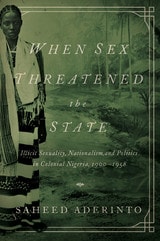
When Sex Threatened the State
Illicit Sexuality, Nationalism, and Politics in Colonial Nigeria, 1900-1958Saheed Aderinto
University of Illinois Press, 2015
Breaking new ground in the understanding of sexuality's complex relationship to colonialism, When Sex Threatened the State illuminates the attempts at regulating prostitution in colonial Nigeria.
As Saheed Aderinto shows, British colonizers saw prostitution as an African form of sexual primitivity and a problem to be solved as part of imperialism's "civilizing mission". He details the Nigerian response to imported sexuality laws and the contradictory ways both African and British reformers advocated for prohibition or regulation of prostitution. Tracing the tensions within diverse groups of colonizers and the colonized, he reveals how wrangling over prostitution camouflaged the negotiating of separate issues that threatened the social, political, and sexual ideologies of Africans and Europeans alike.
The first book-length project on sexuality in early twentieth century Nigeria, When Sex Threatened the State combines the study of a colonial demimonde with an urban history of Lagos and a look at government policy to reappraise the history of Nigerian public life.
[more]
Where Bones Dance
An English Girlhood, An African WarNina Newington
University of Wisconsin Press, 2007
In this stunning debut novel, a child dissects the darkness at the heart of her British diplomatic family. Living in Nigeria on the brink of civil war, Anna—also known as Jake—becomes blood brothers with Dave, the Korean American daughter of a C.I.A. operative. They do push-ups, collect pornography, and plot lives of unmarried freedom while around them a country disintegrates. Luscious, terrifying, and raw, Nigeria itself becomes a lesson in endurance, suffering, love.
Stories are layered upon stories: Anna's grandmother tells stories about life as a white woman on the Gold Coast; the clairvoyant and closeted "Aunt" Elsie gives Anna a story of transformation to hold onto in the coming tumult of adolescence. Yet Where Bones Dance also spirals down to the stories that are not told—sexual abuse, the myth of benign colonialism, the chaos of postcolonial Africa. Sensual and fantastical by turns, this moving, funny, immensely readable book delivers an understanding of the interplay of sexuality, gender, race, and war that is sophisticated beyond the years of its intrepid narrator.
Stories are layered upon stories: Anna's grandmother tells stories about life as a white woman on the Gold Coast; the clairvoyant and closeted "Aunt" Elsie gives Anna a story of transformation to hold onto in the coming tumult of adolescence. Yet Where Bones Dance also spirals down to the stories that are not told—sexual abuse, the myth of benign colonialism, the chaos of postcolonial Africa. Sensual and fantastical by turns, this moving, funny, immensely readable book delivers an understanding of the interplay of sexuality, gender, race, and war that is sophisticated beyond the years of its intrepid narrator.
Winner, Georges Bugnet Award for Novel, Alberta Literary Awards, Writers Guild of Alberta
Best Books for General Audiences, selected by the American Association of School Librarians and the Public Library Association
[more]
Who Owns the Problem?
Africa and the Struggle for AgencyPius Adesanmi
Michigan State University Press, 2020
How may we conceptualize Africa in the driver’s seat of her own destiny in the twenty-first century? How practically may her cultures become the foundation and driving force of her innovation, development, and growth in the age of the global knowledge economy? How may the Africanist disciplines in the humanities, the social sciences, and the natural sciences be revamped to rise up to these challenges through new imaginaries of intersectional reflection? This book assembles lectures given by Pius Adesanmi that address these questions. Adesanmi sought to create an African world of signification in which verbal artistry interpellates performer and audience in a heuristic process of knowledge production. The narrative and delivery of his arguments, the antiphonal call and response, and the aspects of Yoruba oratory and verbal resources all combine with diction and borrowings from Nigerian popular culture to create a distinct African performative mode. This mode becomes a form of resistance, specifically against the pressure to conform to Western ideals of the packaging, standardization, and delivery of knowledge. Together, these short essays preserve the
committed and passionate voice of an African writer lost far too soon. Adesanmi urges his readers to commit themselves to Africa’s cultural agency.
committed and passionate voice of an African writer lost far too soon. Adesanmi urges his readers to commit themselves to Africa’s cultural agency.
[more]