Results by title
58 books match the query 'Novelists, American' and 5 start with w
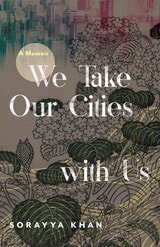
We Take Our Cities with Us
A MemoirSorayya Khan
The Ohio State University Press, 2022
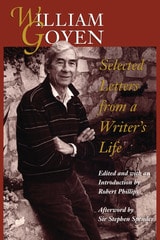
William Goyen
Selected Letters from a Writer’s LifeBy William Goyen
University of Texas Press, 1995
Proclaimed "one of the great American writers of short fiction" by the New York Times Book Review, William Goyen (1915-1983) had a quintessentially American literary career, in which national recognition came only after years of struggle to find his authentic voice, his audience, and an artistic milieu in which to create. These letters, which span the years 1937 to 1983, offer a compelling testament to what it means to be a writer in America.
A prolific correspondent, Goyen wrote regularly to friends, family, editors, and other writers. Among the letters selected here are those to such major literary figures as W. H. Auden, Archibald MacLeish, Joyce Carol Oates, William Inge, Elia Kazan, Elizabeth Spencer, and Katherine Anne Porter.
These letters constitute a virtual autobiography, as well as a fascinating introduction to Goyen's work. They add an important chapter to the study of American and Texas literature of the twentieth century.

William Styron - American Writers 98
University of Minnesota Pamphlets on American WritersRichard Pearce
University of Minnesota Press, 1971
William Styron - American Writers 98 was first published in 1971. Minnesota Archive Editions uses digital technology to make long-unavailable books once again accessible, and are published unaltered from the original University of Minnesota Press editions.
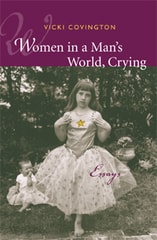
Women in a Man's World, Crying
EssaysVicki Covington
University of Alabama Press, 2002
This thoughtful, engaging collection examines resilience, identity, and inequality in the modern workplace produced by one of the nation's most observant and incisive writers.
This collection of warm, heartfelt essays from award-winning novelist Vicki Covington chronicles the multitude of "in between" moments in the writer's life. These are her stolen moments in between the writing of four novels-Gathering Home, Bird of Paradise, Night Ride Home, and The Last Hotel for Women; in between coauthoring the edgy memoir Cleaving: The Story of a Marriage with her husband Dennis Covington; in between raising two daughters; in between her husband's struggle with cancer and the author's own heart attack; in between a life full of trials and triumphs, disappointments and celebrations - moments that, as Covington demonstrates here, are always rich and revealing.
In the title essay, the author questions why all seven middle-class women who live on her street confess at a neighborhood cookout that in the past 48 hours each of them has cried. In "A Southern Thanksgiving," Covington reflects on the "family dance" that is Thanksgiving in the South: "In the North they put their crazy family members in institutions, but in the South we put them in the living room for everyone to enjoy." In "My Mother's Brain," the author recounts the onset of Alzheimer's in her mother and how, with the spread of the disease, an untapped vein of love is revealed.
Some of these essays were written as weekly newspaper columns for the Birmingham News. Others were written for specific literary occasions, such as the First Annual Eudora Welty Symposium. They are divided into six thematic sections: "Girls and Women," "Neighborhood," "Death," "The South," "Spiritual Matters," and “Writing.”
Throughout, as Covington casts her candid, attentive eye on a situation, confusion yields to comprehension, fear flourishes into faith, and anger flows into understanding. In memorializing the small moments of her life, she finds that they are far from peripheral; indeed, they are central to a life full of value and meaning.
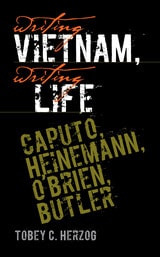
Writing Vietnam, Writing Life
Caputo, Heinemann, O'Brien, ButlerTobey C. Herzog
University of Iowa Press, 2008
Philip Caputo, Larry Heinemann, Tim O'Brien, and Robert Olen Butler: four young midwestern Americans coming of age during the 1960s who faced a difficult personal decision—whether or not to fight in Vietnam. Each chose to participate. After coming home, these four veterans became prizewinning authors telling the war stories and life stories of soldiers and civilians. The four extended conversations included in Writing Vietnam, Writing Life feature revealing personal stories alongside candid assessments of each author's distinct roles as son, soldier, writer, and teacher of creative writing.
As Tobey Herzog's thoughtful interviews reveal, these soldier-authors have diverse upbringings, values, interests, writing careers, life experiences, and literary voices. They hold wide-ranging views on, among other things, fatherhood, war, the military, religion, the creative process, the current state of the world, and the nature of both physical and moral courage. For each author, the conversation and richly annotated chronology provide an overview of the writer's life, the intersection of memory and imagination in his writing, and the path of his literary career. Together, these four life stories also offer mini-tableaux of the fascinating and troubling time of 1960s and 1970s America. Above all, the conversations reveal that each author is linked forever to the Vietnam War, the country of Vietnam, and its people.