Results by title
87 books match the query 'Officials and employees' and 13 start with w
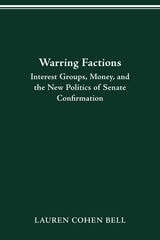
WARRING FACTIONS
INTEREST GROUPS, MONEY, SENATE CONFIRMATIONLAUREN COHEN BELL
The Ohio State University Press, 2002
Warring Factions focuses on the United States Senate’s confirmation process, the constitutional process the Senate uses to approve or reject the president’s choices to fill federal government positions. It is a book about history, the evolution, and, arguably, the decline of the process. Most significantly, it is a book that demonstrates the extent to which interest groups and money have transformed the Senate’s confirmation process into a virtual circus.
Based on in-depth research, including two dozen original interviews with United States senators, former senators and Senate staff members and interest group leaders, this volume demonstrates that today’s confirmation process is nothing more than an extension of the Senate’s legislative work. Changes to internal Senate norms in the 1960s and 1970s, coupled with changes to the external political environment, have allowed interest groups to dominate the Senate confirmation process.
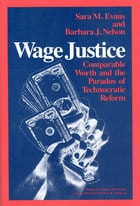
Wage Justice
Comparable Worth and the Paradox of Technocratic ReformSara M. Evans and Barbara N. Nelson
University of Chicago Press, 1991
"A perceptive and judicious analysis of comparable worth."—Wendy Kaminer, New York Times Book Review
"Very well-crafted. . . . Wage Justice has admirably launched the scholarly evaluation of pay equity, revealing the unforeseen complexities of this key feminist public policy innovation."—Maurine Weiner Greenwald, Journal of American History
"An insightful glimpse of the policy process."—Marian Lief Palley, American Political Science Review

Walking George
The Life of George John Beto and the Rise of the Modern Texas Prison SystemDavid M. Horton
University of North Texas Press, 2005

Walter Reuther
THE MOST DANGEROUS MAN IN DETROITNelson Lichtenstein
University of Illinois Press, 1995
Previously published by Basic Books as The Most Dangerous Man in Detroit: Walter Reuther and the Fate of American Labor
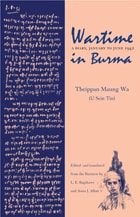
Wartime in Burma
A Diary, January to June 1942Theippan Maung Wa
Ohio University Press, 2009
This diary, begun after the Japanese attack on Pearl Harbor and covering the invasion of Burma up to June 1942, is a moving account of the dilemmas faced by the well-loved and prolific Burmese author Theippan Maung Wa (a pseudonym of U Sein Tin) and his family. At the time of the Japanese invasion, U Sein Tin was deputy secretary in the Ministry of Home and Defense Affairs. An Oxford-trained member of the Indian Civil Service, working for the British administration on the eve of the invasion, he lived with his wife and three small children in Rangoon.
Wartime in Burma is a stirring memoir that presents a personal account of U Sein Tin’s feelings about the war, his anxiety for the safety of his family, the bombing of Rangoon, and what happened to them during the next six chaotic months of the British retreat. The author and his family leave Rangoon to live in a remote forest in Upper Burma with several other Burmese civil servants, their staff, and valuable possessions—rich pickings for robbers. His diary ends abruptly on June 5, his forty-second birthday; U Sein Tin was murdered on June 6 by a gang of Burmese bandits. The diary pages, scattered on the floor of the house, were rescued by his wife and eventually published in Burma in 1966. What survives is a unique account that shines new light on the military retreat from Burma.
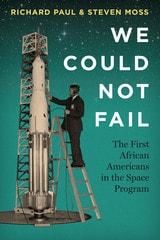
We Could Not Fail
The First African Americans in the Space ProgramBy Richard Paul and Steven Moss
University of Texas Press, 2015
The Space Age began just as the struggle for civil rights forced Americans to confront the long and bitter legacy of slavery, discrimination, and violence against African Americans. Presidents John F. Kennedy and Lyndon Johnson utilized the space program as an agent for social change, using federal equal employment opportunity laws to open workplaces at NASA and NASA contractors to African Americans while creating thousands of research and technology jobs in the Deep South to ameliorate poverty. We Could Not Fail tells the inspiring, largely unknown story of how shooting for the stars helped to overcome segregation on earth.
Richard Paul and Steven Moss profile ten pioneer African American space workers whose stories illustrate the role NASA and the space program played in promoting civil rights. They recount how these technicians, mathematicians, engineers, and an astronaut candidate surmounted barriers to move, in some cases literally, from the cotton fields to the launching pad. The authors vividly describe what it was like to be the sole African American in a NASA work group and how these brave and determined men also helped to transform Southern society by integrating colleges, patenting new inventions, holding elective office, and reviving and governing defunct towns. Adding new names to the roster of civil rights heroes and a new chapter to the story of space exploration, We Could Not Fail demonstrates how African Americans broke the color barrier by competing successfully at the highest level of American intellectual and technological achievement.
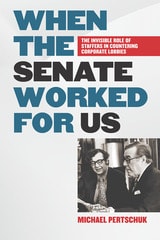
When the Senate Worked for Us
The Invisible Role of Staffers in Countering Corporate LobbiesMichael Pertschuk
Vanderbilt University Press, 2017
What has remained untold is the major behind-the-scenes contribution of entrepreneurial Congressional staff, who planted the seeds of public interest bills in their bosses' minds and maneuvered to counteract the influence of lobbyists to pass laws in consumer protection, public health, and other policy arenas crying out for effective government regulation. They infuriated Nixon's advisor, John Ehrlichman, who called them "bumblebees," a name they wore as a badge of honor.
For his insider account, Pertschuk draws on many interviews, as well as his fifteen years serving on the staff of the Senate Commerce Committee that Senator Warren Magnuson chaired and as the committee's Democratic Staff Director. That committee became, in Ralph Nader's words, "the Grand Central Station for consumer protection advocates."

William H. Emory
Soldier-ScientistL. David Norris, James C. Milligan, and Odie B. Faulk
University of Arizona Press, 1998
Born in Maryland in 1811, Emory was a West Point graduate who resigned his commission to become a civil engineer and join the newly formed Corps of Topographical Engineers. After working along the Canadian boundary, he was selected to accompany Stephen Watts Kearny and the Army of the West in their trek to California in 1846, and his map from that expedition helped guide Forty-Niners bound for the goldfields.
Emory worked for nine years on the new border between the United States and Mexico after the Treaty of Guadalupe Hidalgo and the Gadsden Purchase and was responsible for the survey and marking of the boundary. When the Civil War broke out, Emory refused a commission in the Confederate Army, instead commanding a regiment defending Washington, D.C. Later he saw action at Manassas, in the Red River campaign, and in the Shenandoah Valley, where he served under Phil Sheridan.
This biography draws on Emory’s personal papers to reveal other significant episodes of his life. While commanding a cavalry unit in Indian Territory, he was the only officer to bring an entire command out of insurrectionary territory. In hostile action of a different kind, he was a major witness in the impeachment trial of Andrew Johnson and offered testimony that helped save the president.
William H. Emory: Soldier-Scientist is an important resource for scholars of western expansion and the Civil War. More than that, it is a rousing story of an unsung but distinguished hero of his time.
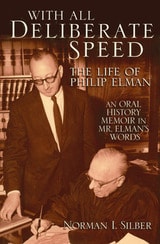
With All Deliberate Speed
The Life of Philip ElmanNorman I. Silber
University of Michigan Press, 2004
-Anthony Lewis, New York Times columnist, and Pulitzer Prize-winning
author of Gideon's Trumpet
"The fascinating, eloquent, and skillfully edited oral memoir of a distinguished public servant, who was at the epicenter of major legal controversies that his memoir illuminates. A major contribution to modern American legal history."
-Richard A. Posner
"With All Deliberate Speed provides an insider's rich account, spanning over thirty years, of the inner workings of the Supreme Court, the Solicitor General's Office and the Federal Trade Commission that anyone seriously interested in a frank behind-the-scenes view of the federal government should find exceptionally provocative and intriguing"
-Drew Days III, Alfred M. Rankin Professor of Law, Yale University, and former Solicitor General of the United States, 1993-96
From a modest childhood in Patterson, N. J., Philip Elman rose to become clerk for the great Supreme Court Justice Felix Frankfurter, and then to a position in the U.S. Solicitor General's Office. As a member of that office, Philip Elman had an exceptional vantage point on one of the most momentous cases in U.S. Supreme Court history: Brown v. Board of Education.
In this oral history memoir of Elman's life, With All Deliberate Speed, author Norman I. Silber reveals the maneuvering that led to the Court's overturning the doctrine of "separate but equal." Working behind the scenes, it was Justice Department attorney Elman who came up with the concept of gradual integration-an idea that worked its way into the final decision as the famous phrase "with all deliberate speed." Though this expression angered those pressing for immediate desegregation, Elman claims that it unified a divided Court, thus enabling them to stand together against the evil of segregation.
With All Deliberate Speed records a decisive moment in Supreme Court history, but it is also Philip Elman's unforgettable oral memoir-the story of his entire career in government service, including his work with Attorney General Robert F. Kennedy as commissioner of the FTC, and his role in founding the modern consumer protection movement, which includes the antismoking campaign that put the Surgeon General's warning on cigarette packs.
At once rich historical testimony and a gripping read, With All Deliberate Speed offers a rarely glimpsed insider's understanding of the politics of the American legal system.
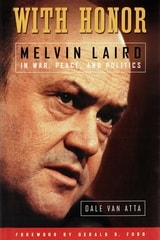
With Honor
Melvin Laird in War, Peace, and PoliticsVan Atta
University of Wisconsin Press, 2008
The first book ever to focus on Laird’s legacy, this authorized biography reveals his central and often unrecognized role in managing the crisis of national identity sparked by the Vietnam War—and the challenges, ethical and political, that confronted him along the way. Drawing on exclusive interviews with Laird, Henry Kissinger, Gerald Ford, and numerous others, author Dale Van Atta offers a sympathetic portrait of a man striving for open government in an atmosphere fraught with secrecy. Van Atta illuminates the inner workings of high politics: Laird’s behind-the-scenes sparring with Kissinger over policy, his decisions to ignore Nixon’s wilder directives, his formative impact on arms control and health care, his key role in the selection of Ford for vice president, his frustration with the country’s abandonment of Vietnamization, and, in later years, his unheeded warning to Donald Rumsfeld that “it’s a helluva lot easier to get into a war than to get out of one.”

Women Guarding Men
Lynn Zimmer
University of Chicago Press, 1986
Women and Regulation
Challenging the Status QuoEdited by Sara R. Rinfret and Michelle C. Pautz
Temple University Press, 2026
Are female food safety inspectors treated differently than men? What do women contribute to the creation and implementation of public policy in the United States? The editors of and contributors to Women in Regulation, all experts in public policy and public administration, analyze the role women (and stakeholders) play in bureaucracies in environmental, budgetary, and other sectors of the U.S. federal, state, and local governments, plus relevant examples from around the world.
Women in Regulation examines the impact of regulatory policy delegation, as well as the actors and processes involved in administrative rulemaking, compliance, and implementation. The book considers representative bureaucracy, organizational stereotypes, emotional labor, and advancement barriers to argue why studying women and regulation is of value. Regulatory case studies focus on topics ranging from water and energy to executive leadership. Chapters also include reflective exercises and prompts for classroom engagement that challenge readers to consider implications for regulatory policy in the future.
Amplifying the underheard voices in policy and implementation, Women in Regulation provides a more holistic picture of regulatory practices.
Contributors: Saman Afshan, Ashley English, Katherine Hoener, Nicole Humphrey, Ekaterina Levintova, Li-Yin Liu, Sean McCandless, Bruce D. McDonald III, Denise Scheberle, Natalie L. Smith, Manuel P. Teodoro, and the editors
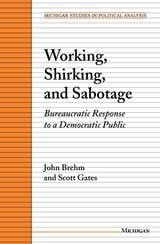
Working, Shirking, and Sabotage
Bureaucratic Response to a Democratic PublicJohn Brehm and Scott Gates
University of Michigan Press, 1999