Results by title
74 books match the query 'Oral history' and 4 start with w
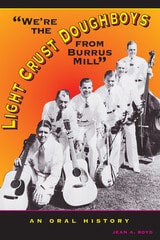
We're the Light Crust Doughboys from Burrus Mill
An Oral HistoryBy Jean A. Boyd
University of Texas Press, 2003
The Light Crust Doughboys are one of the most long-lived and musically versatile bands in America. Formed in the early 1930s under the sponsorship of Burrus Mill and Elevator Company of Fort Worth, Texas, with Bob Wills and Milton Brown (the originator of western swing) at the musical helm and future Texas governor W. Lee "Pappy" O'Daniel as band manager and emcee, the Doughboys are still going strong in the twenty-first century. Arguably the quintessential Texas band, the Doughboys have performed all the varieties of music that Texans love, including folk and fiddle tunes, cowboy songs, gospel and hymns, commercial country songs and popular ballads, honky-tonk, ragtime and blues, western swing and jazz, minstrel songs, movie hits, and rock 'n' roll.
In this book, Jean Boyd draws on the memories of Marvin "Smokey" Montgomery and other longtime band members and supporters to tell the Light Crust Doughboys story from the band's founding in 1931 through the year 2000. She follows the band's musical evolution and personnel over seven decades, showing how band members and sponsors responded to changes in Texas culture and musical tastes during the Great Depression, World War II, and the postwar years. Boyd concludes that the Doughboys' willingness to change with changing times and to try new sounds and fresh musical approaches is the source of their enduring vitality. Historical photographs of the band, an annotated discography of their pre-World War II work, and histories of some of the band's songs round out the volume.
What Has Passed and What Remains
Oral Histories of Northern Arizona's Changing LandscapesEdited by Peter Friederici
University of Arizona Press, 2010
Thirteen narratives—from ranchers, foresters, scientists, Native American farmers, and others—tell how northern Arizona landscapes and livelihoods reflect rapid social and environmental change. The twentieth century saw huge changes as Arizona’s human population swelled and vacation-home developments arose in the backcountry. Riparian areas dried up, cattle ranching declined, and some wildlife species vanished while others thrived. The people whose words are preserved here have watched it all happen.
The book is a product of Northern Arizona University’s Ecological Oral Histories project, which has been collecting remembrances of long-time area residents who have observed changes to the land from the 1930s to the present day. It carves a wide swath, from the Arizona Strip to the Mogollon Rim, from valleys near Prescott to the New Mexico line. It takes readers to the Bar Heart Ranch north of Williams and to the Doy Reidhead Ranch southeast of Holbrook, to the forests of Flagstaff and the mesas of Indian country.
Enhanced with more than fifty illustrations, this book brings environmental change down to earth by allowing us to see it through the eyes of those whose lives it has directly touched. What Has Passed and What Remains is a window on the past that carries important lessons for the future.
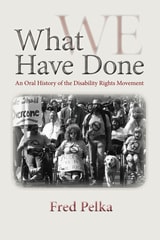
What We Have Done
An Oral History of the Disability Rights MovementFred Pelka
University of Massachusetts Press, 2012
“Nothing about us without us” has been a core principle of American disability rights activists for more than half a century. It represents a response by people with disabilities to being treated with scorn and abuse or as objects of pity, and to having the most fundamental decisions relating to their lives—where they would live; if and how they would be educated; if they would be allowed to marry or have families; indeed, if they would be permitted to live at all—made by those who were, in the parlance of the movement, “temporarily able-bodied.”
In What We Have Done: An Oral History of the Disability Rights Movement, Fred Pelka takes that slogan at face value. He presents the voices of disability rights activists who, in the period from 1950 to 1990, transformed how society views people with disabilities, and recounts how the various streams of the movement came together to push through the Americans with Disabilities Act of 1990, the most sweeping civil rights legislation since passage of the Civil Rights Act of 1964. Beginning with the stories of those who grew up with disabilities in the 1940s and '50s, the book traces how disability came to be seen as a political issue, and how people with disabilities—often isolated, institutionalized, and marginalized—forged a movement analogous to the civil rights, women's rights, and gay rights movements, and fought for full and equal participation in American society.
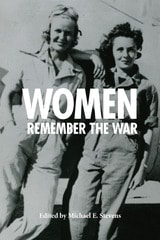
Women Remember the War, 1941-1945
Michael E. Stevens
Wisconsin Historical Society Press, 1993
Women Remember the War, 1941-1945 offers a brief introduction to the experiences of Wisconsin women in World War II through selections from oral history interviews in which women addressed issues concerning their wartime lives.
In this volume, more than 30 women describe how they balanced their more traditional roles in the home with new demands placed on them by the biggest global conflict in history. This book provides a rich mix of insights, incorporating the perspectives of workers in factories, in offices, and on farms as well as those of wives and mothers who found their work in the home. In addition, the volume contains accounts by women who served overseas in the military and the Red Cross. These accounts provide readers with a vivid picture of how women coped with the stresses created by their daily lives and by the additional burden of worrying about loved ones fighting overseas.