Results by title
65 books match the query 'Oral tradition' and 5 start with w
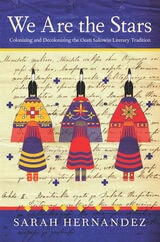
We Are the Stars
Colonizing and Decolonizing the Oceti Sakowin Literary TraditionSarah Hernandez
University of Arizona Press, 2023
Women and land form the core themes of the book, which brings tribal and settler colonial narratives into comparative analysis. Divided into two parts, the first section of the work explores how settler colonizers used the printing press and boarding schools to displace Oceti Sakowin women as traditional culture keepers and culture bearers with the goal of internally and externally colonizing the Dakota, Nakota, and Lakota nations. The second section focuses on decolonization and explores how contemporary Oceti Sakowin writers and scholars have started to reclaim Dakota, Nakota, and Lakota literatures to decolonize and heal their families, communities, and nations.
When Our Words Return
Writing, Hearing, and Remembering Oral Traditions from Alasak and the Yukonedited by Phyllis Morrow & William Schneider
Utah State University Press, 1995
The title to this interdisciplinary collection draws on the Yupik Eskimo belief that seals, fish, and other game are precious gifts that, when treated with respect and care, will return to be hunted again. Just so, if oral traditions are told faithfully and respectfully, they will return to benefit future generations. The contributors to this volume are concerned with the interpretation and representation of oral narrative and how it is shaped by its audience and the time, place, and cultural context of the narration. Thus, oral traditions are understood as a series of dialogues between tradition bearers and their listeners, including those who record, write, and interpret.
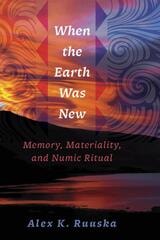
When the Earth Was New
Memory, Materiality, and Numic RitualAlex K. Ruuska
University of Utah Press, 2025
In When the Earth Was New, Alex K. Ruuska explores riveting multigenerational memories of Numic-speaking communities that extend back, potentially, to the late Pleistocene. These diverse oral traditions describe geological, climatic, and ecological events that occurred over thousands of years and were passed down across many generations. Through the examination of place-based memories and the architecture of Numic knowledge, Ruuska demonstrates convergences of oral traditions, ethnography, ethnohistory, archaeology, and geology.
When the Earth Was New critically compares and considers multiple forms of knowledge that contribute to overlapping as well as disparate understandings of both recent and distant pasts in the regions of California, the Great Basin, and the Colorado Plateau. It works at balancing key themes in these regions’ histories within a more holistic framework, exploring ancient and modern strands of knowledge with the assistance of twenty-four Tribes and Consolidated Organizations.
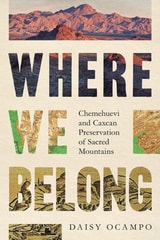
Where We Belong
Chemehuevi and Caxcan Preservation of Sacred MountainsDaisy Ocampo
University of Arizona Press, 2023
The author brings together the history and experiences of the Chemehuevi people and their ties with Mamapukaib, or the Old Woman Mountains in the East Mojave Desert, and the Caxcan people and their relationship with Tlachialoyantepec, or Cerro de las Ventanas, in Zacatecas, Mexico. Through a trans-Indigenous approach, Daisy Ocampo weaves historical methodologies (oral histories, archival research, ethnography) with Native studies and historic preservation to reveal why Native communities are the most knowledgeable and transformational caretakers of their sacred places.
This work transcends national borders to reveal how settler structures are sustained through time and space in the Americas. Challenging these structures, traditions such as the Chemehuevi Salt Songs and Caxcan Xuchitl Dance provide both an old and a fresh look at how Indigenous people are reimagining worlds that promote Indigenous-to-Indigenous futures through preservation.
Ultimately, the stories of these two peoples and places in North America illuminate Indigenous sovereignty within the field of public history, which is closely tied to governmental policies, museums, archives, and agencies involved in historic preservation.
Writing on Water
The Sounds of Jewish PrayerJudit Niran Frigyesi
Central European University Press, 2018
Writing on Water grasps the phenomenon of sound in prayer, that is, a meaning in sounds and soundscapes, and a musical essence in the act of praying.
The impetus for the book arose from the author’s fieldwork among traditional Jews during the era of communism in Budapest and Prague. In that period the Jewish religion and Jewishness in general were supressed and rituals became semi-secret and turned inward. The book is a witness to these communities and their rituals, but it goes beyond documentation. The uniqueness of the sounds of the rituals compelled the author to try to comprehend how melodies and soundscapes became the sustaining/protective environment, as well as the vehicle, for the expression of a world-orientation—in a situation where open discourse was inconceivable.
The book is based on extensive interviews, musical recordings, photographs and scholarly analyses. It is unique in its choice of communities, its wealth of original documents, and its novel interpretation of sound.
Writing on Water is creative non-fiction. The presentation is evocative and poetic, but at the same time it transmits knowledge. The book can aid research and serve in courses in philosophy, religion, music, ethnomusicology, anthropology, aesthetics, Jewish studies, folklore, oral history, and performance studies. It is also a work of art and literature.