Results by title
67 books match the query 'Painting' and 3 start with w
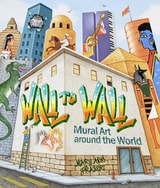
Wall to Wall
Mural Art around the WorldMary Ann Fraser
J. Paul Getty Trust, The, 2024
An exciting tour of remarkable wall art around the globe, from prehistoric caves to futuristic wonders.
People have been drawing on walls since ancient times. They do it to create beauty, to tell a story, to make a statement, or just to say, “I was here.” You can find wall art in a remote cave in Patagonia and a desert castle in Jordan, a kingly palace in the Republic of Benin and the National Palace of Mexico, a miles-long flood channel in Los Angeles and a sky-high rooftop in Norway.
In Wall to Wall, award-winning author, illustrator, and muralist Mary Ann Fraser takes readers on a worldwide journey through time, stopping to see amazing mural art along the way. Stunning color illustrations and fascinating photographs illuminate both famous and little-known examples, and lighthearted text tells engaging stories about the people who inspired or created them. A glossary, selected bibliography, and section about the preservation of murals conclude the book. No reader will ever again pass by a mural—whether in a historic building, a museum, or out on the street—without stopping to take a closer look.
Ages ten to fourteen
[more]
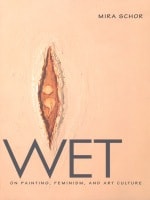
Wet
On Painting, Feminism, and Art CultureMira Schor
Duke University Press, 1997
Taking aim at the mostly male bastion of art theory and criticism, Mira Schor brings a maverick perspective and provocative voice to the issues of contemporary painting, gender representation, and feminist art. Writing from her dual perspective of a practicing painter and art critic, Schor’s writing has been widely read over the past fifteen years in Artforum, Art Journal, Heresies, and M/E/A/N/I/N/G, a journal she coedited. Collected here, these essays challenge established hierarchies of the art world of the 1980s and 1990s and document the intellectual and artistic development that have marked Schor’s own progress as a critic.
Bridging the gap between art practice, artwork, and critical theory, Wet includes some of Schor’s most influential essays that have made a significant contribution to debates over essentialism. Articles range from discussions of contemporary women artists Ida Applebroog, Mary Kelly, and the Guerrilla Girls, to "Figure/Ground," an examination of utopian modernism’s fear of the "goo" of painting and femininity. From the provocative "Representations of the Penis," which suggests novel readings of familiar images of masculinity and introduces new ones, to "Appropriated Sexuality," a trenchant analysis of David Salle’s depiction of women, Wet is a fascinating and informative collection.
Complemented by over twenty illustrations, the essays in Wet reveal Schor’s remarkable ability to see and to make others see art in a radically new light.
[more]

Where Is Ana Mendieta?
Identity, Performativity, and ExileJane Blocker
Duke University Press, 1999
Ana Mendieta, a Cuban-born artist who lived in exile in the United States, was one of the most provocative and complex personalities of the 1970s’ artworld. In Where Is Ana Mendieta? art historian Jane Blocker provides an in-depth critical analysis of Mendieta’s diverse body of work. Although her untimely death in 1985 remains shrouded in controversy, her life and artistic legacy provide a unique vantage point from which to consider the history of performance art, installation, and earth works, as well as feminism, multiculturalism, and postmodernism.
Taken from banners carried in a 1992 protest outside the Guggenheim Museum in New York, the title phrase “Where is Ana Mendieta?” evokes not only the suspicious and tragic circumstances surrounding her death but also the conspicuous absence of women artists from high-profile exhibitions. Drawing on the work of such theorists as Judith Butler, Joseph Roach, Edward Said, and Homi Bhabha, Blocker discusses the power of Mendieta’s earth-and-body art to alter, unsettle, and broaden the terms of identity itself. She shows how Mendieta used exile as a discursive position from which to disrupt dominant categories, analyzing as well Mendieta’s use of mythology and anthropology, the ephemeral nature of her media, and the debates over her ethnic, gender, and national identities.
As the first major critical examination of this enigmatic artist’s work, Where Is Ana Mendieta? will interest a broad audience, particularly those involved with the production, criticism, theory, and history of contemporary art.
[more]