Results by title
104 books match the query 'Parenting' and 3 start with w

WHEN KIDS GO TO COLLEGE
A PARENTS GUIDE TO CHANGING RELATIONSHIPBARBARA & PHILIP R. NEWMAN & NEWMAN
The Ohio State University Press, 1992

What Kind of Mother
A ReckoningJudy Sandler
West Virginia University Press, 2026
A mother’s memoir that reckons with her son’s descent into severe mental illness. What appears to be substance use disorder in high school later becomes a dual diagnosis as bipolar disorder emerges. Her son soon grows disillusioned with prescribed pharmaceuticals and participates in a residential treatment program that assists people in forgoing medication altogether. However, the program ultimately ejects him from the community for the very behaviors that the medication once managed. The book chronicles Sandler's initial denial of her truth, her painful awakening to mental illness in her family, and her eventual acceptance that she cannot save her son—only he can save himself.
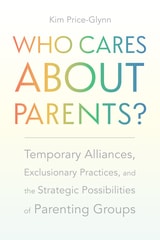
Who Cares About Parents?
Temporary Alliances, Exclusionary Practices, and the Strategic Possibilities of Parenting GroupsKim Price-Glynn
Rutgers University Press, 2026
Who cares for parental caregivers? The short answer is, parenting groups do. Who Cares for Parents examines how parenting groups collectively build and contribute significant resources to form a broader care infrastructure for adult family caregivers with children. This book looks at the content of care parenting groups provide for parents, through comparative research including mothers, fathers, and nonbinary parents. Cases include some of the most recognizable parenting groups in the United States, some with vast networks of parent members numbering in the thousands or even millions, like the Parent Teacher Association, La Leche League, and MOMS Club International. The book also examines newer and, perhaps, less well known groups like the City Dads Group, the Upper East Side (UES) Mommas, as well as smaller sets of local dads’ groups and a babysitting co-op.
Can parents in the contemporary United States secure some of the necessary resources to provide care, not only for their children but also for themselves, through parenting groups? The evidence from this research suggests they can. Parenting groups have a long history of organizing membership, meetings, education, material resources, and advocacy to provide for parents’ needs. Parenting groups’ ideologies and practices often seek broad goals, and sometimes include far reaching advocacy, innovative solutions, and possibilities for what Price-Glynn calls strategic parenting and social change. Alongside their successes, however, parenting groups also face challenges of producing narrow and temporary alliances, exclusion, and exacerbating inequalities. Despite their many challenges, Price-Glynn remains hopeful about the possibilities for non-familial and collective care infrastructure like that performed by parent groups.