Results by title
195 books match the query 'Pennsylvania' and 6 start with w
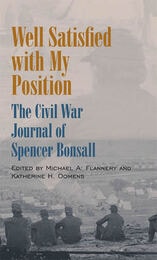
Well Satisfied with My Position
The Civil War Journal of Spencer BonsallEdited by Michael A. Flannery and Katherine H. Oomens
Southern Illinois University Press, 2007
Well Satisfied with My Position offers a first-person account of army life during the Civil War’s Peninsula Campaign and Battle of Fredericksburg. Spencer Bonsall, who joined the 81st Pennsylvania Infantry as a hospital steward, kept a journal from March 1862 until March 1863, when he abruptly ceased writing. Editors Michael A. Flannery and Katherine H. Oomens place his experiences in the context of the field of Civil War medicine and continue his story in an epilogue.
Trained as a druggist when he was in his early twenties, Bonsall traveled the world, spent eight years on a tea plantation in India, and settled in Philadelphia, where he worked in the city surveyor’s office. But in March 1862, when he was in his mid-forties, the lure of serving his country on the battlefield led Bonsall to join the 81st Pennsylvania Infantry as a hospital steward.
Bonsall enjoyed his life with the Union army at first, comparing bivouacking in the woods to merely picnicking on a grand scale. “We are about as jolly a set of old bachelors as can be found in Virginia,” Bonsall wrote. But his first taste of the aftermath of battle at Fair Oaks and the Seven Days’ Battles in Virginia changed his mind about the joys of soldiering—though he never lost his zeal for the Union cause.
Bonsall details the camp life of a soldier from firsthand experience, outlines the engagements of the 81st, and traces the Battle of Fredericksburg and the Peninsula Campaign. He records facts not available elsewhere about camp conditions, attitudes toward Union generals and Confederate soldiers, and troop movements.
From the end of June to late October 1862, Bonsall’s illness kept him from writing in his journal. He picked up the record again in December 1862, just before the Battle of Fredericksburg, Virginia, in which the Union suffered a staggering 10,200 casualties and the 81st Pennsylvania lost more than half its men. He vividly describes the bloody aftermath. Bonsall’s horse was shot out from underneath him at the battle of Gettysburg, injuring him seriously and ending his military career. Although he was listed as “sick in hospital” on the regiment’s muster rolls, he was labeled a deserter in the U.S. Army records. Indeed, after recovery from his injuries, Bonsall walked away from the army to resume life in Philadelphia with his wife and child.
Published for the first time, Bonsall’s journal offers an unusually personal glimpse into the circumstances and motives of a man physically ruined by the war. Seventeen illustrations, including some drawn by Bonsall himself, help bring this narrative to life.

What Are You Afraid Of?
Michael Hyde
University of North Texas Press, 2005
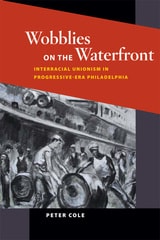
Wobblies on the Waterfront
Interracial Unionism in Progressive-Era PhiladelphiaPeter Cole
University of Illinois Press, 2007
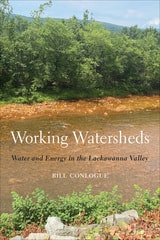
Working Watersheds
Water and Energy in the Lackawanna ValleyWilliam Conlogue
Temple University Press, 2025
Offering a fresh way to think about the Anthropocene, this distinctive history of water and coal in the Lackawanna Valley discusses how both water abundance and scarcity might play out as global temperatures rise. Working Watersheds is designed to trigger debates about the nature of history, the significance of literature, and the importance of linking person, place, and planet in an era of climate change.
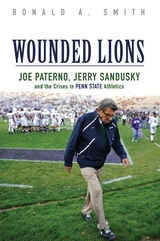
Wounded Lions
Joe Paterno, Jerry Sandusky, and the Crises in Penn State AthleticsRonald A. Smith
University of Illinois Press, 2016
In Wounded Lions, acclaimed sport historian and longtime Penn State professor Ronald A. Smith heavily draws from university archives to answer the How? and Why? at the heart of the scandal. The Sandusky case was far from the first example of illegal behavior related to the football program or the university's attempts to suppress news of it. As Smith shows, decades of infighting among administrators, alumni, trustees, faculty, and coaches established policies intended to protect the university, and the football team considered synonymous with its name, at all costs. If the habits predated Paterno, they also became sanctified during his tenure. Smith names names to show how abuses of power warped the "Penn State Way" even with hires like women's basketball coach Rene Portland, who allegedly practiced sexual bias against players for decades. Smith also details a system that concealed Sandusky's horrific acts just as deftly as it whitewashed years of rules violations, coaching malfeasance, and player crime while Paterno set records and raised hundreds of millions of dollars for the university.
A myth-shattering account of misplaced priorities, Wounded Lions charts the intertwined history of an elite university, its storied sports program, and the worst scandal in collegiate athletic history.
Writing Their Bodies
Restoring Rhetorical Relations at the Carlisle Indian SchoolSarah Klotz
Utah State University Press, 2020
This approach tracks the relationship between curriculum and resistance and enumerates an anti-assimilationist methodology for teachers and scholars of writing in contemporary classrooms. From the Carlisle archive emerges the concept of a rhetoric of relations, a set of Native American communicative practices that circulates in processes of intercultural interpretation and world-making. Klotz explores how embodied and material practices allowed Indigenous rhetors to maintain their cultural identities in the off-reservation boarding school system and critiques the settler fantasy of benevolence that propels assimilationist models of English education.
Writing Their Bodies moves beyond language and literacy education where educators standardize and limit their students’ means of communication and describes the extraordinary expressive repositories that Indigenous rhetors draw upon to survive, persist, and build futures in colonial institutions of education.