Results by title
194 books match the query 'People' and 12 start with w

War Against the People
Israel, the Palestinians and Global PacificationJeff Halper
Pluto Press, 2015
Modern warfare has a new form. The days of international combat are fading. So how do major world powers maintain control over their people today?
This book is a disturbing insight into the new ways world powers such as the US, Israel, Britain and China forge war today. It is a subliminal war of surveillance and whitewashed terror, conducted through new, high-tech military apparatuses, designed and first used in Israel against the Palestinian population. Including nano-technology, hidden camera systems, information databases on civilian activity, automated targeting systems and unmanned drones, it is used to control the very people the nation's leaders profess to serve.
Jeff Halper reveals that this practice is much more insidious than was previously thought. As Western governments claw back individual liberties, War Against the People is a reminder that fundamental human rights are being compromised for vast sections of the world, and that this is a subject that should concern everyone.
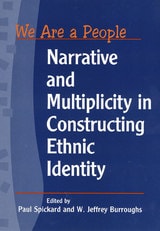
We Are A People
Paul Spickard
Temple University Press, 2000
The growing recognition that ethnicity is not fixed and inherent, but elastic and constructed, fuels the essays in this collection. Regarding identity as a dynamic, on-going, formative and transformative process, We Are a People considers narrative -- the creation and maintenance of a common story -- as the keystone in building a sense of peoplehood. Myths of origin, triumph over adversity, migration, and so forth, chart a group's history, while continual additions to the larger narrative stress moving into the future as a people.
Still, there is more to our stories as individuals and groups. Most of us are aware that we take on different roles and project different aspects of ourselves depending on the situation. Some individuals who have inherited multiple group affiliations from their families view themselves not as this or that but all at once. So too with ethnic groups. The so-called hyphenated Americans are not the only people in the world to recognize or embrace their plurality. This relatively recent acknowledgment of multiplicity has potentially wide implications, destabilizing the limited (and limiting) categories inscribed in, for example, public policy and discourse on race relations.
We Are a People is a path-breaking volume, boldly illustrating how ethnic identity works in the real world.
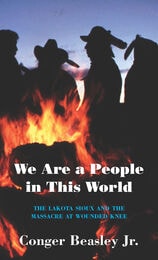
We Are a People in This World
The Lakota Sioux and the Massacre at Wounded KneeConger Beasley Jr.
University of Arkansas Press, 1997
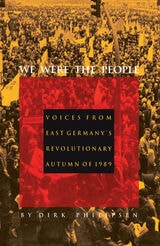
We Were the People
Voices from East Germany’s Revolutionary Autumn of 1989Dirk Philipsen
Duke University Press, 1993
The drama We Were the People recreates is remarkable for its richness and complexity. Here are citizens organizing despite threats of bloody crackdowns; party functionaries desperately trying to survive as time-honored political prerogatives crumble beneath their feet; an oppressed people discovering the possibilities of power and freedom, but also the sobering strangeness of new political realities. With their success, East Germans encountered the overpowering might of thie Western neighbor--and stand perplexed before the onslaught of real estate agents, glossy consumer ads, political professionalism--and the discovery that a lifetime of social experience has suddenly lost all usable context. They became, in the words of one participant, a people "without biography."
Over all the recent events and unlikely turns recounted here, one thing remains paramount: the sweep of the initial democratic conception that animated the East German revolution. We Were the People brings this movement to life in all its drama and detail, and vividly recovers a historic moment that altered forever the shape of modern Europe.
Some Voices of the People
Bärbel Bohley/ "Mother of the Revolution"
Rainer Eppelmann/ Protestant Pastor
Klaus Kaden/ Church Emissary to the Opposition
Hans Modrow/ Former Communist Prime Minister
Ludwig Mehlhorn/ Opposition Theorist
Ingrid Köppe/ Opposition Representative
Frank Eigenfeld/ New Forum
Harald Wagner/ Democracy Now
Sebastian Pflugbeil/ Democratic Strategist
East German Workers
Cornelia Matzke/ Independent Women's Alliance
André Brie/ Party Vice-Chairman
Gerhard Ruden/ Environmental Activist
Werner Bramke/ Party Academic
We are the People
The Rise of the AfD in GermanyPenny Bochum
Haus Publishing, 2020
We are the People analyzes the sudden growth and radicalization of the AfD, from its Euroskeptic beginnings in 2013 to its increasing extremism. Penny Bochum shows us how the leaders’ use of inflammatory, xenophobic, and even Nazi-era language mirrors that of emerging far-right forces across much of the Western world. At the same time, through a lucid examination of the group’s ideology, Bochum shows how their brand of populism is distinct and based on German experiences and history.
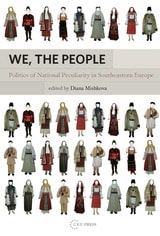
We, the People
Politics of National Peculiarity in Southeastern EuropeDiana Mishkova
Central European University Press, 2009

Weapons of the People
The Culture and Politics of Guns in Modern ChinaLei Duan
University of Michigan Press, 2027
Why did a country that once mobilized millions of armed civilians become one of the most tightly regulated gun societies in the world? Weapons of the People traces the history of private gun ownership in modern China, from the late Qing dynasty to the early People’s Republic of China. Far from being rare, firearms were once embedded in everyday life, used for self-defense, social status, and political struggle. At the same time, government policies toward civilian arms were often inconsistent. These inconsistencies extended beyond uneven enforcement to include shifting official attitudes toward unsanctioned armed groups. The Chinese Communist Party’s treatment of armed individuals and groups repeatedly adapted to changing political conditions and strategic needs.
Drawing on extensive archival research, as well as published documents, legal cases, and personal accounts, Lei Duan reconstructs the social life of firearms and their shifting political meanings across different regimes. By uncovering these patterns of diversity in firearm ownership and inconsistency in government policy, this book highlights the complex interplay between firearms, society, and the state in modern Chinese history. This study invites readers to reconsider the role of firearms in shaping China’s modern trajectory and to challenge conventional understandings of the nation’s sociopolitical landscape. Duan offers a new prism through which to examine state-society relations in modern China.
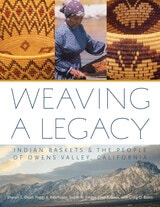
Weaving A Legacy - Paper
Indian Baskets and the People of Owens Valley, CaliforniaSharon Dean
University of Utah Press, 2005
Situated on the western edge of the Great Basin between the Sierra Nevada and White-Inyo mountain ranges, Owens Valley has been home for thousands of years to the Owens Valley Paiute and their southern neighbors, the Panamint Shoshone. The willow baskets both groups created are noteworthy for their complex construction and durability, and their materials and designs reflected available resources as well as the seminomadic existence that characterized life in the Great Basin for generations.
Since the mid-nineteenth-century arrival of non-Indians into the Valley, the baskets have changed. Weaving a Legacy places those changes in the context of the region’s dramatic social history. In addition, the volume closely examines basketry techniques and technology, historic weavers and their lineages, contemporary weavers, and basket collectors.
The text is extensively illustrated with black-and-white photographs of people, landscapes, and baskets. Among the legacies of these baskets are the stories they evoke, many of which the authors recount in this beautiful work.

Weaving Nature
Basketry from Plants to PeopleMark Nesbitt and Ruth Stungo
Royal Botanic Gardens, Kew, 2024
Basketry is a sustainable expression of human ingenuity, and Weaving Nature takes a holistic and interdisciplinary view of the journey from plant to basket. It explains why certain plants are favored by makers and shows how the raw materials are worked to achieve the desired use. This book covers a vast array of basketry types, ranging from netting to quivers from all parts of the world and dating from ancient Egypt to the current day.
Heavily illustrated with approximately three hundred baskets from the historic ethnobotanical collections of the Royal Botanic Gardens, Kew, this book is rich in stories of people, from the communities that made and used basketry to those that collected objects and brought them to Kew over the last two hundred years.
New discoveries in Kew’s archives shed light on the complex web of empire, trade, and exploration that brought so many baskets to Kew in Victorian times. Rich in stories, historical context, and images, Weaving Nature offers new ways of appreciating one of humankind’s oldest art forms.
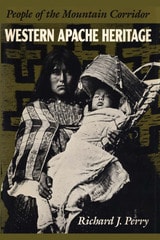
Western Apache Heritage
People of the Mountain CorridorBy Richard J. Perry
University of Texas Press, 1991
Mention "Apaches," and many Anglo-Americans picture the "marauding savages" of western movies or impoverished reservations beset by a host of social problems. But, like most stereotypes, these images distort the complex history and rich cultural heritage of the Apachean peoples, who include the Navajo, as well as the Western, Chiricahua, Mescalero, Jicarilla, Lipan, and Kiowa Apaches. In this pioneering study, Richard Perry synthesizes the findings of anthropology, ethnology, linguistics, archaeology, and ethnohistory to reconstruct the Apachean past and offer a fuller understanding of the forces that have shaped modern Apache culture.
While scholars generally agree that the Apacheans are part of a larger group of Athapaskan-speaking peoples who originated in the western Subarctic, there are few archaeological remains to prove when, where, and why those northern cold dwellers migrated to the hot deserts of the American Southwest. Using an innovative method of ethnographic reconstruction, however, Perry hypothesizes that these nomadic hunters were highly adaptable and used to exploiting the resources of a wide range of mountainous habitats. When changes in their surroundings forced the ancient Apacheans to expand their food quest, it was natural for them to migrate down the "mountain corridor" formed by the Rocky Mountain chain.
This reconstruction of Apachean history and culture sheds much light on the origins, dispersions, and relationships of Apache groups. Perry is the first researcher to attempt such an extensive reconstruction, and his study is the first to deal with the full range of Athapaskan-speaking peoples. His method will be instructive to students of other cultures who face a similar lack of historical and archaeological data.

Wildlife and People
THE HUMAN DIMENSIONS OF WILDLIFE ECOLOGYGary G. Gray
University of Illinois Press, 1993
Wildness
Relations of People and PlaceEdited by Gavin Van Horn and John Hausdoerffer
University of Chicago Press, 2017
This book charts a different path. Exploring how people can become attuned to the wild community of life and also contribute to the well-being of the wild places in which we live, work, and play, Wildness brings together esteemed authors from a variety of landscapes, cultures, and backgrounds to share their stories about the interdependence of everyday human lifeways and wildness. As they show, far from being an all or nothing proposition, wildness exists in variations and degrees that range from cultivated soils to multigenerational forests to sunflowers pushing through cracks in a city alley. Spanning diverse geographies, these essays celebrate the continuum of wildness, revealing the many ways in which human communities can nurture, adapt to, and thrive alongside their wild nonhuman kin.
From the contoured lands of Wisconsin’s Driftless region to remote Alaska, from the amazing adaptations of animals and plants living in the concrete jungle to indigenous lands and harvest ceremonies, from backyards to reclaimed urban industrial sites, from microcosms to bioregions and atmospheres, manifestations of wildness are everywhere. With this book, we gain insight into what wildness is and could be, as well as how it might be recovered in our lives—and with it, how we might unearth a more profound, wilder understanding of what it means to be human.
Wildness: Relations of People and Place is published in association with the Center for Humans and Nature, an organization that brings together some of the brightest minds to explore and promote human responsibilities to each other and the whole community of life. Visit the Center for Humans and Nature's Wildness website for upcoming events and a series of related short films.