Results by title
68 books match the query 'Performance art' and 3 start with w
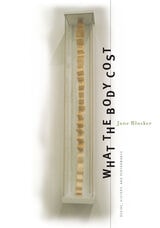
What The Body Cost
Desire, History, And PerformanceJane Blocker
University of Minnesota Press, 2004
Reexamines rebelliousness and desire in the history of performance art
Because performance is by its very nature ephemeral, it elicits a desire for what is lost more than any other form of art making. But what is the nature of that desire, and on what models has it been structured? How has it affected the ways in which the history of performance art gets told?
In What the Body Cost, Jane Blocker revisits key works in performance art by Carolee Schneemann, Vito Acconci, Hannah Wilke, Yves Klein, Ana Mendieta, and others to challenge earlier critiques that characterize performance, or body art, as a purely revolutionary art form and fail to recognize its reactionary—and sometimes damaging—effects. The scholarship to date on performance art has not, she finds, gone far enough in locating the body at the center of the performance, nor has it acknowledged the psychic, emotional, or social costs exacted on that body. Drawing on the work of critical theorists such as Roland Barthes and Catherine Belsey, as well as queer theory and feminism, What the Body Cost reads against patriarchal and heteronormative tendencies in art history while providing a corrective to the established view that performance art is necessarily transgressive. Instead, Blocker suggests that the historiography of performance art is a postmodern lovers’s discourse in which practitioners, historians, and critics alike fervently seek the body while doubting it can ever be found.
Where Is Ana Mendieta?
Identity, Performativity, and ExileJane Blocker
Duke University Press, 1999
Taken from banners carried in a 1992 protest outside the Guggenheim Museum in New York, the title phrase “Where is Ana Mendieta?” evokes not only the suspicious and tragic circumstances surrounding her death but also the conspicuous absence of women artists from high-profile exhibitions. Drawing on the work of such theorists as Judith Butler, Joseph Roach, Edward Said, and Homi Bhabha, Blocker discusses the power of Mendieta’s earth-and-body art to alter, unsettle, and broaden the terms of identity itself. She shows how Mendieta used exile as a discursive position from which to disrupt dominant categories, analyzing as well Mendieta’s use of mythology and anthropology, the ephemeral nature of her media, and the debates over her ethnic, gender, and national identities.
As the first major critical examination of this enigmatic artist’s work, Where Is Ana Mendieta? will interest a broad audience, particularly those involved with the production, criticism, theory, and history of contemporary art.
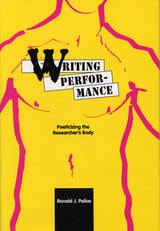
Writing Performance
Poeticizing the Researcher's BodyRonald J. Pelias
Southern Illinois University Press, 1999
Ronald J. Pelias is concerned with writing about performance, from the everyday performative routines to the texts on stage. He seeks to write performatively, to offer poetic or aesthetic renderings of performance events in order to capture some sense of their nature. In his quest for the spirit of theatrical performances, Pelias asks more of the written word than the word can deliver. Yet the attempt is both desirable—and necessary. To discuss performance without some accounting for its essence as art, he asserts, is at best misleading, at worst, fraud.
Pelias divides his efforts to present performance events into three general categories: "Performing Every Day," "On Writing and Performing," and "Being a Witness." "Performing Every Day" focuses on performances ranging from the daily business of enacting roles to the telling of tales that make life meaningful. It incorporates essays about the ongoing process of presenting oneself in everyday life; the gender script that insists that men enact manly performances; the classroom performances of teachers and students; stories of gender, class, and race that mark identity; and a performance installation entitled "A Day’s Talk."
"On Writing and Performing" examines the written script and performance practices. It includes a description of a struggle between a writer and a performer as they protect their own interests; an intimate look at an apprehensive performer; a short play entitled "The Audition"; and a chronicle of performance process from the perspective of an actor.
"Being a Witness" examines performance from the perspective of the audience and the director: being an audience member; viewing theatre in the context of New York City; directing and being directed by actors’ bodies; and watching The DEF Comedy Jam.