Results by title
117 books match the query 'Philippines' and 3 start with w
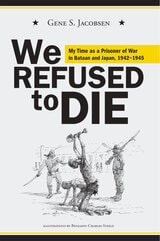
We Refused to Die
My time as a prisoner of war in Bataan and Japan, 1942-1945Gene S Jacobsen
University of Utah Press, 2004
Gene Jacobsen was a nineteen-year-old Idaho ranch kid when he decided to join the Army Air Corps in September 1940. By December 1941 he was supply sergeant for the Twentieth Pursuit Squadron at Clark Field in the Philippines. Five months later he was a captive of the Imperial Japanese Army, enduring the Bataan death march and subsequent horrors in the Philippines and Japan. Of the 207 officers and men who made up Jacobsen’s squadron at the beginning of the war, sixty-five survived to return to the United States. We Refused to Die recounts Jacobsen’s struggle, against all odds, to remain one of those sixty-five men.
In engaging, direct prose, Jacobsen’s three-and-a-half year experience as a prisoner of war takes the reader on a brutal and harrowing march through hatred and forgiveness, fortitude and freedom. We Refused to Die is an honest memoir that shines light on one of history’s darkest moments.
[more]
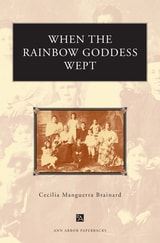
When the Rainbow Goddess Wept
Cecilia Manguerra Brainard
University of Michigan Press, 1999
Set against the backdrop of the Japanese invasion of the Philippines in 1941, Cecilia Manguerra Brainard's brilliant novel weaves myth and legend together with the suffering and tragedies of the Filipino people. When nine-year-old Yvonne flees with her family into the jungle to join the resistance effort, she witnesses death and destruction on an almost unimaginable scale.
In the face of terror and despair, she finds comfort in the stories her people have passed down over generations. In particular, the legends of Bongkatolan, the Woman Warrior, and the merciful rainbow goddess offer her strength and hope. Yvonne becomes determined to preserve these ancient legends and to give voice to the epic she herself is living.
When the Rainbow Goddess Wept is an exploration of the collective wounding of the Filipino people and their heroic response. It shows us the Philippines through an insider's eyes and brings to American audiences an unusual reading experience about a world that is utterly foreign and a child who is touchingly universal.
[more]
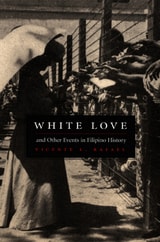
White Love and Other Events in Filipino History
Vicente L. Rafael
Duke University Press, 2000
In this wide-ranging cultural and political history of Filipinos and the Philippines, Vicente L. Rafael examines the period from the onset of U.S. colonialism in 1898 to the emergence of a Filipino diaspora in the 1990s. Self-consciously adopting the essay form as a method with which to disrupt epic conceptions of Filipino history, Rafael treats in a condensed and concise manner clusters of historical detail and reflections that do not easily fit into a larger whole. White Love and Other Events in Filipino History is thus a view of nationalism as an unstable production, as Rafael reveals how, under what circumstances, and with what effects the concept of the nation has been produced and deployed in the Philippines.
With a focus on the contradictions and ironies that suffuse Filipino history, Rafael delineates the multiple ways that colonialism has both inhabited and enabled the nationalist discourse of the present. His topics range from the colonial census of 1903-1905, in which a racialized imperial order imposed by the United States came into contact with an emergent revolutionary nationalism, to the pleasures and anxieties of nationalist identification as evinced in the rise of the Marcos regime. Other essays examine aspects of colonial domesticity through the writings of white women during the first decade of U.S. rule; the uses of photography in ethnology, war, and portraiture; the circulation of rumor during the Japanese occupation of Manila; the reproduction of a hierarchy of languages in popular culture; and the spectral presence of diasporic Filipino communities within the nation-state. A critique of both U.S. imperialism and Filipino nationalism, White Love and Other Events in Filipino History creates a sense of epistemological vertigo in the face of former attempts to comprehend and master Filipino identity.
This volume should become a valuable work for those interested in Southeast Asian studies, Asian-American studies, postcolonial studies, and cultural studies.
[more]