Results by title
68 books match the query 'Philosophical anthropology' and 3 start with w
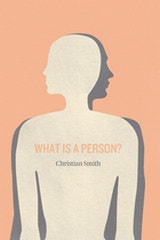
What Is a Person?
Rethinking Humanity, Social Life, and the Moral Good from the Person UpChristian Smith
University of Chicago Press, 2010
What is a person? This fundamental question is a perennial concern of philosophers and theologians. But, Christian Smith here argues, it also lies at the center of the social scientist’s quest to interpret and explain social life. In this ambitious book, Smith presents a new model for social theory that does justice to the best of our humanistic visions of people, life, and society.
Finding much current thinking on personhood to be confusing or misleading, Smith finds inspiration in critical realism and personalism. Drawing on these ideas, he constructs a theory of personhood that forges a middle path between the extremes of positivist science and relativism. Smith then builds on the work of Pierre Bourdieu, Anthony Giddens, and William Sewell to demonstrate the importance of personhood to our understanding of social structures. From there he broadens his scope to consider how we can know what is good in personal and social life and what sociology can tell us about human rights and dignity.
Innovative, critical, and constructive, What Is a Person? offers an inspiring vision of a social science committed to pursuing causal explanations, interpretive understanding, and general knowledge in the service of truth and the moral good.
World
An Anthropological ExaminationJoão de Pina-Cabral
HAU, 2016
Writing the Poetic Soul of Philosophy
Essays in Honor of Michael DavisDenise Schaeffer
St. Augustine's Press, 2017
What is it about the nature of “soul” that makes it so difficult to adequately capture its complexity in a strictly discursive account? Why do some of the most profound human experiences elude our attempts to theorize them? How can a written document do justice to the dynamic activity of thinking, as opposed to merely presenting a collection of thoughts-as-artifacts? Finally, what can we learn about the activity of philosophizing, and about the human soul, by reflecting on the possibilities and limitations of writing?
These concerns, in various forms and in different registers, have preoccupied Michael Davis throughout his distinguished career. This volume is in honor of, and in dialogue with, Davis’s work, which spans ancient philosophy and literature, continental philosophy and political philosophy. It includes original essays by numerous distinguished scholars in the fields of philosophy and political science. The remarkable range and caliber of the contributions attest to the breadth and depth of Davis’s influence.
The essays in Part I of the volume explore the nature of soul through the lens of tragedy. Part II consists of three essays that explore the human longing for perfect knowledge and completion—and the obstacles to the fulfilment of that longing—in relation to the divine. In Part III, the essays address the distinctive challenges of the political sphere and philosophy’s relation to it. And while the relationship between philosophy and poetry is an implicit theme throughout the volume, the essays in Part IV focus directly on philosophy’s aestheticizing tendencies. Many different philosophical and literary works are discussed throughout these chapters, including ancient works such as Plato’s Republic, Euthydemus and Laws, Homer’s Iliad, and Euripides’ Trojan Women, as well as works by modern philosophers such as Rousseau, Kant, Hegel, Kierkegaard and Nietzsche. In addition, three essays analyze some of Shakespeare’s plays in relation to the thought of Plato and Machiavelli. All of the essays are thematically linked by a common thread as they attend to the poetic dimension of philosophical thinking.
Michael Davis is Professor of Philosophy at Sarah Lawrence College, where he has taught since 1977 and has been the Sarah Yates Exley Chair in Teaching Excellence (2003-2005). He has also taught on the graduate faculty at Fordham University and the New School for Social Research. He is the author of numerous articles and books, which include: Ancient Tragedy and the Origins of Modern Science; The Poetry of Philosophy: On Aristotle’s Poetics; The Politics of Philosophy: A Commentary on Aristotle’s Politics; The Autobiography of Philosophy; Rousseau’s The Reveries of the Solitary Walker; Wonderlust: Ruminations on Liberal Education; and The Soul of the Greeks: An Inquiry. He is also co-translator (with Seth Benardete) of Aristotle’s On Poetics.
Contributors include: Abraham Anderson, Jonathan Badger, Robert Berman, Ronna Burger, Kenneth DeLuca, Gwenda-lin Grewal, Scott Hemmenway, Paul Kirkland, Mary Nichols, Denise Schaeffer, Paul Stern, Richard Velkley, Lisa Pace Vetter, Ann Ward, Lee Ward, Catherine Zuckert and Michael Zuckert.
About the Editor: Denise Schaeffer is Professor of Political Science at the College of the Holy Cross. She is the author of Rousseau on Education, Freedom and Judgment and contributing co-editor (with Christopher Dustin) of Socratic Philosophy and Its Others. She is co-editor (with Gregory McBrayer and Mary P. Nichols) of the Focus Philosophical Library edition of Plato’s Euthydemus, for which she authored the Introduction and co-authored the Interpretive Essay.