Results by title
210 books match the query 'Philosophy, Theory & Social Aspects' and 4 start with w

What Does It Mean to Be Human?
Elizabeth Minnich
Temple University Press, 2027
What does it mean to be human? It has long been a tantalizing question for religious figures, scientists, political leaders, artists, and autocrats, among others. Noted philosopher Elizabeth Minnich claims, “There are no answers to such a question (although we all have favored responses).”
In What Does It Mean to Be Human?, Minnich invites us to reclaim our freedom from the dangerously distorted rationales for supremacism. She explores how the simplest mistakes in responses to “what does it mean to be human?” have enabled deadly historical errors, totalizing regimes, colonialisms, genocides, and enslavement. Paying close attention to the languages, logics, and nonsense of authoritative pronouncements, Minnich considers ways of thinking that affect and reflect meaning. She offers a fresh understanding of how mistakenly limited definitions of “human being” can be.
What Does It Mean to Be Human? emerges from Minnich’s ongoing effort to find, think through, and dissolve past mistakes that keep resurfacing to disastrous effect.
What Is Education?
Philip W. Jackson
University of Chicago Press, 2011
What Would It Take to Make an Ed School Great?
Voices from an Unfinished RevolutionJohn Schwille
Michigan State University Press, 2023
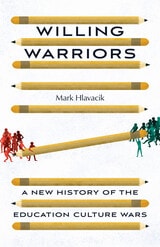
Willing Warriors
A New History of the Education Culture WarsMark Hlavacik
University of Chicago Press, 2025
On August 9, 2022, the Denton Independent School District held a meeting to address complaints about its libraries. Like so many districts in Texas and across the country, Denton had been responding to accusations that children had access to inappropriate books at school. During the public comment session, a local man stood up to the podium and read a sexually explicit passage from a book that he wanted removed from Denton’s school libraries. But beguiled by the prospect of securing a political win, he had confused the title of the lurid psychological thriller he read aloud with a young adult fiction series about mermaids. While his attempt to ban a book that was never in Denton’s school libraries in the first place received a few laughs, it also reflects a deeply serious and troubling culture of conflict that has taken over the politics of education and now divides people so completely as to make public education as a shared endeavor seem impossible.
In Willing Warriors, Mark Hlavacik shows how the culture wars have redefined the politics of US schooling from the 1970s to the present through vivid accounts of public controversies featuring Allan Bloom, Oprah Winfrey, Lynne Cheney, Rush Limbaugh, Betsy DeVos, Nikole Hannah-Jones, and others. Beginning in the 1970s, Hlavacik shows, efforts at innovation in schooling have increasingly been met by attempts to discredit them through exposé. As the culture wars have accelerated and exploded, this cycle of innovation and exposé has embroiled public schools in increasingly heated debates. He explains the dynamics that make curriculum controversies so intractable and confronts the delicate question of whether raucous public arguments are bad for education.
With clarity and insight, Hlavacik reveals why bitter contests between educational ideologies not only add another burden for the schools, but also for the people—the willing warriors—who devote their lives to fighting for their betterment.