Results by title
426 books match the query 'Philosophy & Social Aspects' and 5 start with w
What Is Biodiversity?
James Maclaurin and Kim Sterelny
University of Chicago Press, 2008
In the life sciences, there is wide-ranging debate about biodiversity. While nearly everyone is in favor of biodiversity and its conservation, methods for its assessment vary enormously. So what exactly is biodiversity? Most theoretical work on the subject assumes it has something to do with species richness—with the number of species in a particular region—but in reality, it is much more than that. Arguing that we cannot make rational decisions about what it is to be protected without knowing what biodiversity is, James Maclaurin and Kim Sterelny offer in What Is Biodiversity? a theoretical and conceptual exploration of the biological world and how diversity is valued.
Here, Maclaurin and Sterelny explore not only the origins of the concept of biodiversity, but also how that concept has been shaped by ecology and more recently by conservation biology. They explain the different types of biodiversity important in evolutionary theory, developmental biology, ecology, morphology and taxonomy and conclude that biological heritage is rich in not just one biodiversity but many. Maclaurin and Sterelny also explore the case for the conservation of these biodiversities using option value theory, a tool borrowed from economics.
An erudite, provocative, timely, and creative attempt to answer a fundamental question, What Is Biodiversity? will become a foundational text in the life sciences and studies thereof.
[more]
When Maps Become the World
Rasmus Grønfeldt Winther
University of Chicago Press, 2020
Map making and, ultimately, map thinking is ubiquitous across literature, cosmology, mathematics, psychology, and genetics. We partition, summarize, organize, and clarify our world via spatialized representations. Our maps and, more generally, our representations seduce and persuade; they build and destroy. They are the ultimate record of empires and of our evolving comprehension of our world.
This book is about the promises and perils of map thinking. Maps are purpose-driven abstractions, discarding detail to highlight only particular features of a territory. By preserving certain features at the expense of others, they can be used to reinforce a privileged position.
When Maps Become the World shows us how the scientific theories, models, and concepts we use to intervene in the world function as maps, and explores the consequences of this, both good and bad. We increasingly understand the world around us in terms of models, to the extent that we often take the models for reality. Winther explains how in time, our historical representations in science, in cartography, and in our stories about ourselves replace individual memories and become dominant social narratives—they become reality, and they can remake the world.
[more]
When Physics Became King
Iwan Rhys Morus
University of Chicago Press, 2005
As recently as two hundred years ago, physics as we know it today did not exist. Born in the early nineteenth century during the second scientific revolution, physics struggled at first to achieve legitimacy in the scientific community and culture at large. In fact, the term "physicist" did not appear in English until the 1830s.
When Physics Became King traces the emergence of this revolutionary science, demonstrating how a discipline that barely existed in 1800 came to be regarded a century later as the ultimate key to unlocking nature's secrets. A cultural history designed to provide a big-picture view, the book ably ties advances in the field to the efforts of physicists who worked to win social acceptance for their research.
Beginning his tale with the rise of physics from natural philosophy, Iwan Morus chronicles the emergence of mathematical physics in France and its later export to England and Germany. He then elucidates the links between physics and industrialism, the technology of statistical mechanics, and the establishment of astronomical laboratories and precision measurement tools. His tale ends on the eve of the First World War, when physics had firmly established itself in both science and society.
Scholars of both history and physics will enjoy this fascinating and studied look at the emergence of a major scientific discipline.
[more]
Why Study Biology by the Sea?
Edited by Karl S. Matlin, Jane Maienschein, and Rachel A. Ankeny
University of Chicago Press, 2020
For almost a century and a half, biologists have gone to the seashore to study life. The oceans contain rich biodiversity, and organisms at the intersection of sea and shore provide a plentiful sampling for research into a variety of questions at the laboratory bench: How does life develop and how does it function? How are organisms that look different related, and what role does the environment play?
From the Stazione Zoologica in Naples to the Marine Biological Laboratory in Woods Hole, the Amoy Station in China, or the Misaki Station in Japan, students and researchers at seaside research stations have long visited the ocean to investigate life at all stages of development and to convene discussions of biological discoveries. Exploring the history and current reasons for study by the sea, this book examines key people, institutions, research projects, organisms selected for study, and competing theories and interpretations of discoveries, and it considers different ways of understanding research, such as through research repertoires. A celebration of coastal marine research, Why Study Biology by the Sea? reveals why scientists have moved from the beach to the lab bench and back.
From the Stazione Zoologica in Naples to the Marine Biological Laboratory in Woods Hole, the Amoy Station in China, or the Misaki Station in Japan, students and researchers at seaside research stations have long visited the ocean to investigate life at all stages of development and to convene discussions of biological discoveries. Exploring the history and current reasons for study by the sea, this book examines key people, institutions, research projects, organisms selected for study, and competing theories and interpretations of discoveries, and it considers different ways of understanding research, such as through research repertoires. A celebration of coastal marine research, Why Study Biology by the Sea? reveals why scientists have moved from the beach to the lab bench and back.
[more]
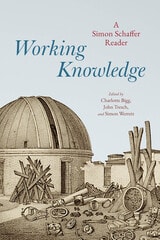
Working Knowledge
A Simon Schaffer ReaderSimon Schaffer
University of Chicago Press, 2026
Collects key articles by Simon Schaffer, one of the most important historians of science working today.
Working Knowledge is the first English-language collection of essays by Simon Schaffer, coauthor of Leviathan and the Air-Pump, a landmark text in the history of science. Though the latter may be his most famous book, Schaffer is also renowned for seminal articles on Isaac Newton and the cultures of popular spectacle, nineteenth-century physics and its practices of labor discipline and standardization, the history of anthropology and collecting, and the globe-spanning cultural interactions that have shaped modern science. Working Knowledge compiles these well-known pieces alongside newer selections, making them accessible in a single place and representing the huge scope and impact of Schaffer’s oeuvre.
The Reader divides sixteen of Schaffer’s articles across five thematic sections, which take up timely issues like the turn toward global histories of science; the intersection of science and capitalism; the interaction between bodies and machines; and the connection between science, politics, and the environment. Eight new essays by notable historians such as Adrian Johns, Lissa Roberts, and Steven Shapin bring Schaffer’s pieces into discussion with current scholarship. Illustrations and brief commentaries by Schaffer and the artist Adam Lowe, a longtime collaborator, are included throughout the volume.
Bringing together essential articles that were previously scattered across several publications, Working Knowledge is an insightful introduction to Schaffer and his ever-relevant writing.
[more]