Results by title
59 books match the query 'Philosophy and aesthetics' and 2 start with w
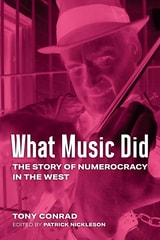
What Music Did
The Story of Numerocracy in the WestTony Conrad. Edited by Patrick Nickleson
University of Michigan Press, 2026
In What Music Did, experimental filmmaker and violinist Tony Conrad explores in depth the relationship between music and mathematics. A work of decades that was left unfinished at the time of his death in 2016, Conrad’s expansive history of the interrelationship of music and mathematics is published here for the first time. Editor Patrick Nickleson describes Conrad’s method as that of an anarchic, interarts haberdasher; much of the research comes from musty and out-of-print sources, giving the impression that Conrad followed paths opened up for him in used book shops and conversations, rather than seeking a direct scholarly argument.
Throughout the book, readers encounter scenes from over two thousand years of history, mathematics, and music: Pythagoras using pebbles to articulate didactic number games to his disciples; Galileo fretting a hill and listening with a musician’s ear to calculate the rate of acceleration under gravity; Rameau trapping Western music in a five-limit tuning system, and what could have been if he were more adept with numbers. Even when drawing on classical sources to explore canonical figures like Saint Augustine, What Music Did offers idiosyncratic critical insights that highlight our ongoing cultural reverence when answers result in simple whole number ratios like 3:2, 4:3, or 5:4. What Music Did is Tony Conrad’s extended indictment of music’s role, from the Pythagoreans to the twentieth century, in upholding the use of number as a clandestine and circumscribed armature of power.
Throughout the book, readers encounter scenes from over two thousand years of history, mathematics, and music: Pythagoras using pebbles to articulate didactic number games to his disciples; Galileo fretting a hill and listening with a musician’s ear to calculate the rate of acceleration under gravity; Rameau trapping Western music in a five-limit tuning system, and what could have been if he were more adept with numbers. Even when drawing on classical sources to explore canonical figures like Saint Augustine, What Music Did offers idiosyncratic critical insights that highlight our ongoing cultural reverence when answers result in simple whole number ratios like 3:2, 4:3, or 5:4. What Music Did is Tony Conrad’s extended indictment of music’s role, from the Pythagoreans to the twentieth century, in upholding the use of number as a clandestine and circumscribed armature of power.
[more]
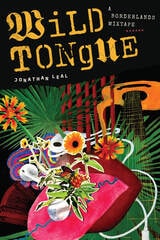
Wild Tongue
A Borderlands MixtapeJonathan Leal
Duke University Press, 2026
In Wild Tongue, writer, scholar, and musician Jonathan Leal invites readers to the Texas borderlands to witness contemporary sonic cultures and expressive forms of Latine struggle and world-making. Blending autoethnography, music criticism, and border theory into an epistolary mixtape, Leal depicts the borderlands as a generative place made by its inhabitants, a geography where creativity and cultural performance engage powerfully with politico-aesthetic issues, create communal identity, and challenge xenophobic and nationalist dominance. Across the mixtape’s contrasting “tracks,” Leal situates living artistries within longer, local arcs of borderlands creativity, amplifying Gloria Anzaldúa’s durable, pathbreaking observation, “Wild tongues can’t be tamed, they can only be cut out.” Combining lyric nonfiction, artist interviews, archival research, transdisciplinary analysis, and popular music criticism and production, Wild Tongue presents an exhilarating, embracing account of freedoms pursued between worlds.
[more]