Results by title
230 books match the query 'Physics' and 3 start with w
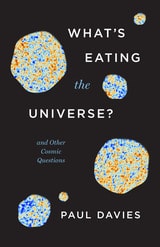
What's Eating the Universe?
And Other Cosmic QuestionsPaul Davies
University of Chicago Press, 2021
Combining the latest scientific advances with storytelling skills unmatched in the cosmos, an award-winning astrophysicist and popular writer leads us on a tour of some of the greatest mysteries of our universe.
In the constellation of Eridanus, there lurks a cosmic mystery: It’s as if something has taken a huge bite out of the universe. But what is the culprit? The hole in the universe is just one of many puzzles keeping cosmologists busy. Supermassive black holes, bubbles of nothingness gobbling up space, monster universes swallowing others—these and many other bizarre ideas are being pursued by scientists. Due to breathtaking progress in astronomy, the history of our universe is now better understood than the history of our own planet. But these advances have uncovered some startling riddles. In this electrifying new book, renowned cosmologist and author Paul Davies lucidly explains what we know about the cosmos and its enigmas, exploring the tantalizing—and sometimes terrifying—possibilities that lie before us.
As Davies guides us through the audacious research offering mind-bending solutions to these and other mysteries, he leads us up to the greatest outstanding conundrum of all: Why does the universe even exist in the first place? And how did a system of mindless, purposeless particles manage to bring forth conscious, thinking beings? Filled with wit and wonder, What’s Eating the Universe? is a dazzling tour of cosmic questions, sure to entertain, enchant, and inspire us all.
[more]
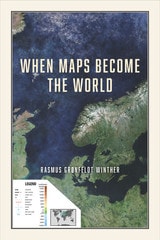
When Maps Become the World
Rasmus Grønfeldt Winther
University of Chicago Press, 2020
Map making and, ultimately, map thinking is ubiquitous across literature, cosmology, mathematics, psychology, and genetics. We partition, summarize, organize, and clarify our world via spatialized representations. Our maps and, more generally, our representations seduce and persuade; they build and destroy. They are the ultimate record of empires and of our evolving comprehension of our world.
This book is about the promises and perils of map thinking. Maps are purpose-driven abstractions, discarding detail to highlight only particular features of a territory. By preserving certain features at the expense of others, they can be used to reinforce a privileged position.
When Maps Become the World shows us how the scientific theories, models, and concepts we use to intervene in the world function as maps, and explores the consequences of this, both good and bad. We increasingly understand the world around us in terms of models, to the extent that we often take the models for reality. Winther explains how in time, our historical representations in science, in cartography, and in our stories about ourselves replace individual memories and become dominant social narratives—they become reality, and they can remake the world.
[more]
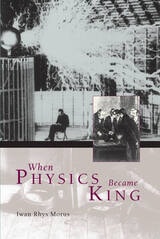
When Physics Became King
Iwan Rhys Morus
University of Chicago Press, 2005
As recently as two hundred years ago, physics as we know it today did not exist. Born in the early nineteenth century during the second scientific revolution, physics struggled at first to achieve legitimacy in the scientific community and culture at large. In fact, the term "physicist" did not appear in English until the 1830s.
When Physics Became King traces the emergence of this revolutionary science, demonstrating how a discipline that barely existed in 1800 came to be regarded a century later as the ultimate key to unlocking nature's secrets. A cultural history designed to provide a big-picture view, the book ably ties advances in the field to the efforts of physicists who worked to win social acceptance for their research.
Beginning his tale with the rise of physics from natural philosophy, Iwan Morus chronicles the emergence of mathematical physics in France and its later export to England and Germany. He then elucidates the links between physics and industrialism, the technology of statistical mechanics, and the establishment of astronomical laboratories and precision measurement tools. His tale ends on the eve of the First World War, when physics had firmly established itself in both science and society.
Scholars of both history and physics will enjoy this fascinating and studied look at the emergence of a major scientific discipline.
[more]