Results by title
413 books match the query 'Pictorial works' and 12 start with w

Wake Up, This Is Joburg
Words by Tanya Zack, Photographs by Mark Lewis
Duke University Press, 2022

Was This Heaven?
A Self-Portrait of Iowa on Early PostcardsLyell D. Jr. Henry
University of Iowa Press, 1995
In the early decades of the twentieth century, Iowans all across the Hawkeye State succumbed to the nationwide craze for exchanging photographic postcards, mailing each other thousands of images—serious and whimsical—of Uncle Bob and Baby Dora, the Sunday school outing, train wrecks, the Fourth of July celebration, the merchants' carnival, the record-setting blizzard following the bin-busting harvest, the new courthouse, Ackley's Sauer-Kraut Band. Now, thanks to the generosity of David A. Wilson, whose ample collection of photographic cards would be the envy of those early Iowans, Lyell Henry has organized more than two hundred postcards into eight reflective chapters that create a beguiling collective portrait of Iowa life and culture from 1905 to 1919.

We Shall Overcome
Press Photographs of Nashville during the Civil Rights EraKathryn E. Delmez
Vanderbilt University Press, 2023
Fifty years after Martin Luther King Jr.'s death—and at a time when race relations and social justice are again at the forefront of our country's consciousness—this book expands on a Frist Art Museum exhibition to present a selection of approximately one hundred photographs that document an important period in Nashville's struggle for racial equality. The images were taken between 1957, the year that desegregation in public schools began, and 1968, when the National Guard was called in to surround the state capitol in the wake of the civil rights leader's assassination in Memphis.
Of central significance are photographs of lunch counter sit-ins in early 1960, led by a group of students, including John Lewis (who contributed the book's foreword) and Diane Nash, from local historically black colleges and universities. The demonstrations were so successful that King stated just a few weeks later at Fisk University: "I did not come to Nashville to bring inspiration but to gain inspiration from the great movement that has taken place in this community." The role that Nashville played in the national civil rights movement as a hub for training students in nonviolent protest and as the first Southern city to integrate places of business is a story that warrants reexamination.
The book also provides an opportunity to consider the role of images and the media in shaping public opinion, a relevant subject in today's news-saturated climate. Photographs from the archives of both daily newspapers are included: the Tennessean, which was the more liberal publication, and the Nashville Banner, a conservative paper whose leadership seemed less interested in covering events related to racial issues. Some of the photographs in the exhibition had been selected to be published in the papers, but many were not, and their disclosure reveals insight into the editorial process. In several images, other photojournalists and news crews are visible, serving as a reminder of the almost constant presence of the camera during these historic times.
Essays by Linda Wynn of Fisk University and the Tennessee Historical Commission and Susan H. Edwards, executive director of the Frist Art Museum, offer historical context on Nashville during the civil rights era and on photojournalism, respectively. Congressman John Lewis's foreword recounts memories of his time in Nashville and reminds us that there is still work to be done to build King's Beloved Community.

Whiskey Tango Foxtrot
A Photographer's Chronicle of the Iraq WarAshley Gilbertson
University of Chicago Press, 2007
Whiskey Tango Foxtrot gathers the best of Gilbertson’s photographs, chronicling America’s early battles in Iraq, the initial occupation of Baghdad, the insurgency that erupted shortly afterward, the dramatic battle to overtake Falluja, and ultimately, the country’s first national elections. No Western photojournalist has done as much sustained work in occupied Iraq as Gilbertson, and this wide-ranging treatment of the war from the viewpoint of a photographer is the first of its kind. Accompanying each section of the book is a personal account of Gilbertson’s experiences covering the conflict. Throughout, he conveys the exhilaration and terror of photographing war, as well as the challenges of photojournalism in our age of embedded reporting. But ultimately, and just as importantly, Whiskey Tango Foxtrot tells the story of Gilbertson’s own journey from hard-drinking bravado to the grave realism of a scarred survivor. Here he struggles with guilt over the death of a marine escort, tells candidly of his own experience with post-traumatic stress, and grapples with the reality that Iraq—despite the sacrifice in Iraqi and American lives—has descended into a civil war with no end in sight.
A searing account of the American experience in Iraq, Whiskey Tango Foxtrot is sure to become one of the classic war photography books of our time.

Wild Orchids of Texas
By Joe Liggio and Ann Orto Liggio
University of Texas Press, 1999
Best of Show Award, Society for Technical Communication International
From the East Texas swamps and forests to the Edwards Plateau canyons and the Trans-Pecos mountains, Texas hosts a surprising number of native orchids. Their exquisite beauty endears them to everyone from wildflower lovers to professional botanists and conservationists.
This beautifully illustrated book presents all 54 wild orchids of Texas. The species descriptions that accompany Joe Liggio's lovely color photos discuss the plant's flowers, blooming season, pollinators, typical habitats, and range (also shown by map), including its distribution within and beyond Texas. The species are grouped by genus and also listed by color, county, and habitat for easy reference.
In addition to the species accounts, the authors offer a general natural history of Texas orchids that discusses such topics as pollination and reproduction, special growing requirements, and threats to orchids from loss of habitats and careless collecting. They also describe the many orchid habitats in Texas and the species that grow in each. This wide variety of information, which has never before been collected in one volume for a general readership, makes this book the essential guide to Texas' wild orchids.

Wildflowers and Other Plants of Texas Beaches and Islands
By Alfred Richardson
University of Texas Press, 2002
Winner, Carroll Abbott Memorial Award, Native Plant Society of Texas, 2002
Many visitors to Texas beaches see only the sands between the surf and the first low dunes. Because few plants grow there, it's easy to get the impression that Texas beaches consist mostly of barren sand—while just the opposite is true. Beyond the dunes grow an amazing variety and abundance of native plants. Many of them, like Indian Blanket, Goldenrod, and Seaside Gerardia, produce great splashes of flowering color. Others display more modest flowers or are interesting for their growing habits. In all, over seven hundred species of flowering plants grow on Texas beaches and islands.
This handy field guide will aid you in identifying some 275 common and/or noteworthy flowering plants of the Texas beaches and islands from the Rio Grande to the Louisiana border. Each plant is illustrated by a color photograph, accompanied by a description of its appearance, habitat, and blooming time. The plants are grouped by families, which in turn are arranged according to relationships and similarities for easy reference. An introduction to beach habitats and plant life, references for further reading, and a glossary of terms make this book fully useful for everyone who wants a good, general understanding of beach plant life and wildflowers.

Wildflowers of Unalaska Island
A Guide to the Flowering Plants of an Aleutian Island, Second EditionSuzi Golodoff
University of Alaska Press, 2013
Each species is introduced and clearly defined and is accompanied by a photograph and line drawings. Many of these plants occur across a wide range of coastal Alaska; others are unique to the Aleutians. The introduction includes background on the unique geologic history, climate, and habitats of the archipelago to fully round out the user’s appreciation of the dramatic environment in which these hardy plants thrive.

Wildflowers of the Mountain West
Richard M. Anderson, Jay Dee Gunnell, Jerry L. Goodspeed
Utah State University Press, 2012
Many recreational hikers have stopped along the trail to admire a wildflower only to wonder what, exactly, they are looking at. Wildflowers of the Mountain West is a useful field guide that makes flower identification easy for the general outdoor enthusiast.
Many available plant guides are too technical or cumbersome for non-specialists to embrace. Covering New Mexico, Colorado, Wyoming, Idaho, Utah, Nevada and Oregon, this book is perfect for the enthusiasts who has little botanical knowledge but would like to know more about the wildflowers they are seeing. Organized by flower color for easy reference, plant records include the common and scientific names, a description of typical characteristics, habitat information and distribution maps, look-alike species, color photographs, and informative commentary. In addition, the book provides a useful introduction to the Mountain West region, along with line drawings to illustrate basic flower parts, shapes, and arrangements; a glossary of common botanical terms; a quick search key; and an index.
The book is spiral-bound, making it easy to bring along while hiking, backpacking, or biking, and stunning full color photographs make visual confirmation of flower type simple and straightforward.

Wisconsin’s Own
Twenty Remarkable HomesM. Caren Connolly
Wisconsin Historical Society Press, 2010
Take an intimate journey through the family, history, and architecture of 20 residential treasures in Wisconsin’s Own by M. Caren Connolly and Louis Wasserman. Richly illustrated with the photography of Zane Williams and complemented by historical images and watercolors and line drawings, Wisconsin’s Own profiles the architectural history of state’s most remarkable residences built between 1854 and 1939. The houses are a mix of public and private homes that are representative of varied architectural styles, from an Italianate along the Mississippi River and an interpretation of a sixteenth-century northern Italian villa overlooking Lake Michigan to an Adirondack-style camp in the North Woods and a fourteen-bedroom Georgian Revival mansion on Lake Geneva. Frank Lloyd Wright’s Prairie School is, of course, represented as well with examples by Wright and his mentor Louis Sullivan.
Wisconsin’s Own tells the story of the considerable contribution that each of these historic homes have made to American residential architecture. It also answers the questions who built the house, what brought them to Wisconsin, why they selected that particular style, and how it is that this historic home still stands—and shines—today.

Woody Plants of Utah
A Field Guide with Identification Keys to Native and Naturalized Trees, Shrubs, Cacti, and VinesRenée Van Buren, Janet G. Cooper, Leila M. Shultz, and Kimball T. Harper
Utah State University Press, 2011
A comprehensive guide that includes a vast range of species and plant communities and employs thorough, original keys. Based primarily on vegetative characteristics, the keys don't require that flowers or other reproductive features be present, like many plant guides. And this guide's attention to woody plants as a whole allows one to identify a much greater variety of plants. That especially suits an arid region such as Utah with less diverse native trees. Woody plants are those that have stems that persist above ground even through seasons that don't favor growth, due to low precipitation or temperatures.
Woody Plants of Utah employs dichotomous identification keys that are comparable to a game of twenty questions. They work through a process of elimination by choosing sequential alternatives.
Detailed, illustrated plant descriptions complement the keys and provide additional botanical and environmental information in relation to a useful introductory categorization of Utah plant communities. Supplementary tools include photos, distribution maps, and an illustrated glossary.

Woven from the Center
Native Basketry in the SouthwestDiane D. Dittemore
University of Arizona Press, 2024
Woven from the Center presents breathtaking basketry from some of the greatest weavers in the Southwest. Each sandal and mat fragment, each bowl and jar, every water bottle and whimsy is infused with layers of aesthetic, cultural, and historical meanings. This book offers stunning photos and descriptions of woven works from Tohono O’odham, Akimel O’odham, Hopi, Western Apache, Yavapai, Navajo, Pai, Paiute, New Mexico Pueblo, Eastern Apache, Seri, Yaqui, Mayo, and Tarahumara communities.
This richly illustrated volume stands on its own as a definitive look at basketry of the Greater Southwest, including northern Mexico. It also serves as a companion to the peerless collection of U.S. Southwest and Northwest Mexican Native American basketry curated at the Arizona State Museum in Tucson, Arizona. Comprehensive in its coverage, this work is based on decades of research on weavers, collectors, and donors. It includes ample illustrations of basket weavers, past and present, bringing to life the people behind these wonderful woven treasures.
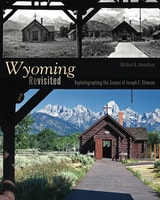
Wyoming Revisited
Rephotographing the Scenes of Joseph E. StimsonMichael A. Amundson
University Press of Colorado, 2014
The 117 locations feature street views of Wyoming towns and cities, as well as views from the state's famous natural landmarks like Yellowstone National Park, Grand Teton National Park, Devil's Tower National Monument, Hot Springs State Park, and Big Horn and Shoshone National Forests. In addition, Amundson provides six in-depth essays that explore the life of Joseph E. Stimson, the rephotographic process and how it has evolved, and how repeat photography can be used to understand history, landscape, historic preservation, and globalization.
Wyoming Revisited highlights the historic evolution of the American West over the past century and showcases the significant changes that have occurred over the past twenty-five years. This book will appeal to photographers, historians of the American West, and anyone interested in Wyoming's history or landscape.
The publication of this book is supported in part by the Wyoming Cultural Trust Fund.