Results by title
557 books match the query 'Poems' and 25 start with w

WORKS OF APHRA BEHN
VOLUME I, POEMSAphra Behn
The Ohio State University Press, 1992
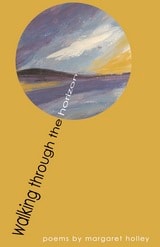
Walking Through the Horizon
PoemsMargaret Holley
University of Arkansas Press, 2006
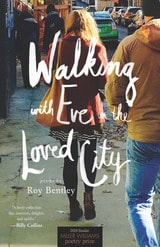
Walking with Eve in the Loved City
PoemsRoy Bentley
University of Arkansas Press, 2018
Finalist, 2018 Miller Williams Poetry Prize
Walking with Eve in the Loved City is an ambitious collection. Using a variety of male figures—Jeff Goldblum, Ringo Starr, the poet’s uncle Billy, to name a few—these poems skillfully interrogate masculinity and its cultural artifacts, searching for a way to reconcile reverence for the father figure with a crisis of faith about the world as run by men. And yet, despite the gravity of the subjects these poems engage, this is a hopeful, frequently funny book that encourages the reader to look deeply at the world, and then to laugh if she can.
Roy Bentley often accomplishes this work through a careful balancing of honesty and misdirection, as when in the poem “Can’t Help Falling in Love” the real drama of the narrative—the appearance of an affair between the speaker’s father and a drive-in restaurant carhop—operates as a backdrop for the eight-year-old speaker’s puerile attraction to the woman; or when the vampire Nosferatu (a frequent figure in the poems) materializes in a trailer park, his immortality becoming a lens through which to process the speaker’s righteous anger about wealth and poverty.
God too features prominently—as does doubt. Drawing from the vernacular of his childhood, Bentley accesses the simultaneous austerity and lyrical opulence of the King James Bible to invent stories in which the last note struck is often a call to pay kinder attention. More than anything, these poems serve as humanistic advocates, using the power of narrative—film, interview, imagination, memoir—to highlight how people matter.
Walking with Eve in the Loved City invites the reader to join in this watching and witnessing, to take part in renewing how we see.

Walt Whitman Bathing
POEMSDavid Wagoner
University of Illinois Press, 1996
"When Wagoner looks at something, he brings it to vivid and immediate life through an extraordinary power with a simple name: love. He is as formally various as Thomas Hardy, as playful as Dickinson, as wry as Frost." -- Dave Smith
"A sharp-eyed, even gutsy nature poet, the deftest and tenderest of love poets, Wagoner is a verbal magician capable of surprising, sometimes crazy tours de force."-- X. J. Kennedy
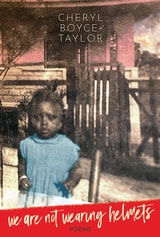
We Are Not Wearing Helmets
PoemsCheryl Boyce-Taylor
Northwestern University Press, 2022
Born in Trinidad and having grown up in Queens, Boyce‑Taylor creates a framework for her own experience out of the life experiences and work of beloved Black women in history. She salutes the women who have lifted her, including Audre Lorde, Fannie Lou Hamer, Ntozake Shange, and Winnie Mandela, as well as her mother, Eugenia Boyce, and her beloved daughter‑in‑law, Deisha Head Taylor.
The poems in this collection are unapologetic, fierce, and confrontational while remaining caring and intimate. They stand strong in the face of adversity and boldly demand what is owed while still honoring and cherishing what is loved.
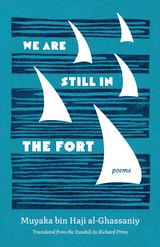
We Are Still in the Fort
PoemsMuyaka bin Haji al-Ghassaniy; Translated from the Swahili by Richard Prins
Vanderbilt University Press, 2026
We Are Still in the Fort is a curated selection of about seventy poems by Muyaka bin Haji al-Ghassaniy, divided into three sections spanning the quotidian, the amorous, and the political. The first part, “‘I Swipe Their String of Fish’: Poems of Mombasan Society,” features his often satirical commentary on daily life in Mombasa. The second part, “‘Take Your Misery With You’: Poems of Love and Marriage,” focuses on his psychologically sensitive observations on the volatility of love, marriage, and illicit affairs. The last part, “‘We Are Still in the Fort’: Poems of War and State,” includes epigrammatic critiques of local political leaders and a series of anti-imperialist poems defending Mombasa’s independence against the invading Omani Empire. The volume also features contextual materials on Muyaka and the context of Swahili poetry, a translator’s note, and introductions for each of the three sections.
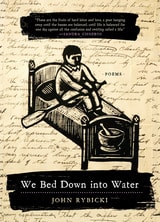
We Bed Down into Water
PoemsJohn Rybicki
Northwestern University Press, 2008
John Rybicki offers up an unafraid set of poems in this charged book of verse. We Bed Down Into Water is rich with imagery of family, love, illness, death, and, indeed, water, which seeps in throughout the pages: rivers, pools, rain, and tears. His moving stories, in both prose and verse, struggle to hang on to a vision of the world that can still allow benevolence, luck, and laughter. In this, the collection embodies a contradiction: it is a tender book of fury, a book of bleak hopefulness.
Rybicki’s work is steeped in challenge: the biological and spiritual challenge posed by his beloved’s recurrent cancer or the daily challenges of an adopted child who could be, all too easily, lost. He spins these phenomenal struggles into a lyrical book that offers hope and awakens the reader into a new way of seeing.
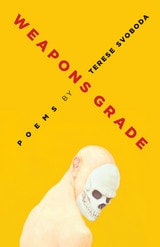
Weapons Grade
PoemsTerese Svoboda
University of Arkansas Press, 2009
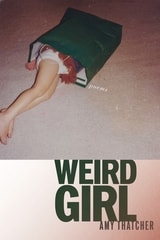
Weird Girl
PoemsAmy Thatcher
The Ohio State University Press, 2027
Poems that confront faith, sexuality, mother-daughter relationships, and the patriarchy to celebrate weird girls everywhere.
Amy Thatcher’s Weird Girl recasts female saints as quirky, transgressive characters, examines the sometimes-bizarre landscape of American girlhood, and reckons with classism and self-definition on the fringes of acceptability. With gusto and humor, Thatcher confronts the taboo—the intrusive, macabre, violent, obsessive, and lonely. Rooted in a working-class Philadelphia Catholic upbringing and embracing the unconventional and the unrefined, this collection captures the experiences of a first-generation college student, the grief of losing a difficult mother, the grandeur and swoon of religious ecstasy, and a girl’s struggle against systems of male power. Weird Girl is a collection for the dreamers, the oddballs, and the resilient ones who have learned to thrive in their own offbeat light: where vulnerability is strength, and the most authentic stories are often the most peculiar.
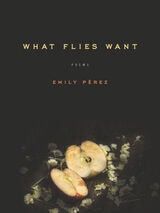
What Flies Want
PoemsEmily Pérez
University of Iowa Press, 2022
In What Flies Want, disaster looms in domesticity: a family grapples with its members’ mental health, a marriage falters, and a child experiments with self-harm. With its backdrop of school lockdown drills, #MeToo, and increasing political polarization, the collection asks how these private and public tensions are interconnected.
The speaker, who grew up in a bicultural family on the U.S./Mexico border, learns she must play a role in a culture that prizes whiteness, patriarchy, and chauvinism. As an adult she oscillates between performed confidence and obedience. As a wife, she bristles against the expectations of emotional labor. As a mother, she attempts to direct her white male children away from the toxic power they are positioned to inherit, only to find how deeply she is also implicated in these systems. Tangled in a family history of depression, a society fixated on guns, a rocky relationship, and her own desire to ignore and deny the problems she must face, this is a speaker who is by turns defiant, defeated, self-implicating, and hopeful.
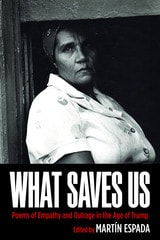
What Saves Us
Poems of Empathy and Outrage in the Age of TrumpEdited by Martín Espada
Northwestern University Press, 2019
This is an anthology of poems in the Age of Trump—and much more than Trump. These are poems that either embody or express a sense of empathy or outrage, both prior to and following his election, since it is empathy the president lacks and outrage he provokes.
There is an extraordinary diversity of voices here. The ninety-three poets featured include Elizabeth Alexander, Julia Alvarez, Richard Blanco, Carolyn Forché, Aracelis Girmay, Donald Hall, Juan Felipe Herrera, Yusef Komunyakaa, Naomi Shihab Nye, Marge Piercy, Robert Pinsky, Danez Smith, Patricia Smith, Brian Turner, Ocean Vuong, Bruce Weigl, and Eleanor Wilner. They speak of persecuted and scapegoated immigrants. They bear witness to violence: police brutality against African Americans, mass shootings in a school or synagogue, the rage inflicted on women everywhere. They testify to poverty: the waitress surviving on leftovers at the restaurant, the battles of a teacher in a shelter for homeless mothers, the emergency-room doctor listening to the heartbeats of his patients. There are voices of labor, in the factory and the fields. There are prophetic voices, imploring us to imagine the world we will leave behind in ruins lest we speak and act.
However, this is not merely a collection of grievances. The poets build bridges. One poet steps up to translate in Arabic at the airport; another walks through the city and sees her immigrant past in the immigrant present; another declaims a musical manifesto after the hurricane that devastated his island; another evokes a demonstration in the street, shouting in an ecstasy of defiance. The poets take back the language, resisting the demagogic corruption of words themselves. They assert our common humanity in the face of dehumanization.
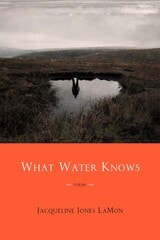
What Water Knows
PoemsJacqueline Jones LaMon
Northwestern University Press, 2021
LaMon’s skillful embodiment of character and her signature use of personae invite the reader to experience the unfathomable. Prepare to go over Niagara Falls in a barrel. Prepare to feel the force of a fire hose on your bare legs. Prepare to experience what happens when greed gets in the way of reason. What Water Knows is a canonical poetic achievement that will remind us of what it means to be human in a world that often forgets.
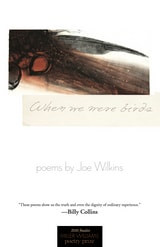
When We Were Birds
PoemsJoe Wilkins
University of Arkansas Press, 2016
Finalist, 2016 Miller Williams Poetry Prize, edited by Billy Collins
In When We Were Birds, Joe Wilkins wrests his attention away from the griefs, deprivations, and high prairies of his Montana childhood and turns toward “the bean-rusted fields & gutted factories of the Midwest,” toward ordinary injustice and everyday sadness, toward the imminent birth of his son and his own confusions in taking up the mantle of fatherhood, toward faith and grace, legacy and luck.
A panoply of voices are at play—the escaped convict, the late-night convenience store clerk, and the drowned child all have their say—and as this motley chorus rises and crests, we begin to understand something of what binds us and makes us human: while the world invariably breaks all our hearts, Wilkins insists that is the very “place / hope lives, in the breaking.”
Within a notable range of form, concern, and voice, the poems here never fail to sing. Whether praiseful or interrogating, When We Were Birds is a book of flight, light, and song. “When we were birds,” Wilkins begins, “we veered & wheeled, we flapped & looped— / it’s true, we flew.”
Winner, 2017 Stafford/Hall Award for Poetry, Oregon Book Awards
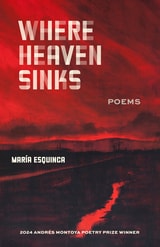
Where Heaven Sinks
PoemsMaría Esquinca
University of Nevada Press, 2025
María Esquinca delivers a searing collection of poems that traverse borders—both physical and emotional. Set against the backdrop of El Paso and Ciudad Juárez, these experimental works weave fragmented verses, striking imagery, and bold typography to confront the brutal realities of immigration and identity. With the precision of a journalist and the heart of a storyteller, Esquinca exposes injustice while celebrating resilience and hope. Her work is shaped by the intersection of cultures, histories, and experiences found in the US-Mexico borderlands. Each poem is a tribute to those who have endured and a call to challenge the systems that oppress. Where Heaven Sinks is a love letter, a memorial for those lost, and a testament to the transformative power of language.
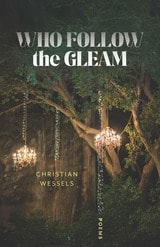
Who Follow the Gleam
PoemsChristian Wessels
University of Massachusetts Press, 2026
A dazzling debut that blends folklore with the everyday
Drifting between the past and present, the material and the otherworldly, Who Follow the Gleam melts lore and magic with history to shape distinctive narratives of childhood, fatherhood, and personhood. In his debut poetry collection, Christian Wessels crosses centuries and takes his readers with him to Germany’s Black Forest, burning hotels, chromatic casinos, and Long Island’s dazing Sound. Uncanny elements of folklore and dreamlike stories are grounded in the atmosphere of the natural world as Wessels turns the sun, moss, and clouds into characters connecting his poems: “maybe I myself am the sun; am / the brilliant silence engraved / in stone; am the arc / through which the future becomes / legible.”
In the world of this collection, intuition, feelings, dreams, and spells mimic cycles, patterns, rules, and structure as the speaker disappears in the magic of language, only to resurface in the everyday. In four sections, Wessels reckons with a changing world, evolving and sometimes unfamiliar, while coming to terms with the uncertain future: “The cloud looks / like me, it looks like me because / the present moves, the present moves.” This collection is a sensitive meditation on the power of passed-down knowledge—personal and collective, factual and mythical—and how such knowledge finds its embodiment in the world.

Wind–Mountain–Oak
The Poems of SapphoDan Beachy-Quick
Tupelo Press, 2023
Wintering
PoemsMegan Snyder-Camp
Tupelo Press, 2016
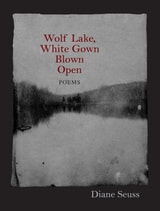
Wolf Lake, White Gown Blown Open
PoemsDiane Seuss
University of Massachusetts Press, 2010
Diane Seuss's poems grow out of the fertile soil of southwest Michigan, bursting any and all stereotypes of the Midwest and turning loose characters worthy of Faulkner in their obsession, their suffering, their dramas of love and sex and death. The first section of this collection pays homage to the poet's roots in a place where the world hands you nothing and promises less, so you are left to invent yourself or disappear. From there these poems both recount and embody repeated acts of defiant self-creation in the face of despair, loss, and shame, and always in the shadow of annihilation.
With darkly raucous humor and wrenching pathos, Seuss burrows furiously into liminal places of no dimension— state lines, lakes' edges, the space “between the m and the e in the word amen.” From what she calls “this place inbetween” come profane prayers in which "the sound of hope and the sound of suffering" are revealed to be “the same music played on the same instrument.”
Midway through this book, a man tells the speaker that beauty is that which has not been touched. This collection is a righteous and fierce counterargument: in the world of this imagination, beauty spills from that which has been crushed, torn, and harrowed. “We receive beauty,” Seuss writes, “as a nail receives / the hammer blow.” This is the poetry that comes only after the white dress has been blown open—the poetry of necessity, where a wild imagination is the only hope.
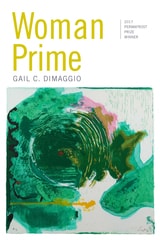
Woman Prime
PoemsGail C. DiMaggio
University of Alaska Press, 2018
Like many women, the speaker believed that leaving her parent’s home, falling in love, and raising children would reveal the essential core of herself. Instead, she learns that those she loves can fail her and that she must embrace a world full of flickering and conflicting expectations for women. Woman Prime is about every woman and no woman—a mutable voice that will still resonate with anyone trying to reconcile their flawed and complicated selves.
Wonder Cabinet
PoemsDavid Barber
Northwestern University Press, 2006

Wordplay for Kids
A Sourcebook of Poems, Rhymes, and Read-AloudsTim Wadham
American Library Association, 2015
Working Classics
POEMS ON INDUSTRIAL LIFEEdited by Peter Oresick and Nicholas Coles
University of Illinois Press, 1990
anthology of poems captures the drama of work and working-class life in
industrial America. It speaks of rolling mills, mine shafts, and foundries,
and of a people who dig coal, tap blast furnaces, sew shirts, clean fish,
and assemble cars. These subjects, though largely absent from literary
anthologies and textbooks, are increasingly evident in the work of contemporary
poets. Working Classics gathers the best and most representative
of these poems, American and Canadian, from 1945 to the present.
Included are poems by Antler, Robert Bly, Lorna Dee Cervantes, Jim Daniels,
Patricia Dobler, Stephen Dunn, Tess Gallagher, Edward Hirsch, David Ignatow,
June Jordan, Lawrence Joseph, Philip Levine, Chris Llewellyn, Joyce Carol
Oates, Anthony Petrosky, Michael Ryan, Gary Soto, Tom Wayman, James Wright,
and many others. The result is a diverse and evocative collection of 169
poems by 74 poets, nearly a third of them women.
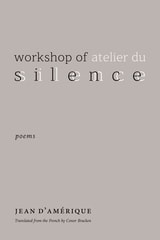
Workshop of Silence
PoemsJean D’Amérique; Translated from French by Conor Bracken
Vanderbilt University Press, 2025
Though D’Amérique’s poems grow out of soils strewn with stones and splotched with blood, they also grow out of play, one of the more daring and dangerous modes there is (“being happy is worth the price” he says in “worth the price”). Produced in a bilingual edition, with a side-by-side translation by Conor Bracken as well as a critical introduction, Workshop of Silence preserves and approximates this spirit of play and scrutiny so that the sound of the translation bears as much semantic heft as the signifying content of the words. This leads, oftentimes, to choices that may seem odd or tangential, but ultimately highlight D’Amérique’s experimentation with the French language in and on poetic form—the puns, the intricate play of assonance and consonance, the rhymes and kennings, the lineation and inversions. These all serve to recalibrate a reader’s relationship with the language he is writing in, one that has been used for centuries to subjugate people throughout the Global South. The more we recognize language as a mighty and strange substance that can be manipulated to do weird things and to effect arbitrary outcomes, the more we can both revel in its potential and question what it has led us to take for granted.
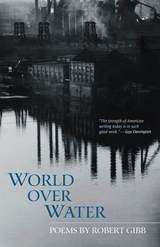
World Over Water
PoemsRobert Gibb
University of Arkansas Press, 2007
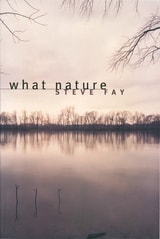
what nature
PoemsSteve Fay
Northwestern University Press, 1998