Results by title
191 books match the query 'Politics and literature' and 8 start with w
When Borne Across
Literary Cosmopolitics in the Contemporary Indian NovelBishnupriya Ghosh
Rutgers University Press, 2004
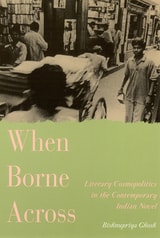
India’s 1997 celebration of the Golden Jubilee marked fifty years of independence from British colonial rule. This anniversary is the impetus for Bishnupriya Ghosh’s exploration of the English language icons of South Asian post-colonial literature: Salman Rushdie, Vikram Chandra, Amitav Ghosh, Upamanyu Chatterjee, and Arundhati Roy. These authors, grouped together as South Asian cosmopolitical writers, produce work challenging and expanding preconceived notions of Indian cultural identity, while being sold simultaneously as popular English literature within the global market. This commodification of Indian language and identity reinforces incomplete and simplified images of India and its writers, and at times counteracts the expressed agenda of the writers. In When Borne Across, Ghosh focuses on the politics of language and history, and the related processes of translation and migration within the global network. In so doing, she develops a new approach to literary studies that adapts conventional literary analysis to the pressures, constraints, and liberties of our present era of globalization.
Where No Flag Flies
Donald Davidson and the Southern ResistanceMark Royden Winchell
University of Missouri Press, 2000
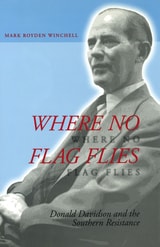
Donald Davidson (1893-1968) may well be the most unjustifiably neglected figure in twentieth-century southern literature. One of the most important poets of the Fugitive movement, he also produced a substantial body of literary criticism, the libretto for an American folk opera, a widely used composition textbook, and the recently discovered novel The Big Ballad Jamboree. As a social and political activist, Davidson had significant impact on conservative thought in this century, imfluencing important scholars from Cleanth Brooks to M. E. Bradford.
Despite these accomplishments, Donald Davidson has received little critical attention from either the literary or the southern scholarly community. Where No Flag Flies is Mark Royden Winchell's redress of this critical disservice. A comprehensive intellectual biography of Davidson, this seminal work offers a complete narrative of Davidson's life with all of its triumphs and losses, frustrations and fulfillments.
Winchell provides the reader with more than a simple study of a man and his achievements; he paints a complete portrait of the times in which Davidson published, from the 1930s to the early 1960s. Davidson was more directly involved in political and social activities than most writers of his generation, and Winchell provides the context, both literary and historical, in which Davidson's opinions and works developed. At the same time, Winchell offers detailed evaluations of Davidson's poetry, fiction, historical writings, and essays.
Drawing upon a wealth of previously unpublished archival material, including Davidson's letters and diary, Where No Flag Flies provides unique access to one of the most original minds of the twentieth-century South. Donald Davidson may not have achieved the recognition he deserved, but this remarkable biography finally makes it possible for a considerable literary audience to discover his true achievement.
William Blake and the Impossible History of the 1790s
Saree Makdisi
University of Chicago Press, 2003
Writers of Conviction
The Personal Politics of Zona Gale, Dorothy Canfield Fisher, Rose Wilder Lane, and Josephine HerbstJulia C. Ehrhardt
University of Missouri Press, 2004
Writing Human Rights
The Political Imaginaries of Writers of ColorCrystal Parikh
University of Minnesota Press, 2017
The legal texts and aspirational ideals of human rights are usually understood and applied in a global context with little bearing on the legal discourse, domestic political struggles, or social justice concerns within the United States. In Writing Human Rights, Crystal Parikh uses the international human rights regime to read works by contemporary American writers of color—Toni Morrison, Chang-rae Lee, Ana Castillo, Aimee Phan, and others—to explore the conditions under which new norms, more capacious formulations of rights, and alternative kinds of political communities emerge.
Parikh contends that unlike humanitarianism, which views its objects as victims, human rights provide avenues for the creation of political subjects. Pairing the ethical deliberations in such works as Beloved and A Gesture Life with human rights texts like the United Nations Convention Against Torture, she considers why principles articulated as rights in international conventions and treaties—such as the right to self-determination or the right to family—are too often disregarded at home. Human rights concepts instead provide writers of color with a deeply meaningful method for political and moral imagining in their literature.
Affiliating transnational works of American literature with decolonization, socialist, and other political struggles in the global south, this book illuminates a human rights critique of idealized American rights and freedoms that have been globalized in the twenty-first century. In the absence of domestic human rights enforcement, these literatures provide a considerable repository for those ways of life and subjects of rights made otherwise impossible in the present antidemocratic moment.
Writing Women's Communities
The Politics and Poetics of Contemporary Multi-Genre AnthologiesCynthia G. Franklin
University of Wisconsin Press, 1997
Beginning in the 1980s, a number of popular and influential anthologies organized around themes of shared identity—Nice Jewish Girls, This Bridge Called My Back, Home Girls, and others—have brought together women’s fiction and poetry with journal entries, personal narratives, and transcribed conversations. These groundbreaking multi-genre anthologies, Cynthia G. Franklin demonstrates, have played a crucial role in shaping current literary studies, in defining cultural and political movements, and in building connections between academic and other communities.
Exploring intersections and alliances across the often competing categories of race, class, gender, and sexuality, Writing Women’s Communities contributes to current public debates about multiculturalism, feminism, identity politics, the academy as a site of political activism, and the relationship between literature and politics.

Writing Wrongs
W.D. King
Temple University Press, 1997
Writing Wrongs: The Work of Wallace Shawn is a close and personal look into the life and literary work of the man whom Joseph Papp called "a dangerous writer." As the son of the late William Shawn, renowned editor of The New Yorker, Wallace Shawn was born into privilege and trained to thoroughly liberal values, but his plays relentlessly question the liberal faith in individualism and common decency. In an uncompromising way that is all his own, Shawn registers the shock of the new.
In works such as Aunt Dan and Lemon, My Dinner with Andre, and The Designated Mourner, he wrenches out of place all of the usual, comfortable mechanisms by which we operate as audiences. Perhaps our discomfort and struggle to understand a play might provoke some change in the way we see ourselves and behave in relation to others -- but Shawn offers little in the way of solace.
W.D. King's incisive critiques of the plays and inquiry into the life and times of their author develop a portrait of Shawn as a major figure in contemporary theater.
Writing
The Political TestClaude Lefort
Duke University Press, 2000
In Writing: The Political Test, France’s leading political philosopher, Claude Lefort, illuminates the process by which writers negotiate difficult path to free themselves from the ideological and contextual traps that would doom their attempts to articulate a new vision. Lefort examines writers whose works provide special insights into this problem of risk, both literary artists and political philosophers. Among them are Salman Rushdie, Sade, Tocqueville,m Machiavelli, Leo Strauss, Orwell, Kant, Robespierre, Guizot, and Pierre Clastres. In Tocqueville, for example, Lefort finds that the author’s improvisatory and open-ended expression represents the character of the democratic experience. Orwell’s work on totalitarianism shows up the totalitarian subject’s complicity in this political regime. And Rushdie is remarkable for his solid attack on relativism. With the character and fate of the political forms of modernity, democracy, and totalitarianism a central theme, Lefort concludes with some reflections on the collapse of the Soviet Union.
This intriguing and accessible exploration of literature’s political aspects and political philosophy’s literary ones will be welcomed by those who have been stymied by current efforts to bridge these two fields. Taken together, the essays in this volume also stand as an intellectual autobiography of Lefort, making it an excellent introduction to his work for less experience students of political theory or philosophy.