Results by title
73 books match the query 'Popular works' and 3 start with w

What Every Senior Needs to Know About Health Care
J Nora
University Press of Colorado, 2004
At a time when astonishing medical advances appear in the media almost daily, access to even the most routine health care and satisfactory doctor-patient relationships is becoming increasingly difficult to find. Moreover, the rapidly growing population of
[more]
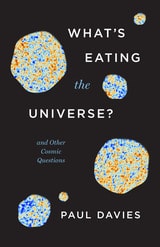
What's Eating the Universe?
And Other Cosmic QuestionsPaul Davies
University of Chicago Press, 2021
Combining the latest scientific advances with storytelling skills unmatched in the cosmos, an award-winning astrophysicist and popular writer leads us on a tour of some of the greatest mysteries of our universe.
In the constellation of Eridanus, there lurks a cosmic mystery: It’s as if something has taken a huge bite out of the universe. But what is the culprit? The hole in the universe is just one of many puzzles keeping cosmologists busy. Supermassive black holes, bubbles of nothingness gobbling up space, monster universes swallowing others—these and many other bizarre ideas are being pursued by scientists. Due to breathtaking progress in astronomy, the history of our universe is now better understood than the history of our own planet. But these advances have uncovered some startling riddles. In this electrifying new book, renowned cosmologist and author Paul Davies lucidly explains what we know about the cosmos and its enigmas, exploring the tantalizing—and sometimes terrifying—possibilities that lie before us.
As Davies guides us through the audacious research offering mind-bending solutions to these and other mysteries, he leads us up to the greatest outstanding conundrum of all: Why does the universe even exist in the first place? And how did a system of mindless, purposeless particles manage to bring forth conscious, thinking beings? Filled with wit and wonder, What’s Eating the Universe? is a dazzling tour of cosmic questions, sure to entertain, enchant, and inspire us all.
[more]
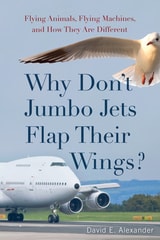
Why Don't Jumbo Jets Flap Their Wings?
Flying Animals, Flying Machines, and How They Are DifferentDavid E. Alexander
Rutgers University Press, 2009
What do a bumble bee and a 747 jet have in common? It’s not a trick question. The fact is they have quite a lot in common. They both have wings. They both fly. And they’re both ideally suited to it. They just do it differently.
Why Don’t Jumbo Jets Flap Their Wings? offers a fascinating explanation of how nature and human engineers each arrived at powered flight. What emerges is a highly readable account of two very different approaches to solving the same fundamental problems of moving through the air, including lift, thrust, turning, and landing. The book traces the slow and deliberate evolutionary process of animal flight—in birds, bats, and insects—over millions of years and compares it to the directed efforts of human beings to create the aircraft over the course of a single century.
Among the many questions the book answers:
David E. Alexander first describes the basic properties of wings before launching into the diverse challenges of flight and the concepts of flight aerodynamics and control to present an integrated view that shows both why birds have historically had little influence on aeronautical engineering and exciting new areas of technology where engineers are successfully borrowing ideas from animals.
Why Don’t Jumbo Jets Flap Their Wings? offers a fascinating explanation of how nature and human engineers each arrived at powered flight. What emerges is a highly readable account of two very different approaches to solving the same fundamental problems of moving through the air, including lift, thrust, turning, and landing. The book traces the slow and deliberate evolutionary process of animal flight—in birds, bats, and insects—over millions of years and compares it to the directed efforts of human beings to create the aircraft over the course of a single century.
Among the many questions the book answers:
- Why are wings necessary for flight?
- How do different wings fly differently?
- When did flight evolve in animals?
- What vision, knowledge, and technology was needed before humans could learn to fly?
- Why are animals and aircrafts perfectly suited to the kind of flying they do?
David E. Alexander first describes the basic properties of wings before launching into the diverse challenges of flight and the concepts of flight aerodynamics and control to present an integrated view that shows both why birds have historically had little influence on aeronautical engineering and exciting new areas of technology where engineers are successfully borrowing ideas from animals.
[more]