Results by title
214 books match the query 'Presidents & Heads of State' and 9 start with w
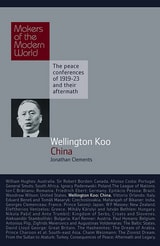
Wellington Koo
ChinaJonathan Clements
Haus Publishing, 2010
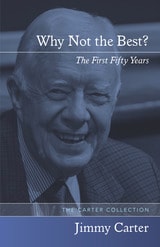
Why Not the Best?
The First Fifty YearsJimmy Carter
University of Arkansas Press, 1996
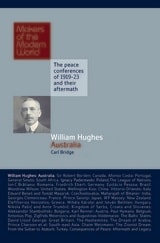
William Hughes
AustraliaCarl Bridge
Haus Publishing, 2010
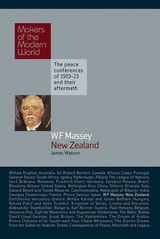
William Massey
New ZealandJames Watson
Haus Publishing, 2010
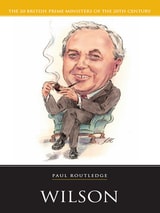
Wilson
Paul Routledge
Haus Publishing, 2006
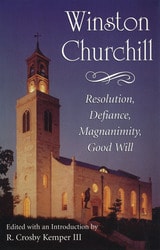
Winston Churchill
Resolution, Defiance, Magnanimity, Good WillEdited by R. Crosby Kemper III
University of Missouri Press, 1995
In 1946 Winston Churchill shook the world with his famous "Iron Curtain" speech on the campus of Westminster College in Fulton, Missouri, now the site of the Winston Churchill Memorial and Library. Inscribed on the pediment of his statue at the memorial is the epigraph from Churchill's History of the Second World War:
In War: Resolution
In Defeat: DefianceIn Victory: MagnanimityIn Peace: Good WillNo other words provide so poignant a summary of the principles that sustained Churchill's life's work.
Under the auspices of the Winston Churchill Memorial and Library, the Crosby Kemper Lectureship was established in 1979 by the Enid and Crosby Kemper Foundation of Kansas City, Missouri. Lectures have been delivered annually, or biennially, at the Winston Churchill Memorial and Library on the campus of Westminster College by authorities on British history and on Sir Winston Churchill. The essays included in this volume constitute the first dozen Crosby Kemper lectures, most by individuals who were personally acquainted with Churchill and all by individuals who had studied his life and his work.
Lord Robert Blake discusses Churchill's ambivalence toward the Conservative party during his political career. Philip S. Ziegler, Earl Mountbatten's biographer, examines whether Britain should have granted independence to India in 1947, taking as his departure Churchill's unequivocal belief that Britain's imperial rule there was a sacred trust not to be betrayed. Martin Gilbert, Churchill's biographer, carefully examines the origins of the Cold War and the famous Iron Curtain speech. Sir Michael Howard, Lovett Professor and Naval Historian at Yale University, further examines Churchill's role during the Cold War and the formulation of his "two-track" strategy that pushed for military strength while persistently striving for peace with the Soviets. Sir John Colville, Churchill's private secretary, ponders the extent to which great men are made by circumstances, citing Churchill's peccadilloes and strengths. Churchill's daughter Mary Soames and granddaughter, the sculptor Edwina Sandys, also give moving portraits of a much-loved family man.
All bring this illustrious leader to life in the process of interpreting his political actions, reviewing his historical contributions, and sharing anecdotes about his personal life.
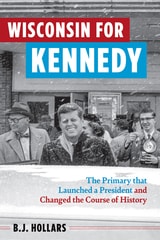
Wisconsin for Kennedy
The Primary That Launched a President and Changed the Course of HistoryB. J. Hollars
Wisconsin Historical Society Press, 2024
When John F. Kennedy ran for president in 1960, he did something no candidate had done before: he leveraged the power of state primaries to win his party’s nomination. Kennedy’s first battleground state? Wisconsin—a state that would prove more arduous, more exhausting, and more crucial to winning the presidency than any other.
Wisconsin for Kennedy brings to life the stories behind JFK’s history-making 1960 Wisconsin primary campaign, and how Kennedy’s team managed to outmaneuver his politically seasoned opponent, Hubert Humphrey. From Jackie Kennedy commandeering a supermarket loudspeaker in Kenosha, to the Wisconsin forklift driver who planned President Kennedy’s final trip to Dallas, this captivating book places readers at the heart of the action.
Author B.J. Hollars chronicles JFK’s nail-biting Wisconsin win by drawing on rarely cited oral histories from the eclectic team of people who worked together to make it happen: a cranberry farmer, a union leader, a mayor, an architect, and others. Wisconsin for Kennedy explores how Wisconsin helped propel JFK all the way to the White House in a riveting historical account that reads like a work of rollicking, page-turning fiction.
“In the spirit of Theodore H. White’s The Making of The President: 1960, B.J. Hollars offers a vivid account of the Wisconsin primary that launched JFK’s successful presidential campaign, inspiring voters to pass the torch to a new generation of leadership for our country. Anyone mesmerized by JFK’s legacy will enjoy this great read.”
—Former US Representative Ron Kind
“For generations, my family has had the great privilege of serving the people of Wisconsin. In Wisconsin for Kennedy, B.J. Hollars performs his own act of service, recounting the riveting and untold story of Wisconsin’s politically perilous 1960 primary. A poignant contribution to political history that reads like a page-turner.”
—Former Wisconsin Governor James Doyle Jr.
"A hopeful quality . . . pervades Wisconsin for Kennedy, written about a time and place when politics was conducted in a less severe and divisive way than it is now. Hollars further succeeds in showing how political history is made by a wide range of citizens. Wisconsinites, Midwesterners, and indeed Americans of all political persuasions can be grateful to B.J. Hollars for these important reminders."
— Middle West Review
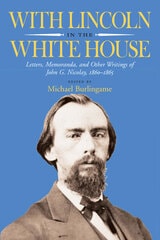
With Lincoln in the White House
Letters, Memoranda, and other Writings of John G. Nicolay, 1860-1865Edited by Michael Burlingame
Southern Illinois University Press, 2000
From the time of Lincoln’s nomination for the presidency until his assassination, John G. Nicolay served as the Civil War president’s chief personal secretary. Nicolay became an intimate of Lincoln and probably knew him as well as anyone outside his own family. Unlike John Hay, his subordinate, Nicolay kept no diary, but he did write several memoranda recording his chief’s conversation that shed direct light on Lincoln. In his many letters to Hay, to his fiancée, Therena Bates, and to others, Nicolay often describes the mood at the White House as well as events there. He also expresses opinions that were almost certainly shaped by the president
For this volume, Michael Burlingame includes all of Nicolay’s memoranda of conversations, all of the journal entries describing Lincoln’s activities, and excerpts from most of the nearly three hundred letters Nicolay wrote to Therena Bates between 1860 and 1865. He includes letters and portions of letters that describe Lincoln or the mood at the White House or that give Nicolay’s personal opinions. He also includes letters written by Nicolay while on troubleshooting missions for the president.
An impoverished youth, Nicolay was an unlikely candidate for the important position he held during the Civil War. It was only over the strong objections of some powerful people that he became Lincoln’s private secretary after Lincoln’s nomination for the presidency in 1860. Prominent Chicago Republican Herman Kreismann found the appointment of a man so lacking in savoir faire
Lacking charm, Nicolay became known at the White House as the “bulldog in the ante-room” with a disposition “sour and crusty.” California journalist Noah Brooks deemed Nicolay a “grim Cerberus of Teutonic descent who guards the last door which opens into the awful presence.” Yet in some ways he was perfectly suited for the difficult job. William O. Stoddard, noting that Nicolay was not popular and could “say 'no'about as disagreeably as any man I ever knew,” still granted that Nicolay served Lincoln well because he was devoted and incorruptible. Stoddard concluded that Nicolay “deserves the thanks of all who loved Mr. Lincoln.”
For his part, Nicolay said he derived his greatest satisfaction “from having enjoyed the privilege and honor of being Mr. Lincoln’s intimate and official private secretary, and of earning his cordial friendship and perfect trust.”
Woodrow Wilson
USABrian Morton
Haus Publishing, 2008