Results by title
129 books match the query 'Press coverage' and 5 start with w
Watching Women's Liberation, 1970
Feminism's Pivotal Year on the Network NewsBonnie J. Dow
University of Illinois Press, 2014
In Watching Women's Liberation, 1970: Feminism's Pivotal Year on the Network News, Bonnie J. Dow uses case studies of key media events to delve into the ways national TV news mediated the emergence of feminism's second wave. First legitimized as a big story by print media, the feminist movement gained broadcast attention as the networks’ eagerness to get in on the action was accompanied by feminists’ efforts to use national media for their own purposes. Dow chronicles the conditions that precipitated feminism's new visibility and analyzes the verbal and visual strategies of broadcast news discourses that tried to make sense of the movement.
Groundbreaking and packed with detail, Watching Women's Liberation, 1970 shows how feminism went mainstream--and what it gained and lost on the way.
Watergate's Legacy and the Press
The Investigative ImpulseJon Marshall
Northwestern University Press, 2011
Bob Woodward and Carl Bernstein symbolize an era when investigative reporters were seen as courageous fighters of corruption and injustice. Although many mainstream news outlets no longer have the resources to support expensive investigative reporters on staff, journalists have found other ways to support themselves Marshall’s discussion of the opportunities they have found in blogs, crowd-sourcing, and nonprofit institutions offers hope for the future of investigative journalism.
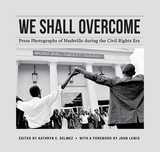
We Shall Overcome
Press Photographs of Nashville during the Civil Rights EraKathryn E. Delmez
Vanderbilt University Press, 2023
Fifty years after Martin Luther King Jr.'s death—and at a time when race relations and social justice are again at the forefront of our country's consciousness—this book expands on a Frist Art Museum exhibition to present a selection of approximately one hundred photographs that document an important period in Nashville's struggle for racial equality. The images were taken between 1957, the year that desegregation in public schools began, and 1968, when the National Guard was called in to surround the state capitol in the wake of the civil rights leader's assassination in Memphis.
Of central significance are photographs of lunch counter sit-ins in early 1960, led by a group of students, including John Lewis (who contributed the book's foreword) and Diane Nash, from local historically black colleges and universities. The demonstrations were so successful that King stated just a few weeks later at Fisk University: "I did not come to Nashville to bring inspiration but to gain inspiration from the great movement that has taken place in this community." The role that Nashville played in the national civil rights movement as a hub for training students in nonviolent protest and as the first Southern city to integrate places of business is a story that warrants reexamination.
The book also provides an opportunity to consider the role of images and the media in shaping public opinion, a relevant subject in today's news-saturated climate. Photographs from the archives of both daily newspapers are included: the Tennessean, which was the more liberal publication, and the Nashville Banner, a conservative paper whose leadership seemed less interested in covering events related to racial issues. Some of the photographs in the exhibition had been selected to be published in the papers, but many were not, and their disclosure reveals insight into the editorial process. In several images, other photojournalists and news crews are visible, serving as a reminder of the almost constant presence of the camera during these historic times.
Essays by Linda Wynn of Fisk University and the Tennessee Historical Commission and Susan H. Edwards, executive director of the Frist Art Museum, offer historical context on Nashville during the civil rights era and on photojournalism, respectively. Congressman John Lewis's foreword recounts memories of his time in Nashville and reminds us that there is still work to be done to build King's Beloved Community.
When the News Broke
Chicago 1968 and the Polarizing of AmericaHeather Hendershot
University of Chicago Press, 2022
“The whole world is watching!” cried protestors at the 1968 Democratic convention as Chicago police beat them in the streets. When some of that violence was then aired on network television, another kind of hell broke loose. Some viewers were stunned and outraged; others thought the protestors deserved what they got. No one—least of all Chicago mayor Richard J. Daley—was happy with how the networks handled it.
In When the News Broke, Heather Hendershot revisits TV coverage of those four chaotic days in 1968—not only the violence in the streets but also the tumultuous convention itself, where Black citizens and others forcefully challenged southern delegations that had excluded them, anti-Vietnam delegates sought to change the party’s policy on the war, and journalists and delegates alike were bullied by both Daley’s security forces and party leaders. Ultimately, Hendershot reveals the convention as a pivotal moment in American political history, when a distorted notion of “liberal media bias” became mainstreamed and nationalized.
At the same time, she celebrates the values of the network news professionals who strived for fairness and accuracy. Despite their efforts, however, Chicago proved to be a turning point in the public’s trust in national news sources. Since those critical days, the political Right in the United States has amplified distrust of TV news, to the point where even the truest and most clearly documented stories can be deemed “fake.” As Hendershot demonstrates, it doesn’t matter whether the “whole world is watching” if people don’t believe what they see.
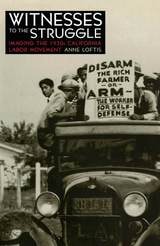
Witnesses to the Struggle
Imaging the 1930s California Labor MovementAnne Loftis
University of Nevada Press, 2014
In this groundbreaking interdisciplinary study, Loftis examines the artists who put a human face on the farmworkers’ plight in California during the Great Depression, focusing on writer John Steinbeck, photographer Dorothea Lange, sociologist and author Paul Taylor, and journalist Carey McWilliams. Loftis probes the interplay between journalism and art in the 1930s, when both academics and artists felt an urgent need to be relevant in the face of enormous misery. The power of their work grew out of their personal involvement in both the labor struggles and the hardships endured by workers and their families. Steinbeck, Lange, and the other artists and intellectuals in their circles created the public images of their times. Works such as The Grapes of Wrath or Lange’s Migrant Mother actually helped mold public opinion and form government policies. Even today these works remain icons in our shared perception of that era. Loftis helps us understand why this art still seems the truest representation of those desperate times, three-quarters of a century later.