Results by title
81 books match the query 'Publishing' and 6 start with w

Whitman's Drift
Imagining Literary DistributionMatt Cohen
University of Iowa Press, 2017
Still, as the budding poet learned, books neither sell themselves nor move themselves: without an efficient set of connections to get books to readers, the democratic media-saturated future Whitman imagined would have remained warehoused. Whitman’s works sometimes ran through the “many-cylinder’d steam printing press” and were carried in bulk on “the strong and quick locomotive.” Yet during his career, his publications did not follow a progressive path toward mass production and distribution. Even at the end of his life, in the 1890s as his fame was growing, the poet was selling copies of his latest works by hand to visitors at his small house in Camden, New Jersey. Mass media and centralization were only one part of the rich media world that Whitman embraced.
Whitman’s Drift asks how the many options for distributing books and newspapers shaped the way writers wrote and readers read. Writers like Whitman spoke to the imagination inspired by media transformations by calling attention to connectedness, to how literature not only moves us emotionally, but moves around in the world among people and places. Studying that literature and how it circulated can help us understand not just how to read Whitman’s works and times, but how to understand what is happening to our imaginations now, in the midst of the twenty-first century media explosion.
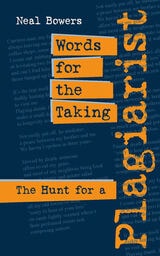
Words for the Taking
The Hunt for a PlagiaristNeal Bowers
Southern Illinois University Press, 2007
In January 1992, poet Neal Bowers received a phone call that changed his life. He learned his poems had been stolen and published under another name. Bowers hired a copyright lawyer and a private detective, and they began the agonizing hunt to track down the person who stole his creative work.
Bowers was dealing with more than the theft of words. He uncovered the plagiarist’s unsavory past when he found convicted child molester David Jones, who published the poems using the name David Sumner.
Determined to hold the plagiarist accountable, Bowers is drawn into a bizarre game of catch-me-if-you-can. His odyssey introduces him to the legal system and a sympathetic female detective, reveals the reactions of fellow poets, and provokes a flood of nationwide publicity and a deluge of letters from strangers interested in the case. Letters from Bowers’s attorney to Jones and phone conversations between the two produce unsatisfactory results. In the end, the plagiarist is not punished, and Bowers deals with the loss of friends, derision from his colleagues, and trouble in his marriage.
Words for the Taking: The Hunt for a Plagiarist, first published in 1997, is as much a commentary on our cultural view of plagiarism as it is a real-life detective story. Bowers’s wry and disturbing account of being the victim of a serial plagiarist offers unexpected twists and startling revelations. This updated edition presents a final consideration of the bizarre case and remains the only book to offer a personal account of the effects of plagiarism.
Ten years after the original publication, Neal Bowers finds his life as a writer altered in ways he could never have foreseen. His responses to the series of events show his vulnerability as an artist and his adjustment to being a victim. In a new chapter, Bowers describes his renewed quest in 2006 for a resolution and explains why he chose to give up writing poetry.
This beautifully written case study about the discovery and attempted resolution of an intellectual crime will appeal to academicians and general readers alike who care about language, the state of poetry, and intellectual property in contemporary America.
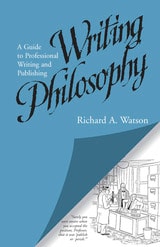
Writing Philosophy
A Guide to Professional Writing and PublishingRichard A. Watson
Southern Illinois University Press, 1992
Richard A. ("Red") Watson has published fiction, general nonfiction, and scholarly books. His essay "On the Zeedijk," about Descartes in Holland and first published in The Georgia Review, was the lead essay in The Pushcart Prize XV, 1990–1991: Best of the Small Presses. Red knows writing.
He also knows academe and has written Writing Philosophy as a kind of survival manual for undergraduates, graduate students, and junior faculty members in philosophy. Also helpful to those in the humanities and the social sciences, the book is a guide to the professional writing and publishing that are essential to an active participation in the conversation and discussion that constitute these professional fields. To the extent that publication is the crucial factor in tenure decisions, it will help the beginning scholar meet tenure criteria.
Despite the importance of the oral tradition in philosophy and the influence of the dialogue, many philosophical points are so intricate and complex that they can be advanced, followed, and criticized only if they are written as stepwise arguments for study and contemplation at length and at leisure. Watson provides a set of basic principles and a plan for writing argumentative papers of 1,500 to 15,000 words (3 to 30 printed pages) and books containing a sequence of sustained arguments of 70,000 to 150,000 words (200 to 300 printed pages).
Because the first book of most professional philosophers is a revised dissertation, Watson presents a plan for writing that dissertation in such a way that its chapters will serve as publishable articles and the dissertation itself will need very little rewriting as a book. His discussion of the principles of reason, clarity, and argument ranges from such topics as dangling participles and the proper usage of ellipses to matters of categorization and univocity.
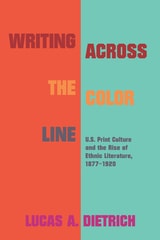
Writing across the Color Line
U.S. Print Culture and the Rise of Ethnic Literature, 1877-1920Lucas A. Dietrich
University of Massachusetts Press, 2020
Writing across the Color Line details how this body of literature was selected for publication, edited, manufactured, advertised, and distributed, even as it faced hostile criticism and frequent misinterpretation by white readers. Shedding light on the transformative potential of multiethnic literature and the tenacity of racist attitudes that dominated the literary marketplace, Dietrich proves that Native American, African American, Latinx, Asian American, and Irish American writers of the period relied on self-caricature, tricksterism, and the careful control of authorial personae to influence white audiences.

Writing and Publishing
The Librarian's HandbookCarol Smallwood
American Library Association, 2009
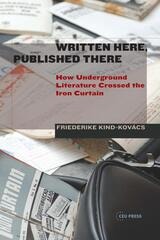
Written Here, Published There
How Underground Literature Crossed the Iron CurtainFriederike Kind-Kovács
Central European University Press, 2015
Written Here, Published There offers a new perspective on the role of underground literature in the Cold War and challenges us to recognize gaps in the Iron Curtain. The book identifies a transnational undertaking that reinforced détente, dialogue, and cultural transfer, and thus counterbalanced the persistent belief in Europe's irreversible division.
It analyzes a cultural practice that attracted extensive attention during the Cold War but has largely been ignored in recent scholarship: tamizdat, or the unauthorized migration of underground literature across the Iron Curtain. Through this cultural practice, I offer a new reading of Cold War Europe's history. Investigating the transfer of underground literature from the 'Other Europe' to Western Europe, the United States, and back illuminates the intertwined fabrics of Cold War literary cultures. Perceiving tamizdat as both a literary and a social phenomenon, the book focuses on how individuals participated in this border-crossing activity and used secretive channels to guarantee the free flow of literature.