Results by title
54 books match the query 'Punishment' and 4 start with w

Wages of Evil
Dostoevsky and PunishmentAnna Schur
Northwestern University Press, 2012
Dostoevsky’s views on punishment are usually examined through the prism of his Christian commitments. For some, this means an orientation toward mercy; for others, an affirmation of suffering as a path to redemption. Anna Schur incorporates sources from philosophy, criminology, psychology, and history to argue that Dostoevsky’s thinking about punishment was shaped not only by his Christian ethics but also by the debates on penal theory and practice unfolding during his lifetime.
As Dostoevsky attempts to balance the various ethical and cultural imperatives, he displays ambivalence both about punishment and about mercy. This ambivalence, Schur argues, is further complicated by what Dostoevsky sees as the unfathomable quality of the self, which hinders every attempt to match crimes with punishments. The one certainty he holds is that a proper response to wrongdoing must include a concern for the wrongdoer’s moral improvement.
As Dostoevsky attempts to balance the various ethical and cultural imperatives, he displays ambivalence both about punishment and about mercy. This ambivalence, Schur argues, is further complicated by what Dostoevsky sees as the unfathomable quality of the self, which hinders every attempt to match crimes with punishments. The one certainty he holds is that a proper response to wrongdoing must include a concern for the wrongdoer’s moral improvement.
[more]
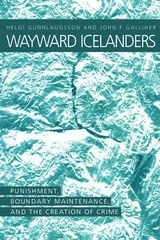
Wayward Icelanders
Punishment, Boundary Maintenance, And TheHelgi Gunnlaugsson
University of Wisconsin Press, 2000
Is Iceland, universally perceived as a peaceful, idyllic nation, being threatened by an inevitable flood of crime as it enters the global community? In recent decades the Icelandic state has taken serious steps to curb mounting crime, establishing a specialized drug court and an undercover drug police agency. Public opinion polls clearly demonstrate Icelanders’ growing concern that crime and drug use are on the rise. In their provocative new book, Wayward Icelanders, Helgi Gunnlaugsson and John Galliher offer another, more nuanced explanation for recent Icelandic attitudes toward crime, one that takes into account the unique history and culture of this relatively homogeneous and isolated nation.
Wayward Icelanders explores how the threat of crime has affected Icelanders’ collective self-identity, producing an ever greater need for social control. Historically Iceland has provided stiff sanctions for the use and abuse of mind-altering substances. Drunk driving has long been systematically punished, and even beer was prohibited for more than seventy years. The rate of conviction for these crimes is high, even in a democracy that prides itself on protecting civil liberties. Even more troubling, however, is the low rate of convictions for rape cases, which suggests that such crimes receive less attention from the state. Drawing on the classic work of Durkheim as well as Kai Erikson’s Wayward Puritans, Gunnlaugsson and Galliher demonstrate that an escalating war on crime can threaten freedom even in a small, affluent, and relatively nonviolent nation like Iceland with a long-standing commitment to democracy and individual rights.
Wayward Icelanders explores how the threat of crime has affected Icelanders’ collective self-identity, producing an ever greater need for social control. Historically Iceland has provided stiff sanctions for the use and abuse of mind-altering substances. Drunk driving has long been systematically punished, and even beer was prohibited for more than seventy years. The rate of conviction for these crimes is high, even in a democracy that prides itself on protecting civil liberties. Even more troubling, however, is the low rate of convictions for rape cases, which suggests that such crimes receive less attention from the state. Drawing on the classic work of Durkheim as well as Kai Erikson’s Wayward Puritans, Gunnlaugsson and Galliher demonstrate that an escalating war on crime can threaten freedom even in a small, affluent, and relatively nonviolent nation like Iceland with a long-standing commitment to democracy and individual rights.
[more]
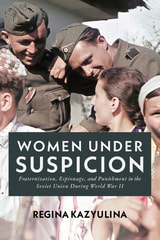
Women Under Suspicion
Fraternization, Espionage, and Punishment in the Soviet Union During World War IIRegina Kazyulina
University of Wisconsin Press, 2025
Officially, women in the Soviet Union enjoyed a degree of equality unknown elsewhere in Allied countries at the time. However, long-standing norms of gendered behavior and stereotypes that cast women as morally weak, politically fallible, and sexually tempting meant that women in the army or living behind enemy lines were viewed with skepticism, seen as weak points easily exploited by the enemy. Concerned about sabotage, espionage, and ideological corruption, authorities categorized women who fraternized with the enemy—or who were suspected of doing so—as “socially dangerous,” a uniquely Soviet legal designation that exposed the accused to prosecution, imprisonment, and exile. Even without official sanction, women rumored to be involved with German occupiers were reviled, and treated accordingly, by their neighbors. By reading official reports against the grain and incorporating rare personal documents, Kazyulina provides a multifaceted study of the realities for non-Jewish Soviet women—in the army or resistance, or at home in occupied territories—during and after Nazi occupation.
[more]
Writing as Punishment in Schools, Courts, and Everyday Life
Spencer Schaffner
University of Alabama Press, 2019
A probing and prescient consideration of writing as an instrument of punishment
Writing tends to be characterized as a positive aspect of literacy that helps us to express our thoughts, to foster interpersonal communication, and to archive ideas. However, there is a vast array of evidence that emphasizes the counterbelief that writing has the power to punish, shame, humiliate, control, dehumanize, fetishize, and transform those who are subjected to it. In Writing as Punishment in Schools, Courts, and Everyday Life, Spencer Schaffner looks at many instances of writing as punishment, including forced tattooing, drunk shaming, court-ordered letters of apology, and social media shaming, with the aim of bringing understanding and recognition to the coupling of literacy and subjection.
Writing as Punishment in Schools, Courts, and Everyday Life is a fascinating inquiry into how sinister writing can truly be and directly questions the educational ideal that powerful writing is invariably a public good. While Schaffner does look at the darker side of writing, he neither vilifies nor supports the practice of writing as punishment. Rather, he investigates the question with humanistic inquiry and focuses on what can be learned from understanding the many strange ways that writing as punishment is used to accomplish fundamental objectives in everyday life.
Through five succinct case studies, we meet teachers, judges, parents, sex traffickers, and drunken partiers who have turned to writing because of its presumed power over writers and readers. Schaffner provides careful analysis of familiar punishments, such as schoolchildren copying lines, and more bizarre public rituals that result in ink-covered bodies and individuals forced to hold signs in public.
Schaffner argues that writing-based punishment should not be dismissed as benign or condemned as a misguided perversion of writing, but instead should be understood as an instrument capable of furthering both the aims of justice and degradation.
[more]