Results by title
753 books match the query 'Race' and 30 start with w

Wandering
Philosophical Performances of Racial and Sexual FreedomSarah Jane Cervenak
Duke University Press, 2014

Warring Genealogies
Race, Kinship, and the Korean WarJoo Ok Kim
Temple University Press, 2022
Warring Genealogies examines the elaboration of kinships between Chicano/a and Asian American cultural production, such as the 1954 proxy adoption of a Korean boy by Leavenworth prisoners. Joo Ok Kim considers white supremacist expressions of kinship—in prison magazines, memorials, U.S. military songbooks—as well as critiques of such expressions in Chicana/o and Korean diasporic works to conceptualize racialized formations of kinship emerging from the Korean War.
Warring Genealogies unpacks writings by Rolando Hinojosa (Korean Love Songs, The Useless Servants) and Luis Valdez (I Don’t Have to Show You No Stinking Badges, Zoot Suit) to show the counter-representations of the Korean War and the problematic depiction of the United States as a benevolent savior. Kim also analyzes Susan Choi’s The Foreign Student as a novel that proposes alternative temporalities to dominant Korean War narratives. In addition, she examines Chicano military police procedurals, white supremacist women’s organizations, and the politics of funding Korean War archives.
Kim’s comparative study Asian American and Latinx Studies makes insightful connections about race, politics, and citizenship to critique the Cold War conception of the “national family.”

Waterfront Workers of New Orleans
Race, Class, and Politics, 1863-1923Eric Arnesen
University of Illinois Press, 1991
Winner of the John H. Dunning Prize in United States History
During the nineteenth century, American and foreign travelers often found New Orleans a delightful, exotic stop on their journeys. Few failed to marvel at the riverfront, the center of the city's economic activity. But historical memory overlooks the immigrants and Black migrants who served in the riverfront's army of laborers and provided the essential human power that kept the cotton, sugar, and other goods flowing. Eric Arnesen examines the diverse group of 10,000 to 15,000 cotton screwmen, longshoremen, cotton and round freight teamsters, cotton yardmen, railroad freight handlers, and Mississippi River roustabouts that formed the backbone of the Crescent City's trade and economic life.
Waterfront Workers
New Perspectives on Race and ClassEdited by Calvin Winslow
University of Illinois Press, 1998

Way Down in the Hole
Race, Intimacy, and the Reproduction of Racial Ideologies in Solitary ConfinementAngela J. Hattery
Rutgers University Press, 2023
Way Down the Hole Video 1 (https://youtu.be/UuAB63fhge0)
Way Down the Hole Video 2 (https://youtu.be/TwEuw1cTrcQ)
Way Down the Hole Video 3 (https://youtu.be/bOcBv_UnHIs)
Way Down the Hole Video 4 (https://youtu.be/cx_l1S8D77c)
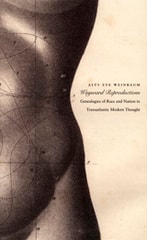
Wayward Reproductions
Genealogies of Race and Nation in Transatlantic Modern ThoughtAlys Eve Weinbaum
Duke University Press, 2004
Gracefully traversing a wide range of discourses––including literature, evolutionary theory, early anthropology, Marxism, feminism, and psychoanalysis––Weinbaum traces a genealogy of the race/reproduction bind within key intellectual formations of the late nineteenth and twentieth centuries. She examines two major theorists of genealogical thinking—Friedrich Nietzsche and Michel Foucault—and unearths the unacknowledged ways their formulations link race and reproduction. She explores notions of kinship and the replication of racial difference that run through Charlotte Perkins Gilman’s work; Marxist thinking based on Friedrich Engel’s The Origin of the Family; Charles Darwin’s theory of sexual selection; and Sigmund Freud’s early studies on hysteria. She also describes W. E. B. Du Bois’s efforts to transcend ideas about the reproduction of race that underwrite citizenship and belonging within the United States. In a coda, Weinbaum brings the foregoing analysis to bear on recent genomic and biotechnological innovations.
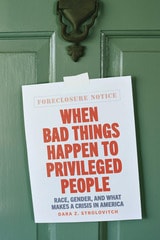
When Bad Things Happen to Privileged People
Race, Gender, and What Makes a Crisis in AmericaDara Z. Strolovitch
University of Chicago Press, 2023
A deep and thought-provoking examination of crisis politics and their implications for power and marginalization in the United States.
From the climate crisis to the opioid crisis to the Coronavirus crisis, the language of crisis is everywhere around us and ubiquitous in contemporary American politics and policymaking. But for every problem that political actors describe as a crisis, there are myriad other equally serious ones that are not described in this way. Why has the term crisis been associated with some problems but not others? What has crisis come to mean, and what work does it do?
In When Bad Things Happen to Privileged People, Dara Z. Strolovitch brings a critical eye to the taken-for-granted political vernacular of crisis. Using systematic analyses to trace the evolution of the use of the term crisis by both political elites and outsiders, Strolovitch unpacks the idea of “crisis” in contemporary politics and demonstrates that crisis is itself an operation of politics. She shows that racial justice activists innovated the language of crisis in an effort to transform racism from something understood as natural and intractable and to cast it instead as a policy problem that could be remedied. Dominant political actors later seized on the language of crisis to compel the use of state power, but often in ways that compounded rather than alleviated inequality and injustice. In this eye-opening and important book, Strolovitch demonstrates that understanding crisis politics is key to understanding the politics of racial, gender, and class inequalities in the early twenty-first century.
When Bad Things Happen to Privileged People
Race, Gender, and What Makes a Crisis in AmericaDara Z. Strolovitch
University of Chicago Press, 2023
A deep and thought-provoking examination of crisis politics and their implications for power and marginalization in the United States.
From the climate crisis to the opioid crisis to the Coronavirus crisis, the language of crisis is everywhere around us and ubiquitous in contemporary American politics and policymaking. But for every problem that political actors describe as a crisis, there are myriad other equally serious ones that are not described in this way. Why has the term crisis been associated with some problems but not others? What has crisis come to mean, and what work does it do?
In When Bad Things Happen to Privileged People, Dara Z. Strolovitch brings a critical eye to the taken-for-granted political vernacular of crisis. Using systematic analyses to trace the evolution of the use of the term crisis by both political elites and outsiders, Strolovitch unpacks the idea of “crisis” in contemporary politics and demonstrates that crisis is itself an operation of politics. She shows that racial justice activists innovated the language of crisis in an effort to transform racism from something understood as natural and intractable and to cast it instead as a policy problem that could be remedied. Dominant political actors later seized on the language of crisis to compel the use of state power, but often in ways that compounded rather than alleviated inequality and injustice. In this eye-opening and important book, Strolovitch demonstrates that understanding crisis politics is key to understanding the politics of racial, gender, and class inequalities in the early twenty-first century.

When Biometrics Fail
Gender, Race, and the Technology of IdentityShoshana Amielle Magnet
Duke University Press, 2011
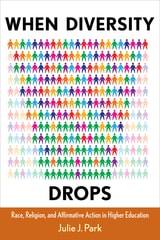
When Diversity Drops
Race, Religion, and Affirmative Action in Higher EducationPark, Julie J.
Rutgers University Press, 2013
The story documents IVCF’s evolution from a predominantly white group that rarely addressed race to the most racially diverse campus fellowship at the university. However, its ability to maintain its multiethnic membership was severely hampered by the drop in black enrollment at California University following the passage of Proposition 209, a statewide affirmative action ban.
Park demonstrates how the friendships that students have—or do not have—across racial lines are not just a matter of personal preference or choice; they take place in the contexts that are inevitably shaped by the demographic conditions of the university. She contends that a strong organizational commitment to diversity, while essential, cannot sustain racially diverse student subcultures. Her work makes a critical contribution to our understanding of race and inequality in collegiate life and is a valuable resource for educators and researchers interested in the influence of racial politics on students’ lives.
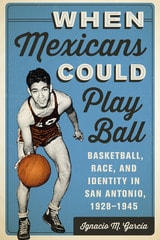
When Mexicans Could Play Ball
Basketball, Race, and Identity in San Antonio, 1928–1945By Ignacio M. García
University of Texas Press, 2014
Winner, Al Lowman Memorial Prize, Texas State Historical Association, 2014
In 1939, a team of short, scrappy kids from a vocational school established specifically for Mexican Americans became the high school basketball champions of San Antonio, Texas. Their win, and the ensuing riot it caused, took place against a backdrop of shifting and conflicted attitudes toward Mexican Americans and American nationalism in the WWII era. “Only when the Mexicans went from perennial runners-up to champs,” García writes, “did the emotions boil over.”
The first sports book to look at Mexican American basketball specifically, When Mexicans Could Play Ball is also a revealing study of racism and cultural identity formation in Texas. Using personal interviews, newspaper articles, and game statistics to create a compelling narrative, as well as drawing on his experience as a sports writer, García takes us into the world of San Antonio’s Sidney Lanier High School basketball team, the Voks, which became a two-time state championship team under head coach William Carson “Nemo” Herrera. An alumnus of the school himself, García investigates the school administrators’ project to Americanize the students, Herrera’s skillful coaching, and the team’s rise to victory despite discrimination and violence from other teams and the world outside of the school. Ultimately, García argues, through their participation and success in basketball at Lanier, the Voks players not only learned how to be American but also taught their white counterparts to question long-held assumptions about Mexican Americans.
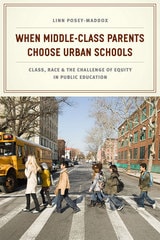
When Middle-Class Parents Choose Urban Schools
Class, Race, and the Challenge of Equity in Public EducationLinn Posey-Maddox
University of Chicago Press, 2014
Drawing on in-depth research at an urban elementary school, Posey-Maddox examines parents’ efforts to support the school through their outreach, marketing, and volunteerism. She shows that when middle-class parents engage in urban school communities, they can bring a host of positive benefits, including new educational opportunities and greater diversity. But their involvement can also unintentionally marginalize less-affluent parents and diminish low-income students’ access to the improving schools. In response, Posey-Maddox argues that school reform efforts, which usually equate improvement with rising test scores and increased enrollment, need to have more equity-focused policies in place to ensure that low-income families also benefit from—and participate in—school change.
When Time Warps
The Lived Experience of Gender, Race, and Sexual ViolenceMegan Burke
University of Minnesota Press, 2019
An inquiry into the phenomenology of “woman” based in the relationship between lived time and sexual violence
Feminist phenomenologists have long understood a woman’s life as inhibited, confined, and constrained by sexual violence. In this important inquiry, author Megan Burke both builds and expands on this legacy by examining the production of normative womanhood through racist tropes and colonial domination. Ultimately, Burke charts a new feminist phenomenology based in the relationship between lived time and sexual violence.
By focusing on time instead of space, When Time Warps places sexualized racism at the center of the way “woman” is lived. Burke transports questions of time and gender outside the realm of the historical, making provocative new insights into how gendered individuals live time, and how their temporal existence is changed through particular experiences.
Providing a potent reexamination of the theory of Simone de Beauvoir—while also bringing to the fore important women of color theorists and engaging in the temporal aspects of #MeToo—When Time Warps makes a necessary, lasting contribution to our understanding of gender, race, and sexual violence.

When Women Rule the Court
Gender, Race, and Japanese American BasketballWillms, Nicole
Rutgers University Press, 2017
For nearly one hundred years, basketball has been an important part of Japanese American life. Women’s basketball holds a special place in the contemporary scene of highly organized and expansive Japanese American leagues in California, in part because these leagues have produced numerous talented female players. Using data from interviews and observations, Nicole Willms explores the interplay of social forces and community dynamics that have shaped this unique context of female athletic empowerment. As Japanese American women have excelled in mainstream basketball, they have emerged as local stars who have passed on the torch by becoming role models and building networks for others.
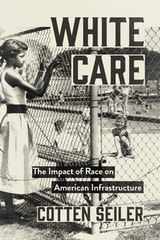
White Care
The Impact of Race on American InfrastructureCotten Seiler
University of Chicago Press, 2026
Infrastructure delivers to its users a range of benefits, from health, safety, and sanitation to mobility, energy, and education. It is, as Cotten Seiler argues, how modern states show care for their populations. White Care recounts the rise and fall of public infrastructure in the United States, unearthing its origins as an investment in those Americans deemed most highly evolved, showing the political stakes of its desegregation, and accounting for its current state of dilapidation.
From the late nineteenth century through much of the twentieth, government investments in physical (“hard”) and social (“soft”) infrastructure constituted a regime of care that Seiler calls “custodial liberalism.” This regime achieved legitimacy with the New Deal, which conferred upon white citizens a bounty of life-enhancing public works. But custodial liberalism began to unravel in the postwar decades, as Americans of color gained access to public schools, housing, swimming pools, parks, and other sites from which they had long been excluded. As the infrastructural commons were desegregated, white Americans withdrew from the social compact that had empowered them and turned toward neoliberalism, with its program of austerity and privatization. This racialized renunciation has deprived everyone—including themselves—of a cleaner, greener, healthier, safer, more affordable, and more functional environment.

White Gypsies
Race and Stardom in Spanish MusicalsEva Woods Peiró
University of Minnesota Press, 2012
Little has been written about the Spanish film musical, a genre usually associated with the early Franco dictatorship and dismissed by critics as reactionary, escapist fare. A timely and valuable corrective, White Gypsies shows how the Spanish folkloric musical films of the 1940s and ’50s are inextricably tied to anxious concerns about race—especially, but not only, Gypsiness.
Focusing on the processes of identity formation in twentieth-century Spain—with multifaceted readings of the cinematic construction of class, gender, and sexuality—Eva Woods Peiró explores how these popular films allowed audiences to negotiate and imaginatively, at times problematically, resolve complex social contradictions. The intricate interweaving of race and modernity is particularly evident in her scrutiny of a striking popular phenomenon: how the musicals progressively whitened their stars, even as their story lines became increasingly Andalusianized and Gypsified.
White Gypsies reveals how these imaginary individuals constituted a veritable cultural barometer of how racial thinking was projected and understood across a broad swath of popular Spanish cinema.
White Innocence
Paradoxes of Colonialism and RaceGloria Wekker
Duke University Press, 2016
White Metropolis
Race, Ethnicity, and Religion in Dallas, 1841-2001By Michael Phillips
University of Texas Press, 2006
Winner, T. R. Fehrenbach Award, Texas Historical Commission, 2007
From the nineteenth century until today, the power brokers of Dallas have always portrayed their city as a progressive, pro-business, racially harmonious community that has avoided the racial, ethnic, and class strife that roiled other Southern cities. But does this image of Dallas match the historical reality? In this book, Michael Phillips delves deeply into Dallas's racial and religious past and uncovers a complicated history of resistance, collaboration, and assimilation between the city's African American, Mexican American, and Jewish communities and its white power elite.
Exploring more than 150 years of Dallas history, Phillips reveals how white business leaders created both a white racial identity and a Southwestern regional identity that excluded African Americans from power and required Mexican Americans and Jews to adopt Anglo-Saxon norms to achieve what limited positions of power they held. He also demonstrates how the concept of whiteness kept these groups from allying with each other, and with working- and middle-class whites, to build a greater power base and end elite control of the city. Comparing the Dallas racial experience with that of Houston and Atlanta, Phillips identifies how Dallas fits into regional patterns of race relations and illuminates the unique forces that have kept its racial history hidden until the publication of this book.
White Slave Crusades
Race, Gender, and Anti-vice Activism, 1887-1917Brian Donovan
University of Illinois Press, 2005
Focusing on the intersection of race, gender, and sex in the antiprostitution campaigns, Brian Donovan analyzes the reactions of native-born whites to new immigrant groups in Chicago, to African Americans in New York City, and to Chinese immigrants in San Francisco. Donovan shows how reformers employed white slavery narratives of sexual danger to clarify the boundaries of racial categories, allowing native-born whites to speak of a collective "us" as opposed to a "them." These stories about forced prostitution provided an emotionally powerful justification for segregation, as well as other forms of racial and sexual boundary maintenance in urban America.

White Space
Essays on Culture, Race, & WritingJennifer De Leon
University of Massachusetts Press, 2021
Alternately honest, funny, and visceral, this powerful collection follows De Leon as she comes of age as a Guatemalan-American woman and learns to navigate the space between two worlds. Never rich or white enough for her posh college, she finds herself equally adrift in her first weeks in her parents' home country. During the years to follow, she would return to Guatemala again and again, meet ex-guerrillera and genocide survivors, get married in the old cobblestoned capital of Antigua, and teach her newborn son about his roots.
Why Americans Hate Welfare
Race, Media, and the Politics of Antipoverty PolicyMartin Gilens
University of Chicago Press, 1999
"With one out of five children currently living in poverty and more than 100,000 families with children now homeless, Gilens's book is must reading if you want to understand how the mainstream media have helped justify, and even produce, this state of affairs." —Susan Douglas, The Progressive
"Gilens's well-written and logically developed argument deserves to be taken seriously." —Choice
"A provocative analysis of American attitudes towards 'welfare.'. . . [Gilens] shows how racial stereotypes, not white self-interest or anti-statism, lie at the root of opposition to welfare programs." -Library Journal
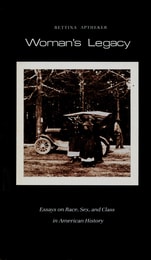
Woman's Legacy
Essays on Race, Sex, and Class in American HistoryBettina Aptheker
University of Massachusetts Press, 1982
Woman's Legacy: Essays on Race, Sex, and Class in American History is a groundbreaking collection of essays by prominent feminist scholar and historian Bettina Aptheker. Emerging from her dissertation research, this work examines the interconnected systems of racial, sexual, and class oppression that have shaped the experiences of women in American history. Through careful historical analysis and feminist scholarship, Aptheker explores how race, sex, and class work together to form complex systems of domination and resistance in the American historical context. The essays investigate women's community roles, activism, and agency while centering the lived experiences of women, particularly Black women, across different historical periods. This seminal work contributes to African American women's history and feminist historiography, bridging women's studies with critical analysis of historical structures and social movements. An essential text for those interested in intersectional approaches to American history and women's studies.
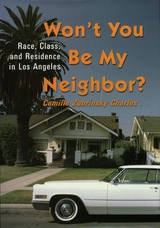
Won't You be My Neighbor
Race, Class, and Residence in Los AngelesCamille Zubrinksy Charles
Russell Sage Foundation, 2006
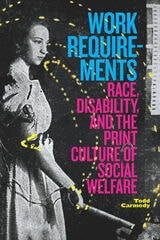
Work Requirements
Race, Disability, and the Print Culture of Social WelfareTodd Carmody
Duke University Press, 2022
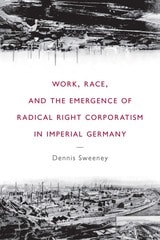
Work, Race, and the Emergence of Radical Right Corporatism in Imperial Germany
Dennis Sweeney
University of Michigan Press, 2010
---Andrew Zimmerman, George Washington University
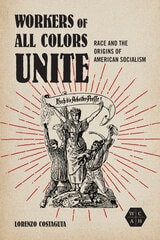
Workers of All Colors Unite
Race and the Origins of American SocialismLorenzo Costaguta
University of Illinois Press, 2023
Costaguta charts the socialist movement’s journey through the conflict and down a path that ultimately abandoned scientific racism in favor of an internationalist class-focused and racial-conscious American socialism. As he shows, the shift relied on a strong immigrant influence personified by the cosmopolitan Marxist thinker and future IWW cofounder Daniel De Leon. The class-focused movement that emerged became American socialism’s most common approach to race in the twentieth century and beyond.
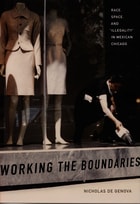
Working the Boundaries
Race, Space, and "Illegality" in Mexican ChicagoNicholas De Genova
Duke University Press, 2005
De Genova worked for two and a half years as a teacher of English in ten industrial workplaces (primarily metal-fabricating factories) throughout Chicago and its suburbs. In Working the Boundaries he draws on fieldwork conducted in these factories, in community centers, and in the homes and neighborhoods of Mexican migrants. He describes how the meaning of “Mexican” is refigured and racialized in relation to a U.S. social order dominated by a black-white binary. Delving into immigration law, he contends that immigration policies have worked over time to produce Mexicans as the U.S. nation-state’s iconic “illegal aliens.” He explains how the constant threat of deportation is used to keep Mexican workers in line. Working the Boundaries is a major contribution to theories of race and transnationalism and a scathing indictment of U.S. labor and citizenship policies.
Worldmaking
Race, Performance, and the Work of CreativityDorinne Kondo
Duke University Press, 2018
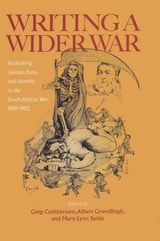
Writing A Wider War
Rethinking Gender, Race, and Identity in the South African War, 1899–1902Greg Cuthbertson
Ohio University Press, 2002
Writing a Wider War presents a dramatically new interpretation of the role of Boer women in the conflict and profoundly changes how we look at the making of Afrikaner nationalism. African experiences of the war are also examined, highlighting racial subjugation in the context of colonial war and black participation, and showcasing important new research by African historians.
The collection includes a reassessment of British imperialism and probing essays on J. A. Hobson; the masculinist nature of life on commando among Boer soldiers; Anglo-Jewry; secularism; health and medicine; nursing, women, and disease in the concentration camps; and the rivalry between British politicians and generals. An examination of the importance of the South African War in contemporary British political economy, and the part played by imperial propaganda, rounds off a thoroughly groundbreaking reinterpretation of this formative event in South Africa's history.
Writing Under the Raj
Gender, Race, and Rape in the British Colonial Imagination, 1830-1947Nancy L. Paxton
Rutgers University Press, 1999
Writing Under the Raj is the first study to challenge the long-held critical assumption that the rape of colonizing women by colonized men was the first, or the only, rape script in British colonial literature. Nancy Paxton asks why rape disappears in British literature about English domestic life in the 1790s and charts its reappearance in British literature about India written between 1830 and 1947. Paxton displays the hybrid qualities of familiar novels like Kipling’s Kim and Forster’s A Passage to India by situating them in a richly detailed cultural context that reveals the dynamic relationship between metropolitan British literature and novels written by men and women who lived in the colonial contact zone of British India throughout this period.
Drawing on current feminist and gender theory as well as a wide range of historical and cultural sources, Paxton identifies four different “scripts” about interracial and intraracial rape that appear in novels about India during the period of British rule. Surveying more than thirty canonized and popular Anglo-Indian novels, Paxton shows how the treatment of rape reflects basic conflicts in the social and sexual contracts defining British and Indian women’s relationship to the nation state throughout the period. This study reveals how and why novels written after the Indian Uprising of 1857 popularized the theme of English women victimized by Indian men. Paxton demonstrates how all these novels reflect unresolved ideological and symbolic conflicts in British ideas about sex, violence, and power.