Results by title
322 books match the query 'Regional' and 14 start with w
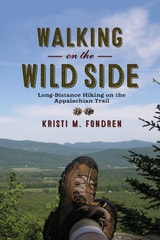
Walking on the Wild Side
Long-Distance Hiking on the Appalachian TrailFondren, Kristi M
Rutgers University Press, 2015
The most famous long-distance hiking trail in North America, the 2,181-mile Appalachian Trail—the longest hiking-only footpath in the world—runs along the Appalachian mountain range from Georgia to Maine. Every year about 2,000 individuals attempt to “thru-hike” the entire trail, a feat equivalent to hiking Mount Everest sixteen times. In Walking on the Wild Side, sociologist Kristi M. Fondren traces the stories of forty-six men and women who, for their own personal reasons, set out to conquer America’s most well known, and arguably most social, long-distance hiking trail.
In this fascinating in-depth study, Fondren shows how, once out on the trail, this unique subculture of hikers lives mostly in isolation, with their own way of acting, talking, and thinking; their own vocabulary; their own activities and interests; and their own conception of what is significant in life. They tend to be self-disciplined, have an unwavering trust in complete strangers, embrace a life of poverty, and reject modern-day institutions. The volume illuminates the intense social intimacy and bonding that forms among long-distance hikers as they collectively construct a long-distance hiker identity. Fondren describes how long-distance hikers develop a trail persona, underscoring how important a sense of place can be to our identity, and to our sense of who we are. Indeed, the author adds a new dimension to our understanding of the nature of identity in general.
Anyone who has hiked—or has ever dreamed of hiking—the Appalachian Trail will find this volume fascinating. Walking on the Wild Side captures a community for whom the trail is a sacred place, a place to which they have become attached, socially, emotionally, and spiritually.
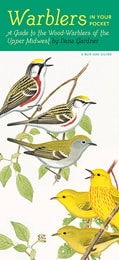
Warblers in Your Pocket
A Guide to Wood-Warblers of the Upper MidwestDana Gardner
University of Iowa Press, 2016
This newest addition to Iowa’s popular series of laminated guides—the twenty-eighth in the series—illustrates the thirty-eight species of warblers that occur in the Upper Midwest states of Minnesota, Illinois, Nebraska, Kansas, North Dakota, South Dakota, Iowa, Indiana, Michigan, Ohio, and Wisconsin. For each species, artist Dana Gardner provides length, range, and habitat; he illustrates male, female, and immature birds where plumage varies; and he includes birds similar to warblers such as kinglets and vireos.
For all their brilliance, warblers can be hard to identify, particularly in the fall—the phrase “confusing fall warblers” was coined for a reason—and when they are in immature plumage. Quick-moving and often found in treetops, they can be challenging even in spring, and the drabber colors of the young birds of the season and of many fall adults can make identification difficult. The illustrations and descriptions in Warblers in Your Pocket will be a most welcome reference for bird watchers throughout the Midwest.
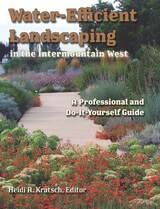
Water-Efficient Landscaping in the Intermountain West
A Professional and Do-It-Yourself GuideHeidi Kratsch
Utah State University Press, 2011
This working manual provides complete information on the technical aspects of designing, building, and maintaining waterwise landscapes in the Mountain West. Written particularly for professionals, including landscape designers, architects, contractors, and maintenance and irrigation specialists, it has an attractive, well-illustrated, user-friendly format that will make it useful as well to DIY homeowners and to educators, plant retailers, extension agents, and many others.
The manual is organized according to landscape principles that are adapted to the climate of the intermountain region. Beginning with planning and design, the topical principles proceed through soil preparation, appropriate plant selection, practicalities of turfgrass, use of mulch, and irrigation planning, winding up with landscape maintenance. Designed for onsite, handy use, the book is illustrated with color images of landscapes, plants, and materials. Tables, charts, diagrams, landscape plans, plant lists, checklists, and other graphic resources are scattered throughout the manual, which is written in an accessible but information-rich style. Water-Efficient Landscaping in the Intermountain West answers, more comprehensively than any other single book, the need for professional information that addresses both growing awareness of the necessity for water conservation and the desire for beautiful, healthy yards and properties.
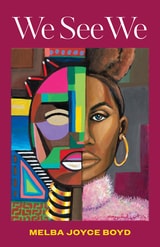
We See We
Melba Joyce Boyd
University of Michigan Press, 2027
Michigan poet laureate Melba Joyce Boyd’s tenth poetry collection, We See We, is a deeply emplaced volume, grounded in Boyd’s hometown of Detroit. The book takes its title from a poem in the collection dedicated to the late photographer, photojournalist, and filmmaker Hugh Grannum, who trained his camera on Black Detroit. Boyd takes a similar approach in this volume, collecting poems “about seeing our collective selves within our interconnected individual lives.” Divided into two sections—Inflexions and Elegies—the poems evoke Detroit’s past and present through works about Romare Bearden at the Detroit Institute of Arts, Idlewild, the 1967 Detroit Rebellion, Aretha Franklin, John Sinclair, and the varied lives of people Boyd knew and loved who demonstrate that you do not have to be famous to have historical impact. As former Michigan poet laureate Nandi Comer writes in the interview that concludes the volume, the poems in this collection are “filled with artists, friends, elders, and collaborators,” making the poems in the collection into “an education in Detroit’s artistic life.”
Weathering Winter
A Gardener's DaybookCarl H. Klaus
University of Iowa Press, 2003
Where the Green Light Shines
A Fifty-Year Odyssey from the Boundary Waters to the Far NorthRyan Rodgers
University of Minnesota Press, 2026
A unique glimpse into the world of arctic canoeing through the travels of one of North America’s most renowned paddlers
A centuries-long story of adventure runs through the Boundary Waters. Stretching from northern Minnesota into the Canadian Shield, this lake-dappled expanse—long an Indigenous homeland and later also a fur trading hub—is the most visited designated wilderness in North America, with more than 200,000 people dipping their paddles into its ancient waterways each year. Bridging the legendary arctic expeditions of the nineteenth century and the making of today’s recreational paddling tradition, Where the Green Light Shines is a fascinating chronicle of canoe exploration, told through the journeys of a true master of the craft, Bob O’Hara.
O’Hara first launched his canoe as a Boy Scout in the 1950s, and he spent every summer for the next sixty-five years venturing further north into the Canadian barrens, a region rarely seen by paddlers. Mentored by a generation of adventurers and by the Inuit who long paddled the northern tundra rivers, O’Hara would become a guiding light for many young canoeists. Passionate yet guarded, O’Hara dedicated his life to the thrill of paddling, and his extraordinary journeys here become a touchstone as Ryan Rodgers tells the story of a nascent canoeing scene that continues to thrive today.
A vivid depiction of the northern wilds traversed by an eclectic roster of paddlers, bush pilots, and historic characters, Where the Green Light Shines illuminates a lost world of arctic canoeing remade in our time. It is bound to transport anyone interested in outdoor adventure—from wilderness canoeists to armchair travelers—and to bring home the eternal allure of the far north.
Whispers and Shadows
A Naturalist’s MemoirJerry Apps
Wisconsin Historical Society Press, 2015
Combining his signature lively storytelling and careful observations of nature, Apps draws on a lifetime of experiences, from his earliest years growing up on a central Wisconsin farm to his current ventures as gardener, tree farmer, and steward of wetlands, prairies, and endangered Karner blue butterflies. He also takes inspiration from the writings of Aldo Leopold, Annie Dillard, Henry David Thoreau, Sigurd Olson, Ralph Waldo Emerson, John Muir, Barbara Kingsolver, Wendell Berry, Richard Louv, and Rachel Carson. With these eloquent essays, Jerry Apps reminds us to slow down, turn off technology, and allow our senses to reconnect us to the natural world. For it is there, he writes, that “I am able to return to a feeling I had when I was a child, a feeling of having room to stretch my arms without interfering with another person, a feeling of being a small part of something much larger than I was, and I marvel at the idea.”

Who Is the City For?
Architecture, Equity, and the Public Realm in ChicagoBlair Kamin
University of Chicago Press, 2022
From his high-profile battles with Donald Trump to his insightful celebrations of Frank Lloyd Wright and front-page takedowns of Chicago mega-projects like Lincoln Yards, Pulitzer Prize–winning architecture critic Blair Kamin has long informed and delighted readers with his illuminating commentary. Kamin’s newest collection, Who Is the City For?, does more than gather fifty-five of his most notable Chicago Tribune columns from the past decade: it pairs his words with striking new images by photographer and architecture critic Lee Bey, Kamin’s former rival at the Chicago Sun-Times. Together, they paint a revealing portrait of Chicago that reaches beyond its glamorous downtown and dramatic buildings by renowned architects like Jeanne Gang to its culturally diverse neighborhoods, including modest structures associated with storied figures from the city’s Black history, such as Emmett Till.
At the book’s heart is its expansive approach to a central concept in contemporary political and architectural discourse: equity. Kamin argues for a broad understanding of the term, one that prioritizes both the shared spaces of the public realm and the urgent need to rebuild Black and brown neighborhoods devastated by decades of discrimination and disinvestment. “At best,” he writes in the book’s introduction, “the public realm can serve as an equalizing force, a democratizing force. It can spread life’s pleasures and confer dignity, irrespective of a person’s race, income, creed, or gender. In doing so, the public realm can promote the social contract — the notion that we are more than our individual selves, that our common humanity is made manifest in common ground.” Yet the reality in Chicago, as Who Is the City For? powerfully demonstrates, often falls painfully short of that ideal.
Wide Branches, Deep Roots
How Appalachian Wisdom Can Help in the Fight for a Sustainable FutureJessica M Jones
West Virginia University Press, 2026
To be Appalachian is to define oneself in terms of a place. Where we’re from plays a tremendous role in who we are, through storytelling about our homeplaces and the people who have loved them. However, what goes largely unaddressed is how this love of place can contribute to sustainability within the region, which has notoriously faced on-going environmental threats from extraction industries. The reality is that our relationship with the environment is thorny and intertwined with our identities, histories, and economic realities. The authors in the collection get down among the thorns to explore what sustainability means in Appalachia and how we can utilize the power of traditional folkways to achieve it.
This collection of over thirty pieces explores the connections between Appalachia’s stories, traditions, and modern events and the pathway to regional sustainability. The contributors — writers and scholars — examine how our definitions of sustainability have been formed, the power of education to encourage or inhibit it, and what moves are being made toward efficacy in the future. They also offer specific actions readers can take to better understand and build sustainability where they live.
Contributors: Greg Bealer, Luc Biscan-White, David Blackmore, Aysha Bodenhamer, Ivy Brashear, Matthew Calloway, Nicole Drewitz-Crockett, Christina Fisanick, Deborah Fleming, Amanda V. Garner, Karie Gunter-Seymour, Richard Hague, Amanda E. Hayes, Lockie Hunter, Jessica M. Jones, Kristen LeFevers, Sarah Long, Meghan Moore-Hubbard, Barbara Marie Minney, Jessica Radicic, Elizabeth Emmerth Rexroad, Barbara Sabol, Larry Smith, Patrice Stank, Taylor Nasim Stone, Paul Thomas, Elizabeth Tussey, and Betsy Weems.
Wild Delicate Seconds
29 Wildlife EncountersCharles Finn
Oregon State University Press, 2012
In Wild Delicate Seconds, Charles Finn captures twenty-nine chance encounters with the everyday—and not so everyday—animals, birds, and insects of North America.
Wildflowers of the Mountain West
Richard M. Anderson, Jay Dee Gunnell, Jerry L. Goodspeed
Utah State University Press, 2012
Many recreational hikers have stopped along the trail to admire a wildflower only to wonder what, exactly, they are looking at. Wildflowers of the Mountain West is a useful field guide that makes flower identification easy for the general outdoor enthusiast.
Many available plant guides are too technical or cumbersome for non-specialists to embrace. Covering New Mexico, Colorado, Wyoming, Idaho, Utah, Nevada and Oregon, this book is perfect for the enthusiasts who has little botanical knowledge but would like to know more about the wildflowers they are seeing. Organized by flower color for easy reference, plant records include the common and scientific names, a description of typical characteristics, habitat information and distribution maps, look-alike species, color photographs, and informative commentary. In addition, the book provides a useful introduction to the Mountain West region, along with line drawings to illustrate basic flower parts, shapes, and arrangements; a glossary of common botanical terms; a quick search key; and an index.
The book is spiral-bound, making it easy to bring along while hiking, backpacking, or biking, and stunning full color photographs make visual confirmation of flower type simple and straightforward.
William Maxwell
A Literary LifeBarbara A. Burkhardt
University of Illinois Press, 2004
Known as a beloved, longtime fiction editor at The New Yorker, William Maxwell worked closely with such legendary writers as Vladimir Nabokov, John Updike, Mary McCarthy, and John Cheever. His own novels include They Came Like Swallows and the American Book Award-winning So Long, See You Tomorrow, and many consider him to be one of the twentieth century's most important writers. Barbara Burkhardt's William Maxwell: A Literary Life represents the first major critical study of this Illinois writer's life and work.
Writing with an economy and elegance befitting her subject, Burkhardt addresses Maxwell's highly autobiographical fiction by skillfully interweaving his biography with her own critical interpretations. She contextualizes his fiction in terms of events including his mother's early death from influenza, his marriage, and the role of his psychoanalysis under the guidance of Theodor Reik. Drawing on a wide range of previously unavailable material, Burkhardt includes letters Maxwell received from authors such as Eudora Welty and Louise Bogan, excerpts from his unpublished manuscripts and correspondence, and her own interviews with Maxwell and key figures from his life, including John Updike, Roger Angell, New Yorker fiction editor Robert Henderson, and Maxwell's family and friends.
Wisconsin Agriculture
A HistoryJerry Apps
Wisconsin Historical Society Press, 2015
"I'm embarrassed to say I thought I knew anything substantial about Wisconsin agriculture or its history before I read this book. 'Wisconsin Agriculture' should be required reading in history classes from high school to the collegiate level. It makes me thankful that Jerry Apps has such a sense of commitment to Wisconsin's agricultural heritage--and to getting the story right." --Pam Jahnke, Farm Director, Wisconsin Farm Report Radio
Wisconsin has been a farming state from its very beginnings. And though it's long been known as "the Dairy State," it produces much more than cows, milk, and cheese. In fact, Wisconsin is one of the most diverse agricultural states in the nation.
The story of farming in Wisconsin is rich and diverse as well, and the threads of that story are related and intertwined. In this long-awaited volume, celebrated rural historian Jerry Apps examines everything from the fundamental influences of landscape and weather to complex matters of ethnic and pioneer settlement patterns, changing technology, agricultural research and education, and government regulations and policies. Along with expected topics, such as the cranberry industry and artisan cheesemaking, "Wisconsin Agriculture" delves into beef cattle and dairy goats, fur farming and Christmas trees, maple syrup and honey, and other specialty crops, including ginseng, hemp, cherries, sugar beets, mint, sphagnum moss, flax, and hops. Apps also explores new and rediscovered farming endeavors, from aquaculture to urban farming to beekeeping, and discusses recent political developments, such as the 2014 Farm Bill and its ramifications. And he looks to the future of farming, contemplating questions of ethical growing practices, food safety, sustainability, and the potential effects of climate change.
Featuring first-person accounts from the settlement era to today, along with more than 200 captivating photographs, "Wisconsin Agriculture" breathes life into the facts and figures of 150 years of farming history and provides compelling insights into the state's agricultural past, present, and future.
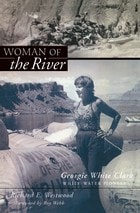
Woman Of The River
Georgie White Clark, Whitewater PioneerRichard Westwood
Utah State University Press, 1997
Georgie White Clark-adventurer, raconteur, eccentric--first came to know the canyons of the Colorado River by swimming portions of them with a single companion. She subsequently hiked and rafted portions of the canyons, increasingly sharing her love of the Colorado River with friends and acquaintances. At first establishing a part-time guide service as a way to support her own river trips, she went on to become perhaps the canyons' best-known river guide, introducing their rapids to many others-on the river, via her large-capacity rubber rafts, and across the nation, via magazine articles and movies. Georgie Clark saw the river and her sport change with the building of Glen Canyon Dam, enormous increases in the popularity of river running, and increased National Park Service regulation of rafting and river guides. Adjusting, though not always easily, to the changes, she helped transform an elite adventure sport into a major tourist activity.