Results by title
119 books match the query 'Religious life and customs' and 3 start with w
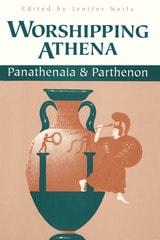
Worshipping Athena
Panathenaia And ParthenonEdited by Jenifer Neils
University of Wisconsin Press, 1996
The foremost religious festival of ancient Athens—the city dedicated to Athena, goddess of war, fertility, arts, and wisdom—was the Panathenaia. Challenging old assumptions and refuting new theories, Worshipping Athena addresses the many problems of interpretation and understanding that have swirled for years around the Panathenaia. Among the issues discussed is the recent sensational controversy over the Parthenon frieze, perhaps the best known but least understood work of Greek art. For centuries the frieze has been thought to represent the Panathenaia procession, but recently the argument has been advanced that it depicts the sacrifice of the daughters of the Athenian king Erechtheus. Worshipping Athena offers compelling evidence that the frieze does indeed depict the festal procession and also demonstrates that scenes of contemporary ritual were not unique to the Parthenon.
Editor Jenifer Neils and the contributors—eminent classicists, archaeologists, and art historians—explore the role of the Panathenaia in Athenian life and compare it with similar festivals held throughout the ancient Greek world. They discuss such topics as the Panathenaia’s mythical origins, the phenomenon of the festival’s valuable prizes (oil-filled amphoras, rather than the customary laurel wreath), and the architecture, sculpture, and painting related to the festival.
Worshipping Athena will provide valuable insights to scholars and students concerned with ancient religion, mythology, art, literature, and gender issues, as well as anyone with a keen interest in the ritual topography of the Athenian Acropolis and the iconography of the Parthenon frieze.
[more]

Writing Faith
Text, Sign, and History in the Miracles of Sainte FoyKathleen Ashley and Pamela Sheingorn
University of Chicago Press, 1999
A trickster saint whose miracles reportedly included the healing of an inguinal hernia via a hammer and anvil, Sainte Foy inspired one of the most important collections of miracle stories of the central middle ages. Kathleen Ashley and Pamela Sheingorn explore the act of "writing faith" as performed both by the authors of these stories and by the scholars who have used them as sources for the study of medieval religion and society.
As Ashley and Sheingorn show, differing agendas shaped the miracle stories over time. The first author, Bernard of Angers, used his narratives to critique popular religion and to establish his own literary reputation, while the monks who continued the collection tried to enhance their monastery's prestige. Because these stories were rhetorical constructions, Ashley and Sheingorn argue, we cannot use them directly as sources of historical data. Instead, they demonstrate how analyzing representations common to groups of miracle stories—such as negative portrayals of Muslims on the eve of the Crusades—can reveal the traces of history.
As Ashley and Sheingorn show, differing agendas shaped the miracle stories over time. The first author, Bernard of Angers, used his narratives to critique popular religion and to establish his own literary reputation, while the monks who continued the collection tried to enhance their monastery's prestige. Because these stories were rhetorical constructions, Ashley and Sheingorn argue, we cannot use them directly as sources of historical data. Instead, they demonstrate how analyzing representations common to groups of miracle stories—such as negative portrayals of Muslims on the eve of the Crusades—can reveal the traces of history.
[more]
Writings on the Sisters of San Luca and Their Miraculous Madonna
Diodata Malvasia
Iter Press, 2015
The Bolognese nun Diodata Malvasia was presumed to have authored only one work, The Arrival and the Miraculous Workings of the Glorious Image of the Virgin (1617). In her recently discovered second manuscript chronicle, A Brief Discourse on What Occurred to the Most Reverend Sisters of the Joined Convents of San Mattia and San Luca (1575), her writing demonstrates active resistance to Tridentine convent reform. Together, Malvasia’s works read as the bookends to a lifelong crusade on behalf of her convent.
[more]