Results by title
436 books match the query 'Renaissance' and 10 start with w
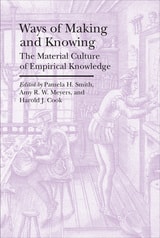
Ways of Making and Knowing
The Material Culture of Empirical KnowledgeEdited by Pamela H. Smith, Amy R. W. Meyers, and Harold J. Cook
Bard Graduate Center, 2017
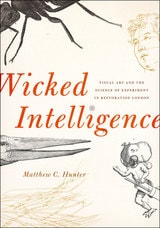
Wicked Intelligence
Visual Art and the Science of Experiment in Restoration LondonMatthew C. Hunter
University of Chicago Press, 2013
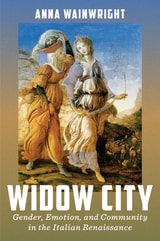
Widow City
Gender, Emotion, and Community in the Italian RenaissanceAnna Wainwright
University of Delaware Press, 2025
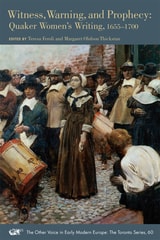
Witness, Warning, and Prophecy
Quaker Women's Writing, 1655-1700Edited by Teresa Feroli and Margaret Olofson Thickstun
Iter Press, 2018
The Other Voice in Early Modern Europe - The Toronto Series: Volume 60

Women Rethinking Genres in Early Modern Europe
Simona Lorenzini
University of Delaware Press, 2027
Women Rethinking Genres in Early Modern Europe brings together research rooted in both gender and genre as categories of analysis to illustrate how the two frameworks are inextricably linked in how we understand the experiences of European women who wrote between the fifteenth and seventeenth centuries. Rather than considering genres as prescriptive, in this collection we emphasize that genres can take different forms and are central to the ways in which authors and readers understand and perceive the world. Together, these essays in this volume demonstrate that women authors not only experimented with genres in different ways but also contributed significantly to the development and circulation of ideas in early modern Europe. This volume includes a variety of case studies from different geographical areas within Western Europe that explore the role of gender in the dissemination of genres such as dialogue, poetry, pastoral, novellas, devotional literature, epic poems, account books, scientific treatises, and fictional romances. In doing so, the essays here contribute to scholarship on marginalized and less studied aspects of early modern female culture.
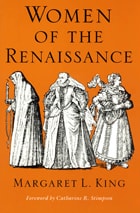
Women of the Renaissance
Margaret L. King
University of Chicago Press, 1991
Utilizing the perspectives of social, church, and intellectual history, King looks at women of all classes, in both usual and unusual settings. She first describes the familial roles filled by most women of the day—as mothers, daughters, wives, widows, and workers. She turns then to that significant fraction of women in, and acted upon, by the church: nuns, uncloistered holy women, saints, heretics, reformers,and witches, devoting special attention to the social and economic independence monastic life afforded them. The lives of exceptional women, those warriors, queens, patronesses, scholars, and visionaries who found some other place in society for their energies and strivings, are explored, with consideration given to the works and writings of those first protesting female subordination: the French Christine de Pizan, the Italian Modesta da Pozzo, the English Mary Astell.
Of interest to students of European history and women's studies, King's volume will also appeal to general readers seeking an informative, engaging entrance into the Renaissance period.
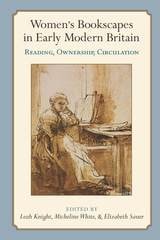
Women’s Bookscapes in Early Modern Britain
Reading, Ownership, CirculationLeah Knight, Micheline White, and Elizabeth Sauer, Editors
University of Michigan Press, 2018
Women in 16th- and 17th-century Britain read, annotated, circulated, inventoried, cherished, criticized, prescribed, and proscribed books in various historically distinctive ways. Yet, unlike that of their male counterparts, the study of women’s reading practices and book ownership has been an elusive and largely overlooked field.
In thirteen probing essays, Women’s Bookscapesin Early Modern Britain brings together the work of internationally renowned scholars investigating key questions about early modern British women’s figurative, material, and cultural relationships with books. What constitutes evidence of women’s readerly engagement? How did women use books to achieve personal, political, religious, literary, economic, social, familial, or communal goals? How does new evidence of women’s libraries and book usage challenge received ideas about gender in relation to knowledge, education, confessional affiliations, family ties, and sociability? How do digital tools offer new possibilities for the recovery of information on early modern women readers?
The volume’s three-part structure highlights case studies of individual readers and their libraries; analyses of readers and readership in the context of their interpretive communities; and new types of scholarly evidence—lists of confiscated books and convent rules, for example—as well as new methodologies and technologies for ongoing research. These essays dismantle binaries of private and public; reading and writing; female and male literary engagement and production; and ownership and authorship.
Interdisciplinary, timely, cohesive, and concise, this collection’s fresh, revisionary approaches represent substantial contributions to scholarship in early modern material culture; book history and print culture; women’s literary and cultural history; library studies; and reading and collecting practices more generally.
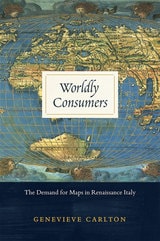
Worldly Consumers
The Demand for Maps in Renaissance ItalyGenevieve Carlton
University of Chicago Press, 2015
Drawing on a variety of sixteenth-century sources, including household inventories, epigrams, dedications, catalogs, travel books, and advice manuals, Worldly Consumers studies how individuals displayed different maps in their homes as deliberate acts of self-fashioning. One citizen decorated with maps of Bruges, Holland, Flanders, and Amsterdam to remind visitors of his military prowess, for example, while another hung maps of cities where his ancestors fought or governed, in homage to his auspicious family history. Renaissance Italians turned domestic spaces into a microcosm of larger geographical places to craft cosmopolitan, erudite identities for themselves, creating a new class of consumers who drew cultural capital from maps of the time.
Writing Cities
Exploring Early Modern Urban DiscourseJames S. Amelang
Central European University Press, 2020
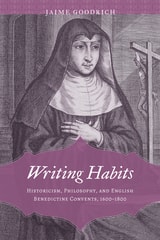
Writing Habits
Historicism, Philosophy, and English Benedictine Convents, 1600–1800Jaime Goodrich
University of Alabama Press, 2021
The first in-depth examination of the texts produced in English Benedictine convents between 1600 and 1800.
After Catholicism became illegal in England during the sixteenth century, Englishwomen established more than twenty convents on the Continent that attracted thousands of nuns and served as vital centers of Catholic piety until the French Revolution. Today more than 1,000 manuscripts and books produced by, and for, the Benedictine convents are extant in European archives. Writing Habits: Historicism, Philosophy, and English Benedictine Convents, 1600–1800 provides the first substantive analysis of these works in order to examine how members of one religious order used textual production to address a major dilemma experienced by every English convent on the Continent: How could English nuns cultivate a cloistered identity when the Protestant Reformation had swept away nearly all vestiges of English monasticism?
Drawing on an innovative blend of methodologies, Jaime Goodrich contends that the Benedictines instilled a collective sense of spirituality through writings that created multiple overlapping communities, ranging from the earthly society of the convent to the transhistorical network of the Catholic Church. Because God resides at the heart of these communities, Goodrich draws on the works of Martin Buber, a twentieth-century Jewish philosopher who theorized that human community forms a circle, with each member acting as a radius leading toward the common center of God. Buber’s thought, especially his conception of the I-You framework for personal and spiritual relationships, illuminates a fourfold set of affiliations central to Benedictine textual production: between the nuns themselves, between the individual nun and God, between the convent and God, and between the convent and the Catholic public sphere. By evoking these relationships, the major genres of convent writing—administrative texts, spiritual works, history and life writing, and controversial tracts—functioned as tools for creating community and approaching God.
Through this Buberian reading of the cloister, Writing Habits recovers the works of Benedictine nuns and establishes their broader relevance to literary history and critical theory.