Results by title
58 books match the query 'Representative government and representation' and 3 start with w

Where Women Run
Gender and Party in the American StatesKira Sanbonmatsu
University of Michigan Press, 2010
Why don’t more women run for office? Why are certain states more likely to have female candidates and representatives? Would strengthening political parties narrow the national gender gap? Where Women Run addresses these important questions through a rare and incisive look at how candidates are recruited. Drawing on surveys and case studies of party leaders and legislators in six states, political scientist Kira Sanbonmatsu analyzes the links between parties and representation, exposing the mechanism by which parties’ informal recruitment practices shape who runs—or doesn’t run—for political office in America.
“Kira Sanbonmatsu has done a masterful job of linking the representation of women in elective office to the activities of party organizations in the states. She combines qualitative and quantitative data to show how women are navigating the campaign process to become elected leaders and the changing role of party organizations in their recruitment and election. It is a significant contribution to the study of representative democracy.”
--Barbara Burrell, Northern Illinois University
“Sanbonmatsu has produced an excellent study that will invigorate research on the role of political parties and the recruitment of women candidates. Using a variety of methods and data sources, she has crafted a tightly constructed, clearly argued, and exceedingly well-written study. A commendable and convincing job.”
--Gary Moncrief, Boise State University
“Sanbonmatsu offers important insights in two neglected areas of American politics: the role of political parties in recruiting candidates and the continued under-representation of women in elected office. Connecting the two subjects through careful qualitative and statistical methods, insightful interpretation of the literature and interesting findings, the book is a significant new addition to scholarship on parties, gender, and political recruitment.”
--Linda Fowler, Dartmouth College
Kira Sanbonmatsu is Associate Professor of Political Science at Rutgers University and Senior Scholar at the Eagleton Institute of Politics’ Center for American Women and Politics (CAWP). She was previously associate professor at Ohio State University. She is the author of Democrats, Republicans, and the Politics of Women’s Place.
[more]
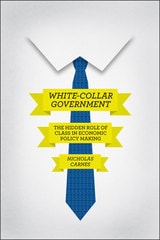
White-Collar Government
The Hidden Role of Class in Economic Policy MakingNicholas Carnes
University of Chicago Press, 2013
Eight of the last twelve presidents were millionaires when they took office. Millionaires have a majority on the Supreme Court, and they also make up majorities in Congress, where a background in business or law is the norm and the average member has spent less than two percent of his or her adult life in a working-class job. Why is it that most politicians in America are so much better off than the people who elect them— and does the social class divide between citizens and their representatives matter?
With White-Collar Government, Nicholas Carnes answers this question with a resounding—and disturbing—yes. Legislators’ socioeconomic backgrounds, he shows, have a profound impact on both how they view the issues and the choices they make in office. Scant representation from among the working class almost guarantees that the policymaking process will be skewed toward outcomes that favor the upper class. It matters that the wealthiest Americans set the tax rates for the wealthy, that white-collar professionals choose the minimum wage for blue-collar workers, and that people who have always had health insurance decide whether or not to help those without. And while there is no one cause for this crisis of representation, Carnes shows that the problem does not stem from a lack of qualified candidates from among the working class. The solution, he argues, must involve a variety of changes, from the equalization of campaign funding to a shift in the types of candidates the parties support.
If we want a government for the people, we have to start working toward a government that is truly by the people. White-Collar Government challenges long-held notions about the causes of political inequality in the United States and speaks to enduring questions about representation and political accountability.
[more]

Who Gets Represented?
Peter K. Enns
Russell Sage Foundation, 2011
An investigation of policy preferences in the U.S. and how group opinion affects political representation. While it is often assumed that policymakers favor the interests of some citizens at the expense of others, it is not always evident when and how groups' interests differ or what it means when they do. Who Gets Represented? challenges the usual assumption that the preferences of any one group—women, African Americans, or the middle class—are incompatible with the preferences of other groups. The book analyzes differences across income, education, racial, and partisan groups and investigates whether and how differences in group opinion matter with regard to political representation. Part I examines opinions among social and racial groups. Relying on an innovative matching technique, contributors Marisa Abrajano and Keith Poole link respondents in different surveys to show that racial and ethnic groups do not, as previously thought, predictably embrace similar attitudes about social welfare. Katherine Cramer Walsh finds that, although preferences on health care policy and government intervention are often surprisingly similar across class lines, different income groups can maintain the same policy preferences for different reasons. Part II turns to how group interests translate into policy outcomes, with a focus on differences in representation between income groups. James Druckman and Lawrence Jacobs analyze Ronald Reagan's response to private polling data during his presidency and show how different electorally significant groups—Republicans, the wealthy, religious conservatives—wielded disproportionate influence on Reagan's policy positions. Christopher Wlezien and Stuart Soroka show that politicians' responsiveness to the preferences of constituents within different income groups can be surprisingly even-handed. Analyzing data from 1876 to the present, Wesley Hussey and John Zaller focus on the important role of political parties, vis-à-vis constituents' preferences, for legislators' behavior. Who Gets Represented? upends several long-held assumptions, among them the growing conventional wisdom that income plays in American politics and the assumption that certain groups will always—or will never—have common interests. Similarities among group opinions are as significant as differences for understanding political representation. Who Gets Represented? offers important and surprising answers to the question it raises.
[more]