Results by title
164 books match the query 'Revolution' and 6 start with w

Waiting For The Revolution To End
Syrian Displacement, Time and SubjectivityCharlotte Al-Khalili
University College London, 2023
An exploration of the Syrian revolution through the experiences of citizens in exile.
Based on more than three years of embedded fieldwork with Syrians displaced in the border city of Gaziantep (southern Turkey), this book places the Syrian revolution and its tragic aftermath under ethnographic scrutiny. It charts the evolution from peaceful uprising (2011) to armed confrontation (2012), descent into fully fledged conflict (2013) and finally to proxy war (2015), to propose an understanding of revolution beyond success and failure.
While the Assad regime remains in place, the Syrian revolution (al-thawra) still holds a transformational power that can be located on intimate and world-making scales. Charlotte Al-Khalili traces the unintended consequences of revolution to reveal the reshaping of Syrian life-worlds and exiles’ evolving theorizations, experiences, and imaginations of al-thawra. She describes the in-between spatio-temporal realm inhabited by Syrians displaced to Turkey as they await the revolution’s outcomes and maps the revolution’s multidimensional and multi-scalar effects on their everyday life. By following the chronology of events inside Syria and Syrians’ geography of displacement, Waiting for the Revolution to End makes the relation between revolution and displacement its centerpiece, both as an ethnographic object and an analytical device.
[more]

Watering the Revolution
An Environmental and Technological History of Agrarian Reform in MexicoMikael D. Wolfe
Duke University Press, 2017
In Watering the Revolution Mikael D. Wolfe transforms our understanding of Mexican agrarian reform through an environmental and technological history of water management in the emblematic Laguna region. Drawing on extensive archival research in Mexico and the United States, Wolfe shows how during the long Mexican Revolution (1910-1940) engineers’ distribution of water paradoxically undermined land distribution. In so doing, he highlights the intrinsic tension engineers faced between the urgent need for water conservation and the imperative for development during the contentious modernization of the Laguna's existing flood irrigation method into one regulated by high dams, concrete-lined canals, and motorized groundwater pumps. This tension generally resolved in favor of development, which unintentionally diminished and contaminated the water supply while deepening existing rural social inequalities by dividing people into water haves and have-nots, regardless of their access to land. By uncovering the varied motivations behind the Mexican government’s decision to use invasive and damaging technologies despite knowing they were ecologically unsustainable, Wolfe tells a cautionary tale of the long-term consequences of short-sighted development policies.
[more]
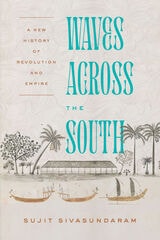
Waves Across the South
A New History of Revolution and EmpireSujit Sivasundaram
University of Chicago Press, 2020
This is a story of tides and coastlines, winds and waves, islands and beaches. It is also a retelling of indigenous creativity, agency, and resistance in the face of unprecedented globalization and violence. Waves Across the South shifts the narrative of the Age of Revolutions and the origins of the British Empire; it foregrounds a vast southern zone that ranges from the Arabian Sea and southwest Indian Ocean across to the Bay of Bengal, and onward to the South Pacific and the Tasman Sea. As the empires of the Dutch, French, and especially the British reached across these regions, they faced a surge of revolutionary sentiment. Long-standing venerable Eurasian empires, established patterns of trade and commerce, and indigenous practice also served as a context for this transformative era. In addition to bringing long-ignored people and events to the fore, Sujit Sivasundaram opens the door to new and necessary conversations about environmental history, the consequences of historical violence, the legacies of empire, the extraction of resources, and the indigenous futures that Western imperialism cut short. The result is nothing less than a bold new way of understanding our global past, one that also helps us think afresh about our shared future.
[more]

Where Was the Working Class?
REVOLUTION IN EASTERN GERMANYLinda Fuller
University of Illinois Press, 1999
In six months bridging 1989 and 1990, the German Democratic Republic underwent a transformation that took the world almost completely by surprise. Yet unlike the revolution in Poland a decade earlier, only a small percentage of workers played apolitically active role in the fall of socialism in Germany.
In this unprecedented study, Linda Fuller sets out to explain why the working class was largely missing from the 1989-90 revolution. Drawing on pre- and post-revolutionary visits to East German work sites and dozens of interviews, Fuller documents workers' day-to-day experience of the labor process, workplace union politics, and class. She shows how all three factors led most workers to withdraw from politics, even while prompting a handful to become actively involved in the struggle.
In this unprecedented study, Linda Fuller sets out to explain why the working class was largely missing from the 1989-90 revolution. Drawing on pre- and post-revolutionary visits to East German work sites and dozens of interviews, Fuller documents workers' day-to-day experience of the labor process, workplace union politics, and class. She shows how all three factors led most workers to withdraw from politics, even while prompting a handful to become actively involved in the struggle.
[more]
Working for Democracy
American Workers from the Revolution to the PresentEdited by Paul Buhle and Alan Dawley
University of Illinois Press, 1985
Written by some of our nation's top historians, Working for Democracy is the first book to examine the politics of American workers from the revolution to the present in terms of broad struggles for power in society at large. In more than a dozen chapters, the topics range from the committees of artisan "republicans" at the time of the American Revolution to the League of Revolutionary Black Workers. Whether the subject is the anti-slavery movement, the New Deal coalition, the Wobblies, or women workers, Working For Democracy is a testament to the struggles of workers everywhere in America.
[more]
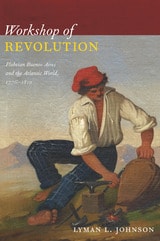
Workshop of Revolution
Plebeian Buenos Aires and the Atlantic World, 1776–1810Lyman L. Johnson
Duke University Press, 2011
The plebeians of Buenos Aires were crucial to the success of the revolutionary junta of May 1810, widely considered the start of the Argentine war of independence. Workshop of Revolution is a historical account of the economic and political forces that propelled the artisans, free laborers, and slaves of Buenos Aires into the struggle for independence. Drawing on extensive archival research in Argentina and Spain, Lyman L. Johnson portrays the daily lives of Buenos Aires plebeians in unprecedented detail. In so doing, he demonstrates that the world of Spanish colonial plebeians can be recovered in reliable and illuminating ways. Johnson analyzes the demographic and social contexts of plebeian political formation and action, considering race, ethnicity, and urban population growth, as well as the realms of work and leisure. During the two decades prior to 1810, Buenos Aires came to be thoroughly integrated into Atlantic commerce. Increased flows of immigrants from Spain and slaves from Africa and Brazil led to a decline in real wages and the collapse of traditional guilds. Laborers and artisans joined militias that defended the city against British invasions in 1806 and 1807, and they defeated a Spanish loyalist coup attempt in 1809. A gravely weakened Spanish colonial administration and a militarized urban population led inexorably to the events of 1810 and a political transformation of unforeseen scale and consequence.
[more]