Results by title
231 books match the query 'Revolutionary Period (1775-1800)' and 8 start with w
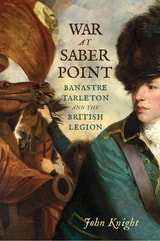
War at Saber Point
Banastre Tarleton and the British LegionJohn Knight
Westholme Publishing, 2023
The British Legion was one of the most remarkable regiments, not only of the American Revolution, but of any war. A corps made up of American Loyalists, it saw its first action in New York and then engaged in almost every battle in the Southern colonies. Led by a twenty-four-year-old libertine who purchased his commission to escape enormous gambling debts, the Legion gained notoriety for its ruthless tactics. Excelling in “special operations,” they frequently overwhelmed the Continental forces they fought, becoming the most feared British regiment of the war.
Banastre Tarleton and the Americans he led have always been characterized as brutal, immoral villains—most recently in the movie, The Patriot. But this study subverts our pre-conceived notions of patriotism. The men who filled the Legions ranks were not weak-willed collaborators or treacherous renegades, but free men as motivated by conscience as the Patriots they battled. Few were wealthy. None had a vested stake in the British Government. Each believed that in defending the Crown; they were upholding the rule of law and preserving individual liberty.
These men followed Banastre Tarleton clear across America for years, sacrificing not only their families and homes but, in many instances, their lives. Self-interest could not have persuaded them to do this. Patriotism and fidelity did. Relying on first-hand accounts—letters, diaries, and journals—War at Saber Point: Banastre Tarleton and the British Legion is the enthralling story of those forgotten Americans and the young Englishman who led them.
War for Independence
A Military HistoryHoward H. Peckham
University of Chicago Press, 1958
This book is an effort to explain how and why that upset was accomplished. Alternating with scene and summary, the narrative has pace and proportion. Battles fall into campaigns, and campaigns interpret strategy. Commanders are deftly characterized, and flashes of insight illuminate victories and defeats. There emerges a picture of American soldiers as tougher and more deeply motivated fighters than the uncommitted British and German professionals. The book also demonstrates how highly prized were the rights that the revolutionists sought to confirm or establish, and serves as a reminder today that some ideas are worth risking life for.
"What is most amazing about this excellent history is Prof. Peckham's ability to retell these . . . legendary events . . . in a way which enriches and absorbs the reader."—Robert Kirsch, Los Angeles Times
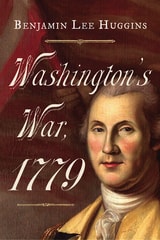
Washington's War 1779
Benjamin Lee Huggins
Westholme Publishing, 2018
Despite great limits of money and manpower, George Washington sought to wage an aggressive war in 1779. He launched the Sullivan–Clinton campaign against Britain’s Iroquois allies in upstate New York, and in response to British attacks up the Hudson River and against coastal Connecticut, he authorized raids on British outposts at Stony Point and Paulus Hook. But given power by Congress to plan and execute operations with the French on a continental scale, Washington planned his boldest campaign. When it appeared that the French would bring a fleet and an army to America, and supported by intelligence from his famed “Culper” spy network, the American commander proposed a joint Franco-American attack on the bastion of British power in North America—New York City—to capture its garrison. Such a blow, he hoped, would end the war in 1779.
Based on extensive primary source material, Washington’s War 1779, by historian Benjamin Lee Huggins, describes Washington’s highly detailed plans and extensive preparations for his potentially decisive Franco-American campaign to defeat the British at New York in the fall of 1779. With an emphasis on Washington's generalship in that year—from strategic and operational planning to logistics to diplomacy—and how it had evolved since the early years of the war, the book also details the other offensive operations in 1779, including the attacks in upstate New York, Stony Point, and Paulus Hook. Although the American and French defeat at Savannah, Georgia, prevented Washington from carrying out his New York offensive, Washington gained valuable experience in planning for joint operations that would help him win at Yorktown two years later.
We Have Not a Government
The Articles of Confederation and the Road to the ConstitutionGeorge William Van Cleve
University of Chicago Press, 2017
In George William Van Cleve’s book, we encounter a sharply divided America. The Confederation faced massive war debts with virtually no authority to compel its members to pay them. It experienced punishing trade restrictions and strong resistance to American territorial expansion from powerful European governments. Bitter sectional divisions that deadlocked the Continental Congress arose from exploding western settlement. And a deep, long-lasting recession led to sharp controversies and social unrest across the country amid roiling debates over greatly increased taxes, debt relief, and paper money. Van Cleve shows how these remarkable stresses transformed the Confederation into a stalemate government and eventually led previously conflicting states, sections, and interest groups to advocate for a union powerful enough to govern a continental empire.
Touching on the stories of a wide-ranging cast of characters—including John Adams, Patrick Henry, Daniel Shays, George Washington, and Thayendanegea—Van Cleve makes clear that it was the Confederation’s failures that created a political crisis and led to the 1787 Constitution. Clearly argued and superbly written, We Have Not a Government is a must-read history of this crucial period in our nation’s early life.
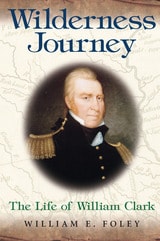
Wilderness Journey
The Life of William ClarkWilliam E. Foley
University of Missouri Press, 2005
Coinciding with the bicentennial in 2004 of the departure of Lewis and Clark’s famed Corps of Discovery, Wilderness Journey fills a major gap in scholarship. Intended for the general reader, as well as for specialists in the field, this fascinating book provides a well-balanced and thorough account of one of America’s most significant frontiersmen.
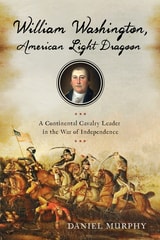
William Washington, American Light Dragoon
A Continental Cavalry Leader in the War of IndependenceDaniel Murphy
Westholme Publishing, 2014
William Washington began the war as a captain of Virginia Militia, was commissioned a junior officer in the Continental Infantry, and slowly rose to field command in the Continental Light Dragoons where he built one of the hardest hitting cavalry regiments to serve in the war. His chief adversary Lord Cornwallis commented, “There could be no more formidable antagonist in a charge, at the head of his cavalry, than Colonel William Washington.” Despite his connection to the commander-in-chief, he suffered his fair share of setbacks, and his relationships varied with not only his legendary cousin George, but many well-known figures of the Revolution including, Henry Lee, Casimir Pulaski, Nathanael Greene, and Daniel Morgan. Relying largely on firsthand accounts and period letters, in William Washington: American Light Dragoon: A Continental Cavalry Leader in the War of Independence, author and avid equestrian Daniel Murphy blends these primary sources with his own working knowledge of period drill, tactics, and terrain to deliver a more complete view of William Washington’s actions throughout the conflict. This perspective traces the often overlooked role of cavalry in the American Revolution and sheds new light on many pivotal battles in of the war, including Trenton, Cowpens, Guilford Courthouse, Hobkirk’s Hill, and William Washington’s final action at Eutaw Springs.
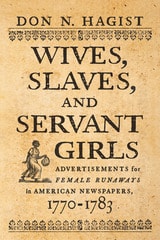
Wives, Slaves, and Servant Girls
Advertisements for Female Runaways in American Newspapers, 1770–1783Don N. Hagist
Westholme Publishing, 2007
In an age when individuals could be owned by others, people were lost and found just like other property. Indentured servants and slaves absconded from the custody of their masters, and their value prompted the masters to seek their return. Wives ran from abusive husbands or into the arms of another. Newspapers in the eighteenth and nineteenth centuries carried large numbers of advertisements offering rewards for the return of runaways or announcing the detention of fugitives. Each ad provided a description of the individual and often included some circumstances of their elopement. The overall effectiveness of these advertisements cannot be measured, but the sheer number of ads suggests they were perceived as useful tools by those who placed them. What could not have been known at the time was the substantial contribution to history that these ads make. The descriptive advertisements provide textual snapshots of thousands of individuals who would otherwise be lost to history, people whose names might not otherwise be recorded. In Wives, Slaves, and Servant Girls: Advertisements for Female Runaways in American Newspapers, 1770–1783, historian Don N. Hagist focuses on the American Revolutionary period to provide a striking portrait of a substantial but largely forgotten segment of the population. Comprised of four hundred advertisements presented chronologically, the volume provides invaluable descriptions of women’s clothes, footwear, jewelry, physical appearances, education, nationalities, occupations, and other details.
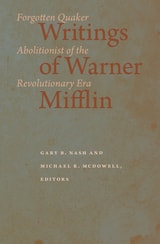
Writings of Warner Mifflin
Forgotten Quaker Abolitionist of the Revolutionary EraGary B. Nash
University of Delaware Press, 2021