56 books match the query 'Revolutions' and 3 start with w
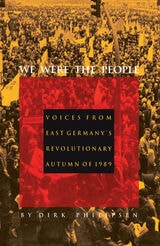
cover of We Were the People: Voices from East Germany’s Revolutionary Autumn of 1989

We Were the People

Voices from East Germany’s Revolutionary Autumn of 1989

Dirk Philipsen

Duke University Press, 1993

On the night of November 9, 1989, an electrified world watched as the Berlin Wall came down. Communism was dead, the Cold War was over, and freedom was on the rise—or so it seemed. We Were the People tells the story behind this momentous event. In an extraordinary series of interviews, the key actors in the drama that transformed East Germany speak for themselves, describing what they did, what happened and why, and what it has meant to them. The result is a powerful firsthand account of a rare historical moment, one that reverberates far beyond the toppled wall that once divided Germany and the world.
The drama We Were the People recreates is remarkable for its richness and complexity. Here are citizens organizing despite threats of bloody crackdowns; party functionaries desperately trying to survive as time-honored political prerogatives crumble beneath their feet; an oppressed people discovering the possibilities of power and freedom, but also the sobering strangeness of new political realities. With their success, East Germans encountered the overpowering might of thie Western neighbor--and stand perplexed before the onslaught of real estate agents, glossy consumer ads, political professionalism--and the discovery that a lifetime of social experience has suddenly lost all usable context. They became, in the words of one participant, a people "without biography."
Over all the recent events and unlikely turns recounted here, one thing remains paramount: the sweep of the initial democratic conception that animated the East German revolution. We Were the People brings this movement to life in all its drama and detail, and vividly recovers a historic moment that altered forever the shape of modern Europe.

Some Voices of the People
Bärbel Bohley/ "Mother of the Revolution"
Rainer Eppelmann/ Protestant Pastor
Klaus Kaden/ Church Emissary to the Opposition
Hans Modrow/ Former Communist Prime Minister
Ludwig Mehlhorn/ Opposition Theorist
Ingrid Köppe/ Opposition Representative
Frank Eigenfeld/ New Forum
Harald Wagner/ Democracy Now
Sebastian Pflugbeil/ Democratic Strategist
East German Workers
Cornelia Matzke/ Independent Women's Alliance
André Brie/ Party Vice-Chairman
Gerhard Ruden/ Environmental Activist
Werner Bramke/ Party Academic
[more]
cover of Wives Not Slaves: Patriarchy and Modernity in the Age of Revolutions

Wives Not Slaves

Patriarchy and Modernity in the Age of Revolutions

Kirsten Sword

University of Chicago Press, 2021

Wives not Slaves begins with the story of John and Eunice Davis, a colonial American couple who, in 1762, advertised their marital difficulties in the New Hampshire Gazette—a more common practice for the time and place than contemporary readers might think. John Davis began the exchange after Eunice left him, with a notice resembling the ads about runaway slaves and servants that were a common feature of eighteenth-century newspapers. John warned neighbors against “entertaining her or harbouring her. . . or giving her credit.” Eunice defiantly replied, “If I am your wife, I am not your slave.” With this pointed but problematic analogy, Eunice connected her individual challenge to her husband’s authority with the broader critiques of patriarchal power found in the politics, religion, and literature of the British Atlantic world.

Kirsten Sword’s richly researched history reconstructs the stories of wives who fled their husbands between the mid-seventeenth and early nineteenth centuries, comparing their plight with that of other runaway dependents.  Wives not Slaves explores the links between local justice, the emerging press, and transatlantic political debates about marriage, slavery and imperial power. Sword traces the relationship between the distress of ordinary households, domestic unrest, and political unrest, shedding new light on the social changes imagined by eighteenth-century revolutionaries, and on the politics that determined which patriarchal forms and customs the new American nation would—and would not—abolish.
[more]
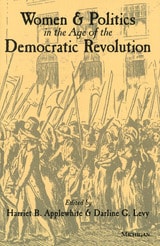
cover of Women and Politics in the Age of the Democratic Revolution

Women and Politics in the Age of the Democratic Revolution

Harriet B. Applewhite and Darline G. Levy, Editors

University of Michigan Press, 1993

Women and Politics in the Age of the Democratic Revolution is a groundbreaking collection that challenges traditional narratives of eighteenth-century political upheaval by centering the experience and agency of women across Europe and North America. Edited by Harriet B. Applewhite and Darline G. Levy, this volume gathers leading historians to explore how gender shaped and was shaped by the processes of revolution and democratization from the 1760s through the early nineteenth century.Bridging comparative and interdisciplinary scholarship, the collection examines the diverse ways that women engaged with, contributed to, and contested revolutionary politics in France, England, the Netherlands, Belgium, and the United States. Essays range from analyses of women’s participation in bread riots, neighborhood activism, and political clubs, to their presence in national insurrections and their influence as writers, petitioners, and public intellectuals. The contributors reveal the ways that women negotiated—and sometimes redefined—the boundaries of citizenship, civic virtue, and political rights during times of extraordinary change.The book also interrogates the limitations of the era’s revolutionary ideals, revealing how promises of liberty and equality were often circumscribed by gendered exclusions from formal political life. Yet, even as new constitutions, legislatures, and parties sidelined women as citizens, these essays show how women’s collective and individual actions laid groundwork for later struggles for suffrage, legal equality, and social reform.Richly documented and theoretically innovative, Women and Politics in the Age of the Democratic Revolution is essential reading for anyone interested in gender, democracy, and the ongoing project of political inclusion. It offers a nuanced portrait not just of women’s defeats and exclusions, but of the complex legacies of empowerment, mobilization, and the reimagining of citizenship that continue to shape modern political cultures.
[more]