Results by title
50 books match the query 'Roots' and 2 start with w
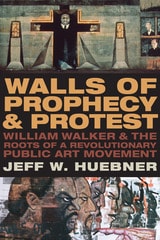
Walls of Prophecy and Protest
William Walker and the Roots of a Revolutionary Public Art MovementJeff W. Huebner
Northwestern University Press, 2019
Though his art could not have been more public, Walker maintained a low profile during his working life and virtually withdrew from the public eye after his retirement in 1989. Author Jeff W. Huebner met Walker in 1990 and embarked on a series of insightful interviews that stretched over the next two decades. Those meetings and years of research form the basis of Walls of Prophecy and Protest, the story of Walker’s remarkable life and the movement that he inspired.
Featuring forty-three color images of Walker’s work, most long since destroyed or painted over, this handsome edition reveals the artist who was the primary figure behind Chicago’s famed Wall of Respect and who created numerous murals that depicted African American historical figures, protested social injustice, and promoted love, respect, racial unity, and community change.
Word and Object in Husserl, Frege, and Russell
The Roots of Twentieth-Century PhilosophyClaire Oritz Hill
Ohio University Press, 2001
In search of the origins of some of the most fundamental problems that have beset philosophers in English-speaking countries in the past century, Claire Ortiz Hill maintains that philosophers are treating symptoms of ills whose causes lie buried in history. Substantial linguistic hurdles have blocked access to Gottlob Frege's thought and even to Bertrand Russell's work to remedy the problems he found in it. Misleading translations of key concepts like intention, content, presentation, idea, meaning, concept, etc., severed analytic philosophy from its roots.
Hill argues that once linguistic and historical barriers are removed, Edmund Husserl's critical study of Frege's logic in his 1891 Philosophy of Arithmetic provides important insights into issues in philosophy now.
She supports her conclusions with analyses of Frege's, Husserl's, and Russell's works, including Principia Mathematica, and with linguistic analyses of the principal concepts of analytic philosophy. She re-establishes links that existed between English and Continental thought to show Husserl's expertise as a philosopher of mathematics and logic who had been Weierstrass's assistant and had long maintained ties with Cantor, Hilbert, and Zermelo.